Live data from Hacker News

A New Kind Of Dance Science (combinatorics of social dancing)

zacksdancelab.com

21–30 of 49 posts

Re: A New Kind Of Dance Science (combinatorics of social dancing)

#21

I enjoy the attempt to analyze the dancing (really choreography). But I'm surprised that in this new world of LLM hype not one word in there was dedicated to what dance really is: a language. Dance is a physical, kinesthetic language. And to riff on some of the posters, it's this expression and communication between the dancers that makes dancing worth dancing. There's also the social communication between the group,…

Agree. I think the approach in TFA is like trying to analyze, say, improv comedy via a context-free grammar for English. There might be something there, in the syntax, but it misses a huge amount of semantics and paralanguage.

Yeah. While I'm sympathetic to the attempt to formalize the representation, there's a psychology to this that a lot of people in tech seem to miss when I see them dancing.

The reasoning goes: "if I understand and represent this choreography properly, I will be better at the activity of dance." Dancing, for them, is the end result of understanding a representation and then doing it.

But the psychological shift is "if I understand my emotions and body properly, I will be able to use the representation of dance to convey that." While dance obviously needs a backing vocabulary of basics and moves, great dancers accidentally come up with better dance moves because their body mechanics combined with the dance's structure, musicality, and emotion constrain what they do. They—and I'm going to use this word intentionally—literally think and communicate through dancing. To use your phrasing, the "semantic" meaning of the dance is their emotions: the actual activity of dance is simply the representational outlet for that.

When you're with a good dancer, your brain shuts off but you're still stuck within the aforementioned set of constraints. And that's when the magic happens. That's when you actually start speaking. That's when your improvised move is the only way you could have possibly said what you wanted to say.
Re: A New Kind Of Dance Science (combinatorics of social dancing)

#22
post #16

Having danced for around a decade, I would say the hand positioning example is a bit reductive. The most obvious example is that there's only one variant of "both hands crossed over" - while it's true that the hands might only fit together one way, the things you can do with the hands depending on what arm is on top varies significantly. Having said that I'm pretty excited about the topic and what the author can do w…

It is, but also it's a helpful simplification, I believe. It's kind of like a cup and a ring being topologically equivalent. Helps you talk about some generic thing without overloading with details.

Then there are many more layers on top: palms facing up/down/side, cupped or pressed against, which part of the hand/arm/body are you holding, which one's on top, compression or stretch, at what height, etc.

Re: A New Kind Of Dance Science (combinatorics of social dancing)

#23

Could someone explain what a hammerlock is and why it is significant? Searching just said it's a type of joint lock in wrestling which doesn't make sense to me in this context. Then again, I have never danced.

You can look for Bachata hammerlock specifically https://www.quicksteps.com.au/dance-lesson-videos/bachata/le...

It's interesting, because you have to do something active about it. If you move into hammerlock, you can't continue moving the same way anymore, so you have to decide on some combination of releasing hands, rotating in the other direction, staying and playing in that position, etc.

Re: A New Kind Of Dance Science (combinatorics of social dancing)

#24
post #10

This partly happened in tango in the 90's, when Gustavo Naveira, Chicho Frumboli and Fabian Salas came together to create a structural and kinesiologica base for something that previously existed more as "an intuition". For each basic configuration of leader and follower and their bodies they looked at all permutations. Then they constrained it first to the subset of those that are possible to do at all, kinesiologic…

I have had the same idea about martial arts. Not sure it is possible. In dancing you have at least some symmetric patterns and rhythm, in martial arts you have even more stances, rotation around more axes and arrhythmic moves. good dancing like good fighting isn‘t mechanical either, it is good because it relies on little imperfections. Just like MIDI files cannot replace a concert pianist. In the end I think motion c…

> in martial arts you have even more stances, rotation around more axes and arrhythmic moves.

I wonder how true this is. Specifically I think you could simplify the moves into steps with "who hits who" states. You could normalise out the rhythm, following the "everything's in 4/4 if you don't count like a nerd" idea.

So you'd end up with just the key frames of either contacts/impact or change of the movement direction. Would martial arts really have even more variety here?

Re: A New Kind Of Dance Science (combinatorics of social dancing)

#25

I don't know. This is ok if it's helpful, but reminds me of why I quit playing chess: the mystery was lost. As I got more into chess and with the advancement of chess computers and championships, I felt there was little creativity left to have fun with the game. So for dancing, it's literally meant to be "danced". Of course you can figure out all the combinations and so on, but being overly analytical about it remove…

> why I quit playing chess: the mystery was lost.

Well, the problem is that with all the online resources, you quickly learn that chess is more about blunder avoidance than any brilliant, dynamic scheme.

That takes a lot of the fun out of chess.

Re: A New Kind Of Dance Science (combinatorics of social dancing)

#27
post #10

This partly happened in tango in the 90's, when Gustavo Naveira, Chicho Frumboli and Fabian Salas came together to create a structural and kinesiologica base for something that previously existed more as "an intuition". For each basic configuration of leader and follower and their bodies they looked at all permutations. Then they constrained it first to the subset of those that are possible to do at all, kinesiologic…

I have had the same idea about martial arts. Not sure it is possible. In dancing you have at least some symmetric patterns and rhythm, in martial arts you have even more stances, rotation around more axes and arrhythmic moves. good dancing like good fighting isn‘t mechanical either, it is good because it relies on little imperfections. Just like MIDI files cannot replace a concert pianist. In the end I think motion c…

Time to load up toribash

Re: A New Kind Of Dance Science (combinatorics of social dancing)

#28
post #10

Earlier quoted context omitted.

I have had the same idea about martial arts. Not sure it is possible. In dancing you have at least some symmetric patterns and rhythm, in martial arts you have even more stances, rotation around more axes and arrhythmic moves. good dancing like good fighting isn‘t mechanical either, it is good because it relies on little imperfections. Just like MIDI files cannot replace a concert pianist. In the end I think motion c…

> in martial arts you have even more stances, rotation around more axes and arrhythmic moves. I wonder how true this is. Specifically I think you could simplify the moves into steps with "who hits who" states. You could normalise out the rhythm, following the "everything's in 4/4 if you don't count like a nerd" idea. So you'd end up with just the key frames of either contacts/impact or change of the movement directio…

> Would martial arts really have even more variety here?

It depends, but yes. Martial arts is not just boxing. Take the following choreography from one style of Pencak silat:

https://youtu.be/8H0x1AKlpM4?si=QJLNffTUozn9kCf9

Re: A New Kind Of Dance Science (combinatorics of social dancing)

#29
post #18
post #15

Earlier quoted context omitted.

Indeed. Where it goes wrong is the notion it will help people learn how to dance.

I could see stuff like this helping advanced dancers come up with new stuff or perhaps help some instructors.

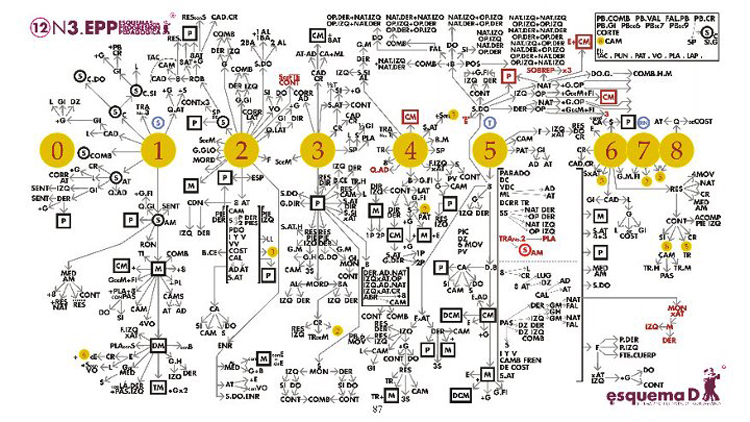
Indeed invaluable to help dance instructors come up with stuff to sell. Because its so well suited to incomprehensibility e.g. this famous example https://www.tangomovimentoterapia.com/wp-content/uploads/201...

Re: A New Kind Of Dance Science (combinatorics of social dancing)

#30

This partly happened in tango in the 90's, when Gustavo Naveira, Chicho Frumboli and Fabian Salas came together to create a structural and kinesiologica base for something that previously existed more as "an intuition". For each basic configuration of leader and follower and their bodies they looked at all permutations. Then they constrained it first to the subset of those that are possible to do at all, kinesiologic…

As a one-time avid Tango dancer, while I believe all the motions/steps can (and have been) be sketched out, named, and notated and put to paper, that which can be written down is necessarily insufficient to make it easy for people who understand the syntax but not the dance to replicate the dance easily. Let alone beginners. There's a great deal of unspoken communication in the embrace, in the way the partners' center of gravity is shifted about, in the music and song, in the timing, in their understanding of each other's abilities, and in their personal connection. Those details would have to be rediscovered by those reading the notation.

Some things are just hard to write down with fidelity. Think of tastes: we can have cookbooks, but its hard to reproduce the exact ingredients of grandma's cooking, or that one restaurant. Smells are even harder to express in words. Dance is kinda like that.

None of which is to say that one shouldn't do it, or try. Quite the contrary. It's a good challenge! Even if you could write it all down, leaving a bit of mystery/mystique would be a good idea, but I don't fear that mystique will be lost.

Post reply on HN