Live data from Hacker News

A hacker creates his own version of Google Project Glass

thenextweb.com

21–30 of 50 posts

Re: A hacker creates his own version of Google Project Glass

#21
post #17
post #11

Earlier quoted context omitted.

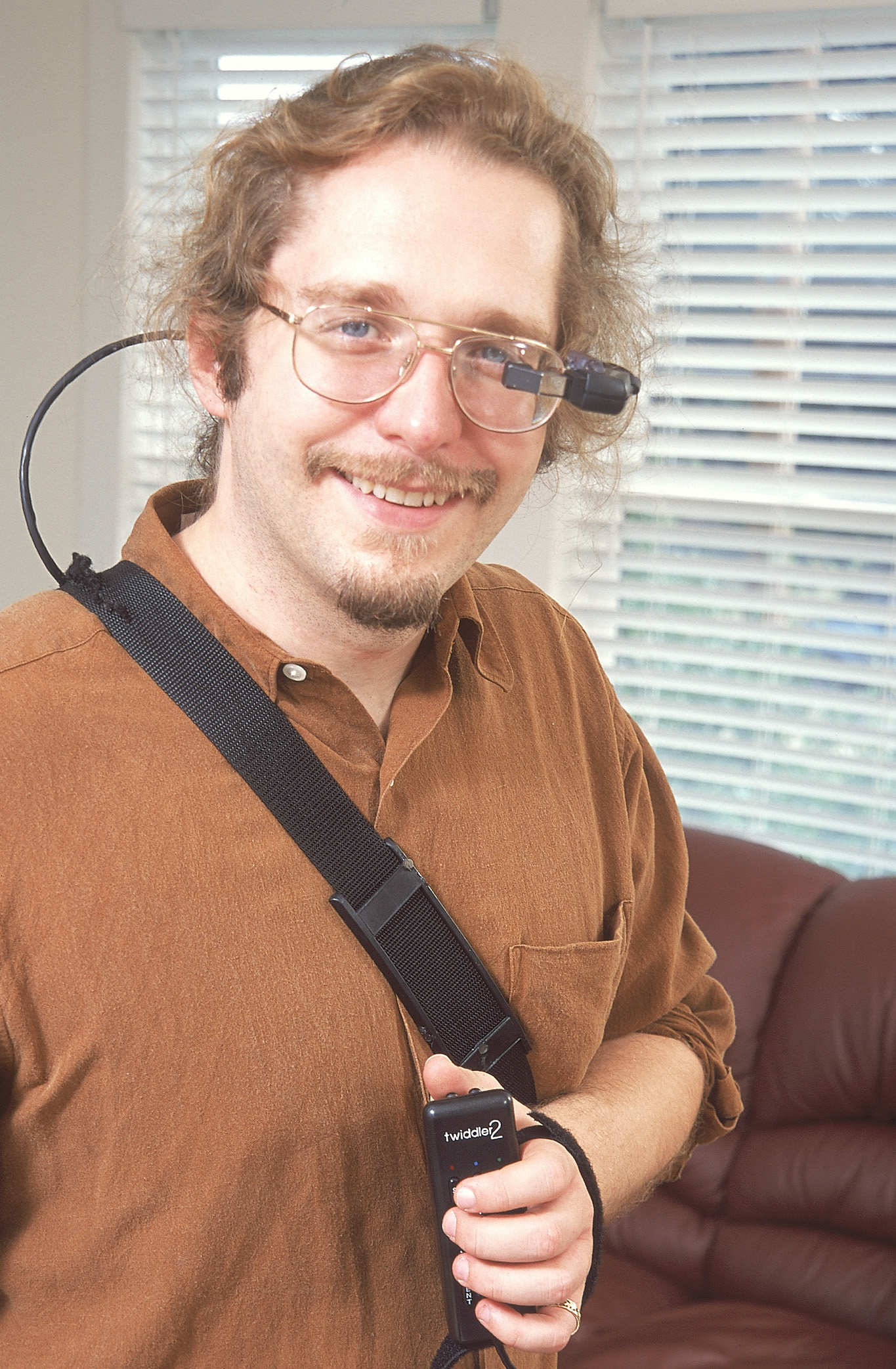
Thad Starner, shown in [2] is actually a member of the team working on Project Glass. http://www.cc.gatech.edu/~thad/

I actually saw Thad in school walking around with his "glass". The Google version looks way better and a lot less geekier (and less creepier) than the thing he used to wear to say the least.

I'm not sure the last time you saw him with it, but it seems he's iterated a couple times. The most recent version isn't too far off from the Glass concept. http://www.sciencephoto.com/image/349511/large/T4200406-Wear...

Re: A hacker creates his own version of Google Project Glass

#22

Earlier quoted context omitted.

I don't know if you knew this, but Google, Inc. isn't Apple, Inc. Two separate companies! I know it's surprising, it took me a while to figure out myself. You may be also surprised to know that there are actually more ways to release products than how Apple does it. In fact, there many ways, each with various tradeoffs.

The Apple way being the one that results in multi-day campouts and kidney sales. Of course the trade-off to announcing/shipping simultaneously is…?

A better nicer world.

A world where people hack together cool things using Google tech, or hack together cool things a bit like Google tech, or hack together cool things better than Google tech.

Re: A hacker creates his own version of Google Project Glass

#23

Earlier quoted context omitted.

I don't know if you knew this, but Google, Inc. isn't Apple, Inc. Two separate companies! I know it's surprising, it took me a while to figure out myself. You may be also surprised to know that there are actually more ways to release products than how Apple does it. In fact, there many ways, each with various tradeoffs.

The Apple way being the one that results in multi-day campouts and kidney sales. Of course the trade-off to announcing/shipping simultaneously is…?

Cost of keeping engineer/supplier secrecy [financial, intellectual, and morale cost], unable to use real people as beta testers, more difficult to involve outside research centers, encourages insular culture. "Oh, is that public now? I don't even know anymore."

In the case of something that has a developer culture around it (say, a chumby or something) you have a higher number of developers ready to go 'at the start' since they've had time to think about killer apps.

One could point at how early-stage multiplayer videogames are developed for a good counterexample.

Re: A hacker creates his own version of Google Project Glass

#24
post #17
post #11

Earlier quoted context omitted.

Thad Starner, shown in [2] is actually a member of the team working on Project Glass. http://www.cc.gatech.edu/~thad/

I actually saw Thad in school walking around with his "glass". The Google version looks way better and a lot less geekier (and less creepier) than the thing he used to wear to say the least.

Thad's been walking about Georgia Tech and other places with a wearable computer since 1993. I remember how big his previous version was, but the current version isn't too bad:

http://3.bp.blogspot.com/_sqPHIOY4PBQ/TTtAjzFy6TI/AAAAAAAAAv...

http://hci.stanford.edu/courses/cs547/Resources/Pictures/tha...

Re: A hacker creates his own version of Google Project Glass

#25
post #9

I certainly don't want to bad mouth a guy who builds something cool, but there's a significant difference between this and Project Glass. He states in his blog post ( http://www.willpowell.co.uk/blog/?p=210 ) The Vuzix glasses are driven by stereoscopic feeds, which are fed by the HD cameras. What he's seeing is coming through the cameras. He's not looking at reality with an overlaid display. The glasses he is using…

Consumer partially transparent head mounted displays are sort of available. SiliconMicroDisplay has one that is bulky and not really transparent enough to walk around in, but could be used to approximate Project Glass: http://www.siliconmicrodisplay.com/st1080.html

A useful wearable augmented reality experience would require a retinal scanning display, which is presumably what Google's prototypes use. Brother has been showing off a product like this, but it has been nothing more than expo fodder for the last few years: http://www.brother.com/en/news/2010/airscouter/

Re: A hacker creates his own version of Google Project Glass

#26
post #9

I certainly don't want to bad mouth a guy who builds something cool, but there's a significant difference between this and Project Glass. He states in his blog post ( http://www.willpowell.co.uk/blog/?p=210 ) The Vuzix glasses are driven by stereoscopic feeds, which are fed by the HD cameras. What he's seeing is coming through the cameras. He's not looking at reality with an overlaid display. The glasses he is using…

This got me thinking about whether "fly-by-wire" vision will ever be viable (or preferable) to human vision and how various sight impairments would be dealt with using such a system. Certainly myopia would be a trivial fix since the image could be placed directly in front of the eye, but how would you correct for hyperopia without a convex lens between the eye and the display?

Re: A hacker creates his own version of Google Project Glass

#27
post #25
post #9

I certainly don't want to bad mouth a guy who builds something cool, but there's a significant difference between this and Project Glass. He states in his blog post ( http://www.willpowell.co.uk/blog/?p=210 ) The Vuzix glasses are driven by stereoscopic feeds, which are fed by the HD cameras. What he's seeing is coming through the cameras. He's not looking at reality with an overlaid display. The glasses he is using…

Consumer partially transparent head mounted displays are sort of available. SiliconMicroDisplay has one that is bulky and not really transparent enough to walk around in, but could be used to approximate Project Glass: http://www.siliconmicrodisplay.com/st1080.html A useful wearable augmented reality experience would require a retinal scanning display, which is presumably what Google's prototypes use. Brother has bee…

http://www.youtube.com/watch?v=9I0hF0cbw8E

Retinal scanning display. Hm… I wonder how good this really looks? I didn't find a review video by a independent party. So I remain doubtful as long as I don't experience it myself.

Re: A hacker creates his own version of Google Project Glass

#28
I still think Google made a big mistake showcasing their product a year earlier. It reminds me of when they showed ChromeOS one and a half years before it actually launched. What's the point of doing that? Sure you might get some benefit from the feedback, but I believe the disadvantages of showing it so much earlier are much bigger than the benefits.

And user feedback doesn't even mean that much when you're trying to build an entirely new product category (ok, maybe the basic idea existed for a long time, but I think we can all agree their concept of the AR glasses is a lot more modern and practical, and might actually turn into a popular commercial product if they do it right).

Re: A hacker creates his own version of Google Project Glass

#29
As far as the hardware goes, a lot of this stuff is already out there in different forms: Epson Moverio, Vuzix (as shown in this demo, ...), albiet not in the form factor that would allow for mass market penetration. That's where Google, and hopefully Apple & Microsoft, will do well and allow for the app makers to come in and add value.

That being said, there are still a great deal of Computer Vision problems that will need to be solved to successfully implement "Strong AR". The video was a nice proof of concept, but that's what the Google video was too.

Re: A hacker creates his own version of Google Project Glass

#30
post #26
post #9

I certainly don't want to bad mouth a guy who builds something cool, but there's a significant difference between this and Project Glass. He states in his blog post ( http://www.willpowell.co.uk/blog/?p=210 ) The Vuzix glasses are driven by stereoscopic feeds, which are fed by the HD cameras. What he's seeing is coming through the cameras. He's not looking at reality with an overlaid display. The glasses he is using…

This got me thinking about whether "fly-by-wire" vision will ever be viable (or preferable) to human vision and how various sight impairments would be dealt with using such a system. Certainly myopia would be a trivial fix since the image could be placed directly in front of the eye, but how would you correct for hyperopia without a convex lens between the eye and the display?

Contact lenses mandatory for users with impaired vision?
Post reply on HN