Honeybees are dying en masse from diseases. Yet they are being neglected by the animal health industry. We need safe and sustainable solutions to help protect the world's honeybees. Dalan Animal health is developing the worlds first honeybee vaccine. To learn more go to: https://www.dalan.com/
Whatever happened to the bee apocalypse?
21–30 of 184 posts
Re: Whatever happened to the bee apocalypse?
#22This article buries its lede, which is about how honey bees get all the attention but are at less risk than wild bees: > And that brings us to the actual problem. The honey bee (Apis mellifera) is only one of about 20 thousand different bee species. The non-honey bees are usually referred to as wild bees, and each location has its native species. According to an estimate from researchers at Cornell University in 2006…
I think the colloquial term for (edit; the most commonly well-known) many wild bees in English is "bumblebees". They're often burrowing species that don't have honey producing hives (They do stuff like make little caves in moss, dirt, and underbrush), and are often crucial pollinators of certain species of plants which are specifically attractive to certain wild bees (Orchids are a good example here) but which domesticated honeybees might not even touch.
I was once dreaming how cool it would be to get into beekeeping but after realizing it might be at a greater detriment to wild species in my area those dreams have become somewhat faded.
Re: Whatever happened to the bee apocalypse?
#23People will always click on apocalypse stories, so the market will keep supplying them.
You didn't read the article, did you? The author did not diminish CCD. Let me spoil it for you, this is the summary
"It’s really just a matter of time until there’ll be too few bees to pollinate some of the flowers or too few insects to support some of the birds, or too few birds to spread seeds and so on. And we may be able to fix a few of these problems with technology, but not all of them. So, while it is important to talk to your kids about the birds and the bees, it really is important to talk to your kids about the birds and the bees.
We simply don’t know what’s going to happen in response to what we do, and I’m afraid we’re not paying attention which is why I’m standing here recording this video. Because if we don’t pay attention, one day we’ll be surprised to be remembered that in the end we, too, are just part of the ecosystem."
Our situation is still really bad and we don't even know the extent of how bad it is. Everyone just reflexively has to believe it's not really the end of the world as we've known it for most of human history, and that we can't really be bringing about an extinction cycle that will end a significant percentage of species. We are, though, every scientist in the field knows it. We are inducing a hot earth out of the planetary cycle because of carbon dioxide at the same time we're weakening ecosystem. It's going to end badly, and instinctively we all know it.
Re: Whatever happened to the bee apocalypse?
#24Horizontal well fracking was perfected/took-off in 2006 https://ballotpedia.org/File:EIA_fracked_wells_2015.png Wells are burnt off for months, the more wells the more burnoff. People get sick up to 60 miles away from the burnoff, I wonder how that affects wildlife.
If fracking was related, we'd see a dramatically higher die-off around the permian basin and more or less no die-off whatsoever in the north-west and north-east. This isn't quite what we see: https://fractracker.org and https://www.smithsonianmag.com/smart-news/new-map-highlights... Now, as for fracking and air pollution, I am not an expert, but I did have a very interesting set of discussions with a fracking enginee…
Thanks for the information. What about water table pollution? Those videos of people's tap water lighting on fire certainly stuck with me [1]
Re: Whatever happened to the bee apocalypse?
#25Simply put.
Please America stop using more and more artificial modern chemicals in your farming and go back to tried and tested agricultural methods.
Your soil is getting destroyed through mega tractors. Your buying everything glaxo can sell and your harming your own wasteland that for some reason you grow copious amounts of corn on.
The problem is still there and making an article suggesting that it's not for a (surprise twist...), "the problem is worst than you think" ending, is just turning a topic into a discussion that should be settled fact.
Re: Whatever happened to the bee apocalypse?
#26> However, the numbers may sound more alarming than they really are because honey bees are efficiently bred and managed by humans. Could that be part of the problem, they mention diversity loss in habitat, how about diversity of honeybee genetics. At the same time, HoneyBees are basically barnyard animals, we don't monitor the collapse of pig populations as they head to the slaughterhouse. I understand its not quite…
Honeybees are basically an invasive species that humans brought to the Americas in order to pollinate old-world crops (and also harvest honey). The thing is, we've replaced a lot of native new-world ecosystems and foods with old-world crops that depend on old-world bees.
There are a few separate problems that the media often mixes up:
One is that our old-world crops aren't getting enough old-world bees to meet their pollination needs.
Separately, new-world bees (what the article calls "wild bees") are also being replaced by old-world bees, losing out in competition, and not being cared for by professional beekeepers. They're more vulnerable, less protected, and less monitored.
To top it all off, many kinds of bees, old-world or new, are also suffering from the cumulative (and unfortunately complex) domino effects of habitat loss, pesticides, climate change, etc.
I think what's happening in the media is that journalists, knowingly or not, are using #2 and #3 to amplify the concern of #1 even though they're not always aligned (e.g., old-world bees are often one of the reasons contributing to the decline of native new-world bees).
It's relatively harder to get the public to care about an industrial economics problem (#1, where farmers have to resort to expensive human manual pollination instead of cheap bees), so trying to sell that as environmental crisis a la Silent Spring gets more eyeballs.
Re: Whatever happened to the bee apocalypse?
#27Tangentially related, I wonder if anyone has done a meta-analysis about media reported calamities, like Zika, the bee population dying off, etc., and doing a follow up. Then comparing it to what the media reported initially. Was this accurate, blown out of proportion, understated, or simply sensational reporting?
Endemic zika virus is horrible if you're in a region that has it like me. As if we didn't have enough with dengue, chikungunya, yellow fever and malaria... Any of these diseases feel like getting run over by a bus to get and only two of those have effective preventative vaccines (Yellow fever and now thankfully malaria), but if I get dengue again I could possibly die. The fact that herd immunity kicked in is definitely why you haven't heard as much about it but trust us, this isn't a fun thing to get used to and many, many lives are affected daily by neglected tropical diseases. Maybe you will notice when these diseases make it north of Florida.
Re: Whatever happened to the bee apocalypse?
#28Earlier quoted context omitted.
SSC did a blog post about the various environmental panics of the 1990s. Some were real, some weren't; some were solved, some weren't[0]. [0] https://slatestarcodex.com/2019/01/01/what-happened-to-90s-e...
This article is notable in that it contained this sentence: > Recycling remained inefficient and of dubious benefit, and never really caught on. Which made me realise, the first time I read it, that he didn't know what he was talking about and was just repeating what he heard in his weird echo chamber with unwarranted confidence. If you're in that bubble that will apparently seem like a totally normal thing to say, i…
> Oh so recycling actually works, but we need fake jobs for people who don't care about economic efficiency? I'm glad we got some clear eyed realists in to explain this all to us.
That's not what the op-ed is saying. The existence of benefits does not mean the benefits are bigger than the costs. In context, that sentence is part of an argument against the idea that landfills are filling up.
So how big are the benefits relative to the costs?
Well, it cites some data to say that recycling paper and metal does a good job, and that everything else combined is pretty useless. That doesn't strike me as wrong in any obvious way.
Combine that with "That money could buy far more valuable benefits, including more significant reductions in greenhouse emissions." and "He concludes that the social good would be optimized by subsidizing the recycling of some metals, and by imposing a $15 tax on each ton of trash that goes to the landfill." and this doesn't sound like an argument for fake jobs or ignoring economic efficiency to me.
Re: Whatever happened to the bee apocalypse?
#29Simply put. Please America stop using more and more artificial modern chemicals in your farming and go back to tried and tested agricultural methods. Your soil is getting destroyed through mega tractors. Your buying everything glaxo can sell and your harming your own wasteland that for some reason you grow copious amounts of corn on. The problem is still there and making an article suggesting that it's not for a (sur…
Artificial modern chemicals increase yield, which reduces food price. Yes, we should use less of those chemicals. Yes, that will hit the poorest hardest.
Is this problem solvable? Maybe. But let’s not pretend it’s simple.
Re: Whatever happened to the bee apocalypse?
#30Simply put. Please America stop using more and more artificial modern chemicals in your farming and go back to tried and tested agricultural methods. Your soil is getting destroyed through mega tractors. Your buying everything glaxo can sell and your harming your own wasteland that for some reason you grow copious amounts of corn on. The problem is still there and making an article suggesting that it's not for a (sur…
> go back to tried and tested agricultural methods
https://www.agry.purdue.edu/ext/corn/news/timeless/images/US...
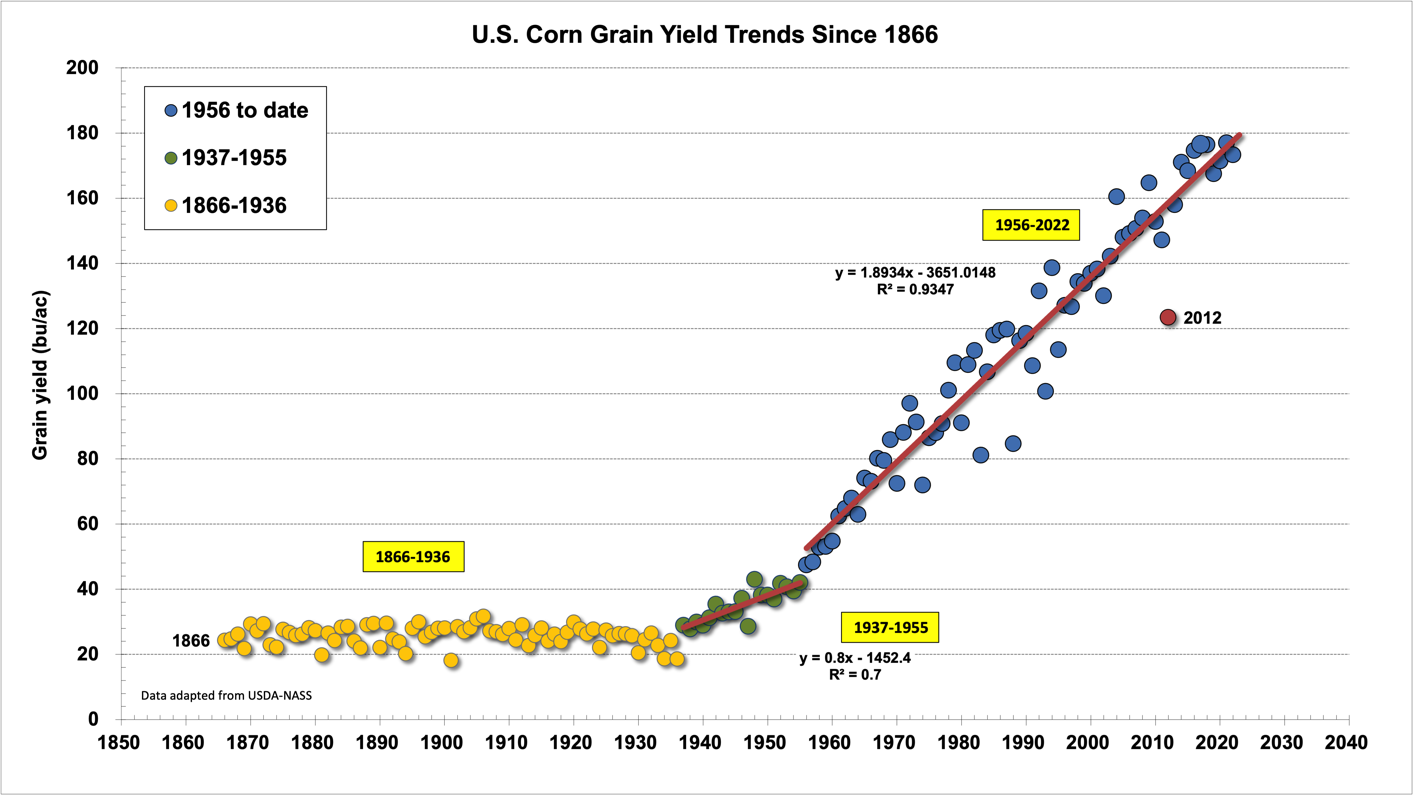
"Tried and tested" agricultural methods produced about 20 bushels of corn per acre.
Current "artificial modern chemicals" methods produce about 160. Eight times as much.
> your harming your own wasteland that for some reason you grow copious amounts of corn on
The reason is that it feeds a substantial portion of the planet.