Live data from Hacker News

Planning is for doing

biggestfish.substack.com

21–30 of 62 posts

Re: Planning is for doing

#21
good article. my questions now is how can we avoid over-plannings and under-plannings?

a lot of time I feel like the diminishing return of a planning is pretty steep for many situations but it's hard to tell how much time we should spend for the planning beforehand. (this is a planning for planning and maybe this itself is over-planning lol).
Re: Planning is for doing

#22
post #15

The driving parable reminded me of my one and only time driving in the USA. The thing that absolutely did my head in was the intersections with four-way stop signs. There was no clear indication of who had right of way which I would have thought would cause a lot of collisions. It just seemed like the biggest bully goes first. Give me roundabouts any day.

The rule for four-way stops is simple: Right-of-way is established in order of arrival at the intersection. First to arrive at the stop sign can go first, followed by the second, etc. Not everybody follows the rule, and technically they're breaking traffic laws by doing so. And you're right. I prefer roundabouts too, they're objectively safer. Massachusetts has a fair few roundabouts, but other parts of the country s…

There are other rules. Always yield to pedestrians. Two cars can sometimes go at the same time if they're not on a collision course. If pedestrians are blocking the person whose turn it is, you can go instead. Order is based on arrival time, unless there's a lot of cars then it's yield to the right if you're unsure.

These rules combine in such a way that it's genuinely unclear who should go in some situations - the above rules might contradict, or you might need information you don't have cause you got there after something broke "the order". But if you think it's your turn and start to go, people will let you, and ultimately no one gets stuck forever.

Re: Planning is for doing

#23

Earlier quoted context omitted.

> question like "Will we want to change our action in some way based on the result of this test?" This is my absolute favorite question. I am continually amazed at how much crap it can cut through.

Agreed. This question is a superpower. Not just 'the result of this test', this applies to all kinds of questions. It's also relevant when people ask for ill-specified 'dashboards', or 'reports'. Will what we do change substantially based on what we see on these dashboards? If not, why make them? And if so... can we just automate that behavior so we don't have to rely on someone noticing the dashboard?

I think some dashboards are meant for some form of situational awareness. At least "I can see when something is different" ideally even "I can recognize if everything is going well".

For those purposes it is difficult to answer 'what will we change' and even harder to automate the process.

Re: Planning is for doing

#24

The author is suggesting replacing a bad plan (everyone discuss each intersection) with another bad plan (just drive however you like). (And as an aside, stopping at each intersection to discuss is not ideal, but at least no one is going to die.) Anyway, I’m unconvinced. Most of the planning failures I’ve seen came about because people were bad at planning, not because they were talking too much. I’ve seen the opposi…

>The author is suggesting replacing a bad plan (everyone discuss each intersection) with another bad plan (just drive however you like).

The author is suggesting replacing it with the normal rules of the road, which are as close to not planning as possible (following basic heuristics like go on green). The example in the parable didn't have "unjust" stop signs or traffic lights for a reason.

Re: Planning is for doing

#25

>The common way of determining right of way on roads is some combination of right of way, stop signs, and traffic lights. None of these take into account the needs of the drivers, so should characterize them as unjust. In modern societies having equal rights is 'unjust'.

It often can be. But a slightly wider point of the article is that figuring out a more just process is so harmful that 'equality' turns out to be the least unjust.

And that counts even if you assume everyone is honestly participating rather than selfishly manipulating the system. Once you take that into account the least unjust approach quickly becomes equality.

Re: Planning is for doing

#26
What is the name for the fallacy in which you make an analogy that does not reflect the real-world territory at all, and then draw a conclusion from it?

“Doing” is not at all enough. (Well, it shouldn’t be.)

Peer into any random engineering org and you’ll inevitably find loads of engineers driving around in circles with the wind in their hair, smiling with a sense of how “fast” and productively they’re moving!

Re: Planning is for doing

#27
post #4

> Finally, the third, and most pernicious situation in which there is too much planning is when planning becomes its own end. This can happen because individuals in organizations get more reward for planning work than actually executing on it. It might be seen that the execution is the “easy part”, and can be done by anyone, whereas the grand visionary (or “architect”) is the real cause of success. I've experienced t…

Over Planning is also an institutional response to risk. In these cases it is actually "the easy part" and so preferred by environments where any mistakes are costly. As in the "If at first you don't succeed, then Sky Diving is not for you" kind. In these cases I would not call planning an end in itself but rather a defense mechanism deployed to avoid the risk of action until absolutely necessary. Not that I justify what can become analysis-paralysis situations, but it is better to understand the beast you are dealing with if you want to navigate a path through.

Re: Planning is for doing

#28
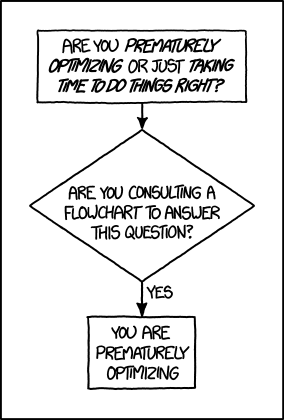
This issue is discussed by Donald Knuth in one of his interviews [1].

"I know that every large project has some things that are much less fun than others; so I can get through the tedium, the sweeping or whatever else needs to be done. I just do it and get it over with, instead of wasting time figuring out how not to do it. I learned that from my parents. My mother is amazing to watch because she doesn't do anything efficiently, really: She puts about three times as much energy as necessary into everything she does. But she never spends any time wondering what to do next or how to optimize anything; she just keeps working. Her strategy, slightly simplified, is, "See something that needs to be done and do it." All day long. And at the end of the day, she's accomplished a huge amount." - Donald Knuth

[1] https://shuvomoy.github.io/blogs/posts/Knuth-on-work-habits-....

[2] https://www.explainxkcd.com/wiki/images/d/d5/optimization.pn...

Re: Planning is for doing

#29

A couple of things this makes me think of: No plan survives contact with the enemy. It's a military saying but I think it applies equally to business. I think that's the whole point of rubrics about how much you need to talk to customers. When seconds count, the police are minutes away. Said by pro gun people. I'm of mixed feelings about that but I still like the saying very much to encapsulate an idea about making h…

> No plan survives contact with the enemy. I've also heard a variation like "It is certain that the plan will fail, however, without the plan everything fails."
Post reply on HN