Live data from Hacker News

15 uncoupled simple pendulums of increasing lengths dance together

sciencedemonstrations.fas.harvard.edu

21–27 of 27 posts

Re: 15 uncoupled simple pendulums of increasing lengths dance together

#21
post #12

it seems as if there is another interpretation lurking here... that you can also explain this phenomenon as a single wave of increasing frequency in time observed at 15 points. Because of the discrete nature of the points, there is an aliasing effect as the wavelength of the wave gets shorter. For instance, once the wavelength is equal to the spacing between pendulums, all pendulums will line up. When the wavelength…

You wish for it, HTML5 delivers. http://pepsdev.com/pendulums/

Don't miss the moiré patterns in the wires.
Re: 15 uncoupled simple pendulums of increasing lengths dance together

#22

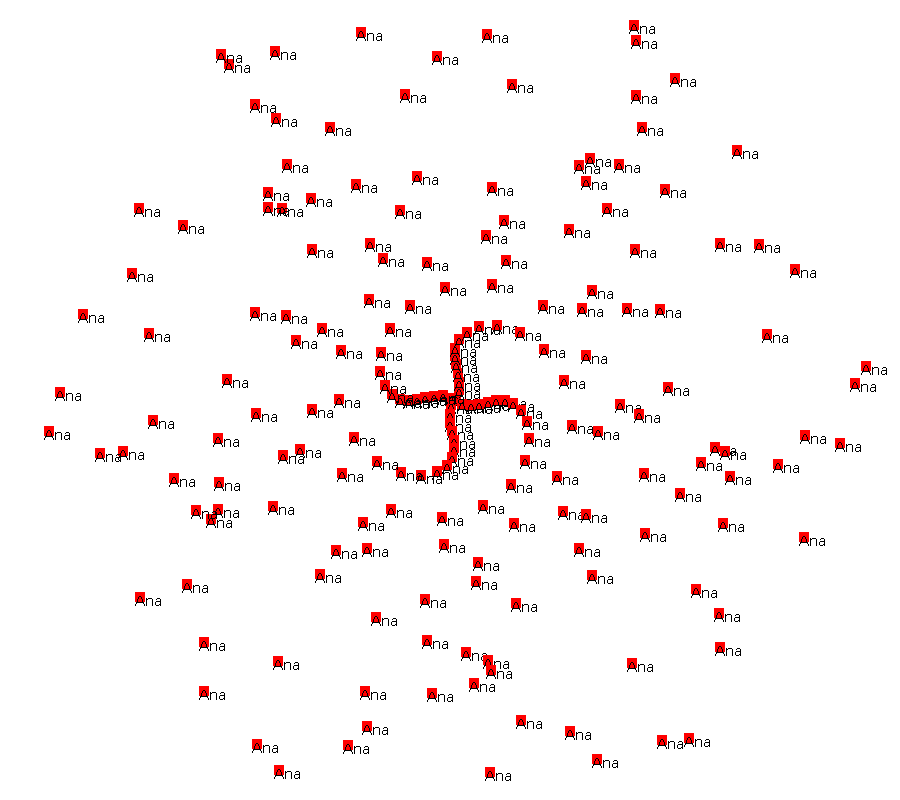
This made curious what patterns emerge when the objects move along circles instead. So I made this 10 minute hack to simulate it: http://www.gibney.org/spiral_clock

This version is nice because it's even clearer what's going on at integer-divisor points in the process, with different numbers of "arms" on the pattern.

Re: 15 uncoupled simple pendulums of increasing lengths dance together

#23

This made curious what patterns emerge when the objects move along circles instead. So I made this 10 minute hack to simulate it: http://www.gibney.org/spiral_clock

Interesting visual side-effect: watch the spiraling to completion, then flip back to HN and watch the text swirl.

Re: 15 uncoupled simple pendulums of increasing lengths dance together

#26
post #22

This made curious what patterns emerge when the objects move along circles instead. So I made this 10 minute hack to simulate it: http://www.gibney.org/spiral_clock

This version is nice because it's even clearer what's going on at integer-divisor points in the process, with different numbers of "arms" on the pattern.

Wow, it is beautiful. I'm trying to wrap my mind around the scheduling and the scale. It looks like it's calibrated to run an entire cycle in an hour, so if you see 6 arms (say) at the center, it's been running for 1/6 of an hour.

I'm trying to grok how the outward propagation works. It seems that a structure at the core propagates outward, while the core reorganizes itself into the next integral division (say 1/5). So you can get 5 arms at the core and 6 arms near the outer edges at the same time.

Check out this capture image. 4-way symmetry at the core, 5-way symmetry in the clusters halfway out, 6-way symmetry (faint but recognizable) at the outermost edge. http://www.dos486.com/misc/spiral-clock.gif

You also get recognizable structure for non-integral divisions, say 2/5. These structures are shorter-lived because each element is passing by an element two spins away instead of one so they converge and diverge faster.

Post reply on HN