Is the extruder speeding up and slowing down for each "blob" in the texture? Or is the extruder going constant speed and you're relying on surface tension to make the blobbyness?
Most like some postprocessing in the gcode to multiply the extrusion rate by some factor for each blob.
Leveraging a 3D printer “defect” to create a new quasi-textile
21–30 of 46 posts
Re: Leveraging a 3D printer “defect” to create a new quasi-textile
#22Out of curiosity, what printer would they be using for something like this? I've been considering getting a 3D-printer for a while, but I don't know enough to decide which one to get.
https://shop.prusa3d.com/en/upgrades/183-original-prusa-i3-m...
Re: Leveraging a 3D printer “defect” to create a new quasi-textile
#23Finally someone solved the problem of sold out toilet paper in the pandemic
Sign me up!
Re: Leveraging a 3D printer “defect” to create a new quasi-textile
#24If you think of it, all we do currently is cut and sew flat tiles of deformable cloth to approximate whatever curvature, but if you can print the material with the curvatures embedded it’s an interesting path to explore
Re: Leveraging a 3D printer “defect” to create a new quasi-textile
#25This is fantastic. I'm reminded of the 3D printed broom from a few years ago. I remember being blown away in a similar fashion then. This type of under extrusion can create very thin filaments, but the Gcode to generate these structures isn't easy to create with the traditional model=>slicer=>Gcode software stack. I've been out of the loop for a couple of years though, so I'm interested to know if this has evolved mu…
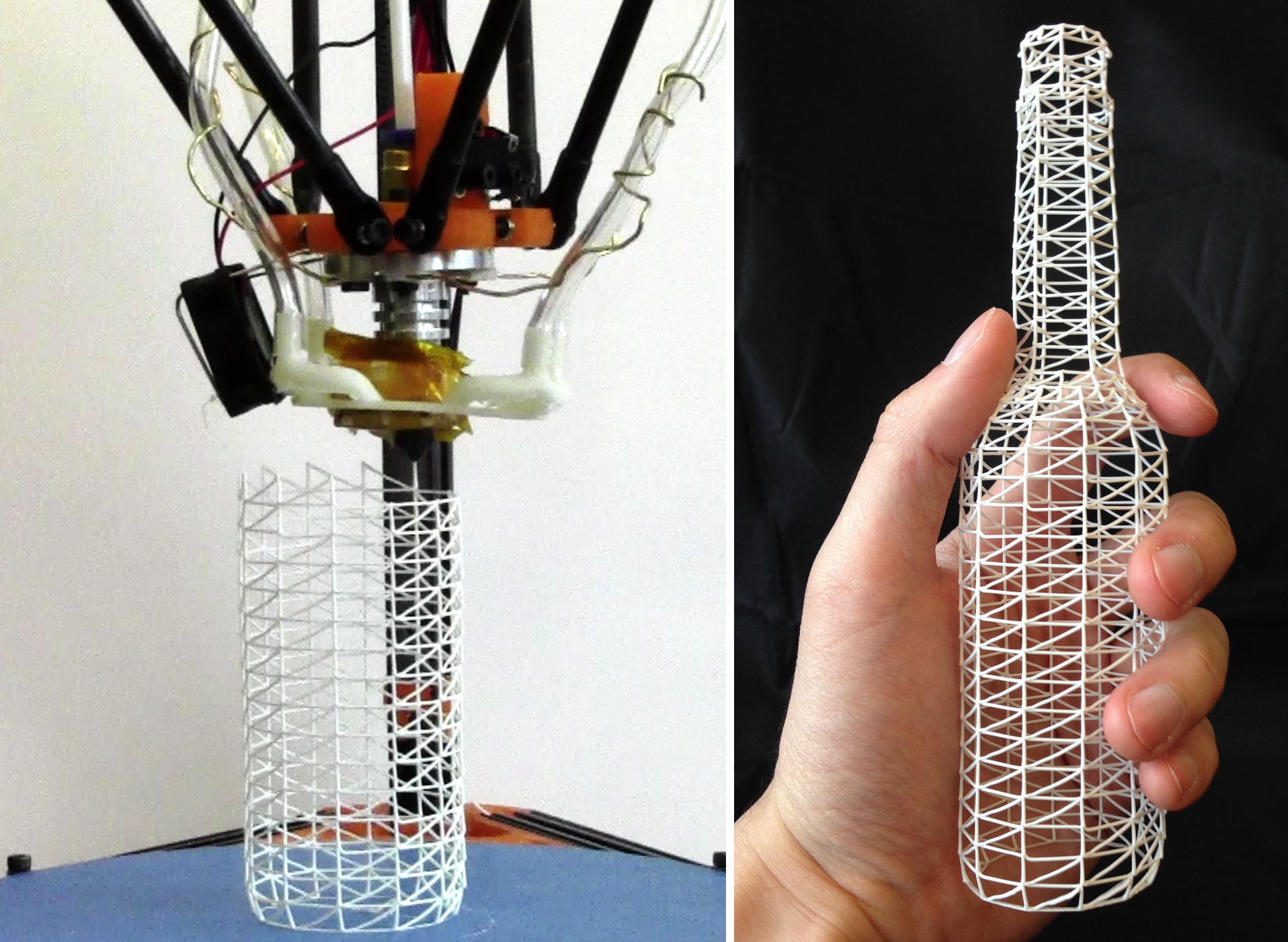
Some years ago I did some experiments with 3d printing in 3d (printing wire frames in 3d).
But it takes time to get the feed rates and print speeds right.
Edit: an example of wireframe printing: http://www.creativeapplications.net/wp-content/uploads/2014/...
Re: Leveraging a 3D printer “defect” to create a new quasi-textile
#26Re: Leveraging a 3D printer “defect” to create a new quasi-textile
#27Out of curiosity, what printer would they be using for something like this? I've been considering getting a 3D-printer for a while, but I don't know enough to decide which one to get.
I did get the Prusa I3 MK3S and it's just incredible, I'm astounded by the quality of the prints and the printer itself. I've already designed a number of parts in Fusion360 and printed them with a variety of different filaments (Flex, PLA, PETG) and having a lot of fun creating things!
Re: Leveraging a 3D printer “defect” to create a new quasi-textile
#28I've run a 3d printer with the extrusion rate way down before (to try and produce very thin surfaces), and the results were far less consistent. I got big holes in my parts and massive dribbles and blobs in other places. I wonder how these results can be so so so much better in comparison?
Re: Leveraging a 3D printer “defect” to create a new quasi-textile
#29Finally someone solved the problem of sold out toilet paper in the pandemic