Live data from Hacker News

Unker Non-Linear Writing System

s.ai

21–30 of 71 posts

Re: Unker Non-Linear Writing System

#21
post #2

What a fascinating concept, especially this part: > We have only started to develop how to hold a conversation in UNLWS itself. As we currently have it, it's a very, very different kind of thing than linear atomic turntaking. Rather, it's a sort of ongoing mutual edit of a shared structure, where revision history playback (or live observation) expresses the 'conversational' tone expected by linear conversation, and t…

> I can't help but wonder how this would look like applied to instant messaging: We are used to seeing our conversations arranged in differently colored bubbles, but how would our form of communication change if we instead communicated on a collaborative surface where we could freely choose which color to use and where to add our thoughts?

Sounds a lot like Google Docs.

Maybe all this time that Google has been struggling to develop the killer chat app, they were sitting one the ultimate one this whole time.
Re: Unker Non-Linear Writing System

#23
post #9

Programming is a non linear writing system. Now that I think of it ... if you replace functions names with logograms you get a top to down writing system of sorts.

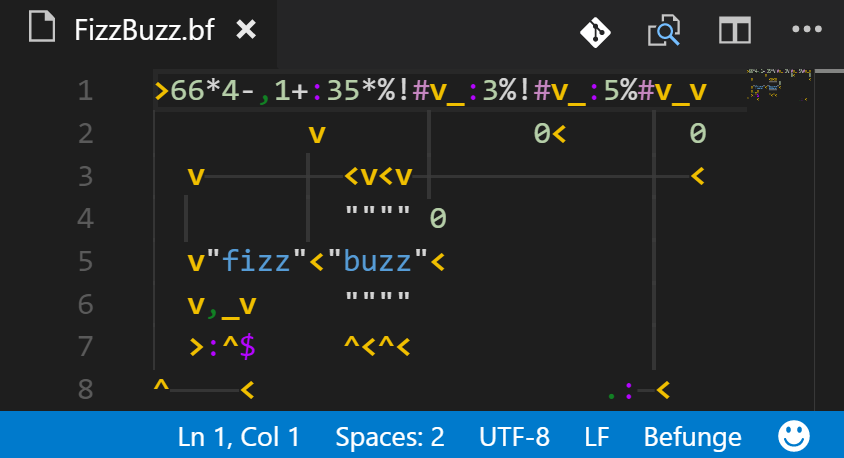
Especially Befunge. Here's fizzbuzz[0].

It's a stack based language where each character pushes something onto the stack or operates on the stack. The code pointer starts in the top left going to the right. But when it hits things that look like arrows (, ^), the code pointer turns in that direction and starts executing that way. There is also the ? command which sends the pointer in a random direction, _ and | which pop a value and send the pointer left/right or up/down if its true, and # which makes the pointer trampoline over and skip the following cell in whatever direction the pointer is moving.

https://raw.githubusercontent.com/kagof/VSCode-Befunge/maste...

Re: Unker Non-Linear Writing System

#24
Holy shit. I'm blown away by this. Imagine the ability to use these as training inputs for language processing. Just add one more representation to the bucket of things to train models on. Very fascinating. Favoriting this.

Re: Unker Non-Linear Writing System

#25
Reminds me of this [1] blog post which was on HN a while ago about Yukaghir's (a paleosiberian group) semasiographic writing system.

Also related is this conlang that was posted to r/conlangs maybe a couple years ago that I can't seem to find now. The idea was that you can represent elementary ideas with shapes and then connect those shapes in a non-linear fashion and add slight variations to specify certain semantic properties, allowing there to be numerous different "correct" readings.

Also, shameless plug of my blog [2] where I've been fleshing out a similar idea (albeit not focused on writing) for the past few months. It takes inspiration from Discourse Representation Theory and semantic graphs.

Edit: Just read about halfway through and the similarities between your conlang and mine are striking. I'd go so far as to say that yours is just a really interesting visual representation of mine.

[1] http://historyview.blogspot.com/2011/10/yukaghir-girl-writes...

[2] https://rpandey.tech/blog

Re: Unker Non-Linear Writing System

#28

This reminds me of the film Arrival and relates to the Sapir-Whorf hypothesis [1]regarding how language affects our perception and cognition. It's certainly a very interesting design (there's a hieroglyphic electrical circuit quality to it), but it wasn't clear what we can infer or gain from this non-linear form of writing. I feel like non-linear thinking is naturally how our brains work (or has more potential to wor…

Part of the inspiration for UNLWS was Heptapod B from Ted Chiang's Story of Your Life, from which Arrival was made.

See also my essays Non-Linear Fully Two-Dimensional Writing System Design ¹ and On the design of an ideal language ², which I wrote before we started to make UNLWS.

The written "language" in Arrival is purely babble (though it has some nice aesthetics at the fine level). It also violates explicit features described in the story, e.g. that an utterance is composed of unbroken strokes (i.e. a connected graph).

FWIW, I asked Chiang years ago whether he had any actual implementation or visualization in mind for Heptapod B. He didn't; it was purely an abstract set of properties for him.

¹ https://s.ai/essays/nlf2dws

² https://s.ai/essays/on_the_design_of_an_ideal_language

Re: Unker Non-Linear Writing System

#29

After going through the phase of admiring this new and intellectually stimulating thing, I went on with an exercise of imagination about how it would look like for a society to have evolved somehow into using this at large. Each new word (or at least morpheme) has to have its own signature/ideogram that has to be learned and remembered. For a lexicon of any practical use that would mean thousands of ideograms. That f…

Words (nouns) should not be a problem, verbs maybe are. "A gives a to B" is set in the language if I understand it correctly. How to add novel concepts and interactions? There could be the risk of a reduced expressiveness compared to the spoken language which in this case is English. Anyway, natural languages had thousands (millions?) of years to evolve, this one is at the very beginning. I wonder, we don't have a natural written language like this one because it was too difficult to devise or because it's suboptimal so phonetic, syllabic and characters (as for Chinese) won?

Re: Unker Non-Linear Writing System

#30
post #2

What a fascinating concept, especially this part: > We have only started to develop how to hold a conversation in UNLWS itself. As we currently have it, it's a very, very different kind of thing than linear atomic turntaking. Rather, it's a sort of ongoing mutual edit of a shared structure, where revision history playback (or live observation) expresses the 'conversational' tone expected by linear conversation, and t…

See also Ouwi¹ by Schuyler Duveen, which is one of the very few other non-linear written languages. It takes a somewhat different approach, and (IIRC) has some examples of conversational output.

(Ouwi & UNLWS were developed without either of us knowing about the other, though we got to know each other later on.)

¹ https://ouwi.org

Post reply on HN