Live data from Hacker News

The de Havilland Comet

greatdisasters.co.uk

21–30 of 54 posts

Re: The de Havilland Comet

#21

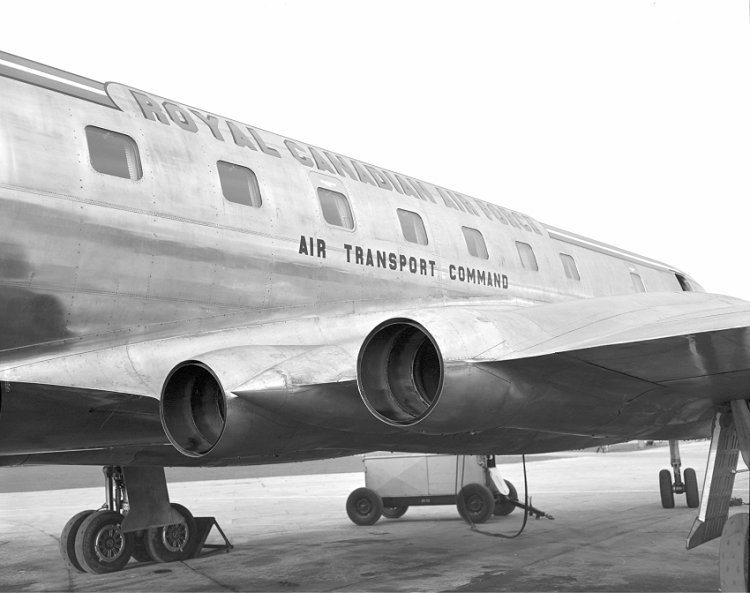
I still think the Comet manages to look more futuristic than other civil planes. Something about the look of those engines in the wing roots with not a nacelle in sight. Such a shame it turned out to be doomed due to being first and the now well known metal fatigue story. The article, as with everything Comet related, ends with noting that lesson is why airliners now have very rounded windows. Yet none ever wonder or…

> Something about the look of those engines in the wing roots with not a nacelle in sight. Quite a few early jetliners lacked normal nacelles.

Can you give some examples? I'm curious as I also find the de Havilland Comet design to be quite remarkable for this compared to modern jetliners, and this is the first time I'm encountering the design.

EDIT: I found this wikipedia page [1] and clicked around, and the only jetliners I found without nacelles are the Tupolev ones -- the Tu-334, Tu-104, Tu-110, Tu-124 -- and the Tuplev supersonic Tu-144.

[1] https://en.wikipedia.org/wiki/List_of_jet_airliners

Re: The de Havilland Comet

#22
Chester Wilmot, author of "The Struggle for Europe" who was an Australian War Correspondent during the Second World War was one of the passengers who sadly lost their lives in the crash of the Comet over the Mediterranean Sea.

I can recommend "The Struggle for Europe" - he wasn't just writing about the history, he was actively taking part.

https://en.wikipedia.org/wiki/Chester_Wilmot

Re: The de Havilland Comet

#23
post #12

I still think the Comet manages to look more futuristic than other civil planes. Something about the look of those engines in the wing roots with not a nacelle in sight. Such a shame it turned out to be doomed due to being first and the now well known metal fatigue story. The article, as with everything Comet related, ends with noting that lesson is why airliners now have very rounded windows. Yet none ever wonder or…

>Yet none ever wonder or look at why cockpit windows remain decidedly rectangular. :) Aerospace engineer here. It's not the shape of the window but the radius of the corner. A circle is just a square with large-radius corners, really, and it's the sharp corner that causes stress concentrations. If you look closely at modern jet liner cockpit windows you'll see they are in fact still rounded at the corners.

The radius of cockpit windows doesn't look that different than the radius on the Comet's square windows.

https://upload.wikimedia.org/wikipedia/commons/2/2e/Boeing_7...

http://www.c-and-e-museum.org/marville/photos/planes/comet-6...

Re: The de Havilland Comet

#24
post #11
post #7

Earlier quoted context omitted.

The Comet did go on in a military role as the Nimrod - I once saw an AEW Nimrod parked at the edge of RAF Kinloss - a staggeringly ugly beast: https://en.wikipedia.org/wiki/Hawker_Siddeley_Nimrod

They were an amazing example of a legacy system being maintained far beyond any reasonable expectation of life at gradually increasing cost, to a great extent because nobody could agree on a replacement and the one-off cost of a replacement was always a bit more than the endless "maintenance" and "refurbishment". If I remember rightly the refurbishment project hit the problem that, because the original planes were ha…

The B-52 program is slated to have a 95 year operational time span. Partly as an experiment in maintaining old aircraft.

Re: The de Havilland Comet

#25

One story I heard was that one of the production engineers added a rivet in the skin near the corners of the window. This was added because he thought it would strengthen the structure. Unfortunately it actually acted as an additional stress concentrator. I'm not entirely sure there wouldn't have been an issue without that extra rivet. The guy that made that change thought he was doing the right things but in fact ma…

According to Wikipedia:

> The accident report's use of the word "window" when referring to the Automatic Direction Finding (ADF) aerial cutout panel[121] has led to a common belief that the Comet 1's accidents were the result of its having square passenger windows. In fact, Comet 1's cabin windows were very similar in shape, with similar corner radii, to those of the Boeing 377 and Douglas DC-7[122], both of which were pressurised aircraft. The windows in Northwest Airlines' B-377 were in fact larger and notably more rectangular[123] than those of the Comet 1. While stresses in the area of the passenger windows were significantly higher than de Havilland had calculated, nowhere in the accident report is it claimed that the fatigue failure of the Comet fuselage occurred was a result of the shape of the passenger windows, but instead from excessively high localised stress at bolt and rivet holes, for which insufficient reinforcing (and therefore structural load distribution) existed.

Re: The de Havilland Comet

#26

Earlier quoted context omitted.

My school was right next to a runway (as in a couple of hundred metres at most) — whenever a Nimrod was taking off, class had to stop and wait for it to do its thing as there was simply no competing with it on volume. Loud buggers! As with a lot of British war jets from the post War decades, there was something quite beautiful — almost organic — in their lines.

Concorde is still the most beautiful aircraft ever, IMO.

The SR-71 would like a word https://en.wikipedia.org/wiki/Lockheed_SR-71_Blackbird

Re: The de Havilland Comet

#27
post #12

I still think the Comet manages to look more futuristic than other civil planes. Something about the look of those engines in the wing roots with not a nacelle in sight. Such a shame it turned out to be doomed due to being first and the now well known metal fatigue story. The article, as with everything Comet related, ends with noting that lesson is why airliners now have very rounded windows. Yet none ever wonder or…

>Yet none ever wonder or look at why cockpit windows remain decidedly rectangular. :) Aerospace engineer here. It's not the shape of the window but the radius of the corner. A circle is just a square with large-radius corners, really, and it's the sharp corner that causes stress concentrations. If you look closely at modern jet liner cockpit windows you'll see they are in fact still rounded at the corners.

I'm sure my brain had another sentence that never made it to keyboard when I was writing that, as I've given completely the wrong impression, opposite to intended. No idea what I was thinking. :)

Comet windows did have rounded corners, as seen in the wreckage photo, similar to the 707's and others. The cause was stress at rivet holes and lack of strength in those areas. After strengthening it had oval windows. The popular view continues to believe the cause was windows with corners.

Re: The de Havilland Comet

#29
post #23
post #12

Earlier quoted context omitted.

>Yet none ever wonder or look at why cockpit windows remain decidedly rectangular. :) Aerospace engineer here. It's not the shape of the window but the radius of the corner. A circle is just a square with large-radius corners, really, and it's the sharp corner that causes stress concentrations. If you look closely at modern jet liner cockpit windows you'll see they are in fact still rounded at the corners.

The radius of cockpit windows doesn't look that different than the radius on the Comet's square windows. https://upload.wikimedia.org/wikipedia/commons/2/2e/Boeing_7... http://www.c-and-e-museum.org/marville/photos/planes/comet-6...

Perhaps not, but remember that the metal fatigue phenomenon responsible for cracking in the Comet was not yet fully understood at that time.

Nowadays we have a very good understanding of how metals degrade/respond to repeated load cycles and can design around it. I have not personally worked on airliner window structures but there are a number of avenues that one could take to retain the general shape of the window and still avoid structural compromise due to cracking.

Re: The de Havilland Comet

#30

Earlier quoted context omitted.

My school was right next to a runway (as in a couple of hundred metres at most) — whenever a Nimrod was taking off, class had to stop and wait for it to do its thing as there was simply no competing with it on volume. Loud buggers! As with a lot of British war jets from the post War decades, there was something quite beautiful — almost organic — in their lines.

I remember seeing a Vulcan bomber doing aerobatics over our wee Scottish village - quite a site and the noise was incredible.

Some time in my teens I was at an air show with very relaxed views on where a crowd line should be compared to today. A Vulcan, howling away at full throttle, pulling into a max climb at what seemed just above our heads will never be forgotten, or unfelt. That display was definitely the highlight of the show. Ridiculously agile for the age and size.

No one had car alarms back then or they'd all have surely joined in. :)

Post reply on HN