Live data from Hacker News

The next capitalist revolution

economist.com

21–30 of 65 posts

Re: The next capitalist revolution

#21
post #12

Earlier quoted context omitted.

Lol, alright buddy. The intellectual class is why we have progress at all. Do feel free to go back to hunting and gathering, though.

You really think academics and critics are responsible for the successes of our society? Lol How many of your beloved CEOs are dropouts?

Most of them dropped out from extremely prestigious institutions because they had a business to run. It's not like Bill Gates couldn't hack it at Harvard so he dropped out and started Microsoft.

Re: The next capitalist revolution

#22

What we need is a revolution in how people think about complex systems. People nowadays throw ideas around thinking they have a good understanding of how systems operate or should operate, when in fact most are clueless and fail to realize their ignorance. Society, economy, biological organisms, climate, cognition, etc are all complex systems, and no single person can claim to understand how they work, or the types o…

Exponential growth, feed back loops and side effects are all hard to reason about intuitively.

"Business Dynamics" by Stermer was surprisingly good.

"How we know what is not so" by Thomas Gilovich is a good tonic against arrogance (as is "Uncommon Sense" by Comer).

I really like SystemAntics (John Gall - Good luck finding the original!) about, mostly, how our arrogance fails us when we try to define systems that are complex and include humans...

Re: The next capitalist revolution

#23
post #10

Earlier quoted context omitted.

Nice clip. I'm sorry that I don't find it compelling for the purpose of answering the question as asked. Maybe you went to a different logic school.

I got kicked out for abduction.

At least you're funny. (And, no, I have not downvoted you)

Re: The next capitalist revolution

#24
My takeaway from this article was mainly about how much competition should be fostered within the system.

One interesting thing about the neoliberal era, it seems, is that the things in it seem to be simultaneously very big and very small.

There are some very big things -- cyberpunk-style megacorps that literally have free rein to make and remake entire markets and populations -- and at the same time very small things -- gig workers, freelancers, contractors, and other kinds of "entrepreneurs" that are out on their own in a dog-eat-dog world of hustle.

I think the question is less about whether we should have more competition, and more about whether this can be done safely. As it stands, you basically have two choices, modeled after the above: to become a cog in a machine (or a machine-in-the-making), or be completely out on your own.

Can something sustainably exist in the middle, and without being consumed by the big thing or becoming the big thing?

Re: The next capitalist revolution

#25
This is one of those really tough areas where the problems are so significant and comprehensive that the approach people want to take immediately gets into their worldview and belief system. And no one readily changes their worldview, so its difficult to have productive discussions about such things.

Nevertheless I will state my worldview and hopefully mention a few specifics that might be anchor points for an attempted discussion.

Technology _alone_ cannot solve our societal problems, but I believe that there is great opportunity to address them by better incorporating the right technologies into society.

And I believe that peer-to-peer distributed (and so decentralized) technologies offer quite a lot of promise. Starting with the idea that over-centralization, whether it stems from a more socialist traditional system or a more capitalist traditional system, is one of the main problems, and technologies that are inherently decentralized can address that.

Well, maybe I will just start with a few premises. I would like to suggest that we should re-evaluate all of our societal structures in a technological context. I think that we can usefully think of them all as types of (mostly primitive) technologies.

For example, I suggest that money is in fact a technology. It is probably the most fundamental technology of society. I think that although an over-reliance on traditional money obviously causes problems, the answer is not to simply de-emphasize its use in society, although that can help in certain contexts. I believe that we should upgrade the technology of money and in doing so we can improve the functioning of society.

I also believe that government is another type of fundamental technology for society. It should also have its technology upgraded.

Another idea I have is that there is a fundamental interaction between money and government which we normally refer to as "corruption" with the idea that this is an abnormal state for the relationship. However I believe that the close relation between money and government in their present primitive forms is a core structural element, i.e. corruption is structurally guaranteed.

I realize that convincing people of these views would require quite extensive prose. But it is unlikely that those with different worldviews would be convinced and I am tired of writing this answer so unfortunately I am not going to try right here. However at least I have explained some of my viewpoint.

Anyway, I think that Ethereum and related or similar technologies are moral causes because they allow us the possibility of upgrading core technologies used in society. We can upgrade money with cryptocurrency. We can upgrade government using something like Ethereum-based decentralized autonomous organizations. I think that you need to upgrade money _and_ government at the same time and be sure that your system considers them as closely related so that you can handle "corruption" in a structural way.
Re: The next capitalist revolution

#26
post #2

None of this matters, not one iota. The world is choking in the filth we are creating, all while people like this pontificate about the next generation of the system that positively reinforces the creation of filth.

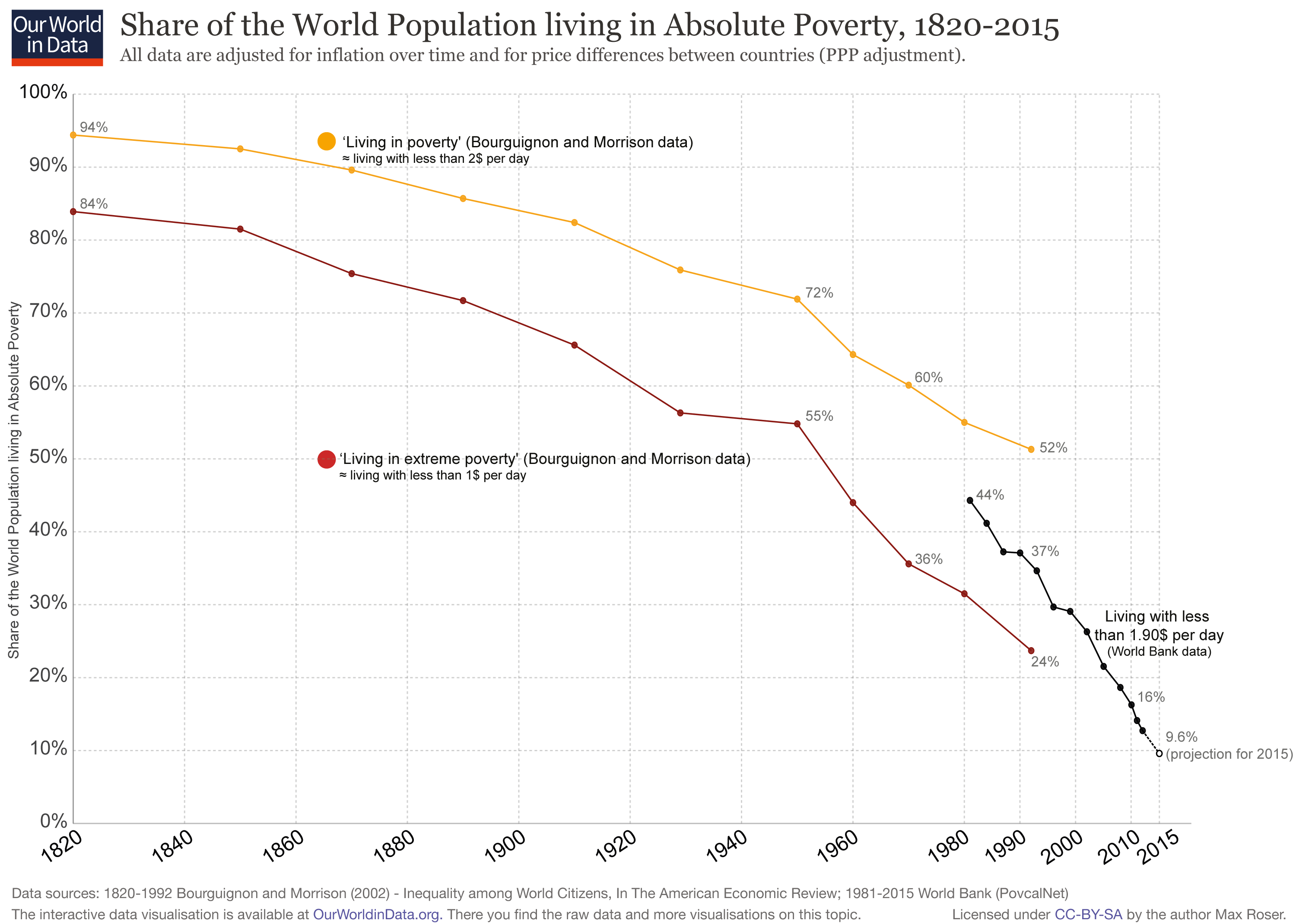
By filth, you mean a world where we've gone from 94% destitute in 1820, to 90%+ not destitute in 2015, coinciding with an outrageous boom in population, and the availability of technologies which would have seemed basically like magic to people of the time?

You're welcome, and I'm sorry your friends let you manage to be so miserable in the best time ever for humanity.

The overwhelming majority of those remaining in extreme poverty live in sub-Saharan Africa, if any of the improvements we've seen everywhere else can be extended there, the remaining 8.6% of people living in extreme poverty can escape it.

https://ourworldindata.org/wp-content/uploads/2013/05/World-...

https://openknowledge.worldbank.org/bitstream/handle/10986/3...

Re: The next capitalist revolution

#27
post #23

Earlier quoted context omitted.

I got kicked out for abduction.

At least you're funny. (And, no, I have not downvoted you)

Personally I'm amazed that people appear to like the cheap shot I made with the spitting image clip, but hate the formal logic joke.

Re: The next capitalist revolution

#28

Earlier quoted context omitted.

These downvotes are unfortunate given this statement is objectively true.

I think the downvotes are coming from the lack of context accompanying the GP’s bold statements.

Not sure what's expected here. I mean, this is hardly the format for 20 page dissertations on lived history. I'm guessing these downvotes are coming from folks that are missing context because they're in their 20's and don't actually know anything about Reaganomics, what was proposed vs what the actual observed outcomes were, etc.

Re: The next capitalist revolution

#29
post #20

Earlier quoted context omitted.

Behemoths like Amazon are taking a flamethrower to complexity already. Want practically anything? Just click and the day after tomorrow it magically appears at your door. Google, Amazon, Apple...they are reducing our IQs by simplifying our lives to the point of stupefaction.

>> Society, economy, biological organisms, climate, cognition, etc are all complex systems You can't buy any of these from any company, and you definitely can't buy understanding of them.

TFA is about wealth and power, not human evolution

Re: The next capitalist revolution

#30
post #25

This is one of those really tough areas where the problems are so significant and comprehensive that the approach people want to take immediately gets into their worldview and belief system. And no one readily changes their worldview, so its difficult to have productive discussions about such things. Nevertheless I will state my worldview and hopefully mention a few specifics that might be anchor points for an attemp…

Shameless plug: I wrote a blog post a while ago using your premise to argue why decentralized technologies wouldn't be useful to society: https://www.notion.so/Yet-Another-Rant-About-Blockchains-ece...
Post reply on HN