Earlier quoted context omitted.
Packet.net offers it: https://www.packet.net/bare-metal/servers/c2-medium-epyc/
Please see other comments. It's EPYC and not RYZEN. 2.0 Ghz base clock speed is not nice for single-thread.
Unexpected benefit with Ryzen – reducing power for build server
21–30 of 61 posts
Re: Unexpected benefit with Ryzen – reducing power for build server
#22Not every workload is memory bandwidth bound like his "make -j16" compile. Some workloads need memory latency or fast inter-core (and inter-socket) operations (e.g. RDBMS OLTP), some need CPU throughput (e.g. HPC), some need best possible single thread CPU performance (e.g. some gaming). As he wrote, CPUs are most efficient (compute per Watt) at a specific frequency, and if his CPU mostly waits for RAM, this can be d…
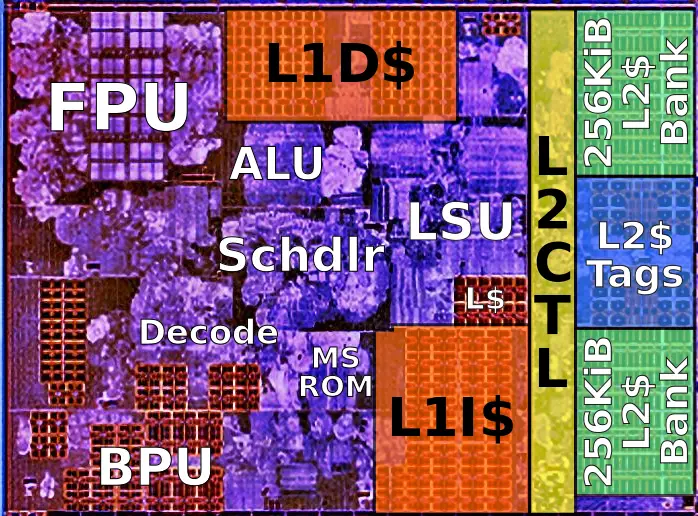
It's certainly possible to build a more lightweight core, but most of that work is reducing the complexity of the out-of-order machinery. The FPU+ALU is under a quarter of each Zen core. https://en.wikichip.org/w/images/c/cb/amd_zen_core_%28annota...
Re: Unexpected benefit with Ryzen – reducing power for build server
#23Still, the conclusion holds: if most of the time is spent waiting for values to come back from memory, a higher core frequency has strongly diminishing returns.
Re: Unexpected benefit with Ryzen – reducing power for build server
#24Not every workload is memory bandwidth bound like his "make -j16" compile. Some workloads need memory latency or fast inter-core (and inter-socket) operations (e.g. RDBMS OLTP), some need CPU throughput (e.g. HPC), some need best possible single thread CPU performance (e.g. some gaming). As he wrote, CPUs are most efficient (compute per Watt) at a specific frequency, and if his CPU mostly waits for RAM, this can be d…
He actually did `make -j32`, not 16. Which is going to absolutely devastate the cache.
`make -j` was a good rule of thumb back when you had 1/2/4 physical CPUs with their own sockets on a motherboard and spinning rust hard disks. A lot of "compilation" time was reading the source code off the disk. But it doesn't make any sense anymore with so many cores, hyperthreading, and SSDs that serve you the file in milliseconds.
If he's bandwidth limited, he would gain a significant performance improvement by reducing the number of processes.
Re: Unexpected benefit with Ryzen – reducing power for build server
#25Earlier quoted context omitted.
Packet.net offers it: https://www.packet.net/bare-metal/servers/c2-medium-epyc/
Please see other comments. It's EPYC and not RYZEN. 2.0 Ghz base clock speed is not nice for single-thread.
Re: Unexpected benefit with Ryzen – reducing power for build server
#26Not every workload is memory bandwidth bound like his "make -j16" compile. Some workloads need memory latency or fast inter-core (and inter-socket) operations (e.g. RDBMS OLTP), some need CPU throughput (e.g. HPC), some need best possible single thread CPU performance (e.g. some gaming). As he wrote, CPUs are most efficient (compute per Watt) at a specific frequency, and if his CPU mostly waits for RAM, this can be d…
Zen is already light on vector units, and microcodes 256-bit operations. It's certainly possible to build a more lightweight core, but most of that work is reducing the complexity of the out-of-order machinery. The FPU+ALU is under a quarter of each Zen core. https://en.wikichip.org/w/images/c/cb/amd_zen_core_%28annota...
In that picture (thanks!) I see the FPU is big, the decoder is big, the branch predictor is big, the rest is probably needed. Maybe emulated FPU is good for some workloads, maybe ability to program in microinstructions instead of x86-64 is useful too. But maybe silicon area is not the expensive thing (dark silicon, etc.).
Re: Unexpected benefit with Ryzen – reducing power for build server
#27Earlier quoted context omitted.
Please see other comments. It's EPYC and not RYZEN. 2.0 Ghz base clock speed is not nice for single-thread.
Epyc is the name for the server chips. Both Ryzen and Epyc are based on the same microarchitecture.
Re: Unexpected benefit with Ryzen – reducing power for build server
#28Re: Unexpected benefit with Ryzen – reducing power for build server
#29Earlier quoted context omitted.
You are confusing principle with implementation. Reducing clock speed reduces power usage and you can compensate with more cores is indeed a truth. However, finding that option in consumer hardware has been relatively difficult. That is the surprise indicated.
Ryzen is known to be memory constrained even with much faster memory than he used. It is completely predicable that he found his CPU to be severely starved for memory bandwidth thus enabling him to reduce operating frequency without penalty. This is like putting an LS engine in an otherwise stock Miata and acting surprised that you can run the engine at lower RPM and still put in good lap times.
In other words, he's reached peak CPU. As in a faster unit will not speed it up, and more cores can only do that to a point. Amdahl law (power efficiency variant) and also memory controllers say hello.
Re: Unexpected benefit with Ryzen – reducing power for build server
#30I think the claim that parallel compilation with gcc is memory bandwidth bound is unlikely. gcc is known to be a very pointer-chasy, branch-mispredicty load that is highly sensitive to memory latency - far from a streaming load that is sensitive to raw bandwidth. Still, the conclusion holds: if most of the time is spent waiting for values to come back from memory, a higher core frequency has strongly diminishing retu…
Even more cache ways won't help too much in this workload.