Live data from Hacker News

First ever color X-ray on a human

yahoo.com

21–30 of 83 posts

Re: First ever color X-ray on a human

#21
post #5

Another article at http://www.eurekamagazine.co.uk/design-engineering-news/firs... It sounds like the chips are detecting the energy of each xray, which is equivalent to a wavelength, and that data is then used to synthesize a 3D image.

The 3D nature of the output is still generated using tomography (CT). The colour comes from the x-ray energy which is detected using two thresholds giving effectively two channels of data.
Re: First ever color X-ray on a human

#22

This feels like a real black swan event to me. I guess I just assumed that black-and-white x-rays were as good as it gets, and that there wasn't any room for improvement. I've never even thought about the idea of a color x-ray. It's very exciting to see something that could change the entire field of radiology.

OsiriX (and others) have been rendering radiology imaging in color and 3D for quite a while.

https://www.osirix-viewer.com/osirix/osirix-md/

https://www.osirix-viewer.com/resources/dicom-image-library/

Patients can even download the lite version and review their own images.

Re: First ever color X-ray on a human

#24
How much exposure to radiation is needed for this? Their brochure indicates 20-80 mGy/mSv. But a typical clinical head CT is only 2 mGy. AFAIK, exposures that high would not be acceptable for clinical human use.

It's probably inevitable that a 'spectral' scanner requires greater exposure than clinical CT scanners since the intensity of a spectral X-ray source apparently varies during the scan. This implies slower scans and more X-ray exposure than a conventional CT.

Apparently that's why MARS' current product is intended for preclinical (non-human) use only.

Re: First ever color X-ray on a human

#25
post #8
post #6

Earlier quoted context omitted.

And get 3 times the does of radiation? Seems impractical, but possibly true.

A chest x-ray will give you 0.1 millisieverts. That's the 60th of the dose limit used in scientific facilities like cern. And 200 times less than for radiation workers. It's still ok, it's not supposed to be that of a regular procedure.

It actually looks like it's a CT scan, which is a type of x-ray. A chest CT scan is 7 mSv.

Re: First ever color X-ray on a human

#26
post #3

There are slightly more details on the product page [0]. It looks like they have a small bore version right now, they're working on making a human sized one. There is one test image that shows part of a wrist, a watch, and part of a hand. [0] https://www.marsbioimaging.com/mars/overview/

Oh yeah, and if you scroll down, there's a lot more detail. Sounds like you can customize the color mapping somewhat in their software -- there's mention of adjustable binning and customizable energy thresholds.

Re: First ever color X-ray on a human

#27
I remember discussing this as a possibility with Phil and Anthony in CERN Cafetera in 2007/2008 when they had first licensed some imaging tech from CERN. It is absolutely thrilling to see how far the team have come since then and to see them start to get the wider coverage their achievements deserve. Seeing this on HN just made my day.

Re: First ever color X-ray on a human

#28
post #6
post #2

Article is short on details. Do they take pictures with X-rays at three different wavelengths, and then render the three resulting images as individual color channels?

And get 3 times the does of radiation? Seems impractical, but possibly true.

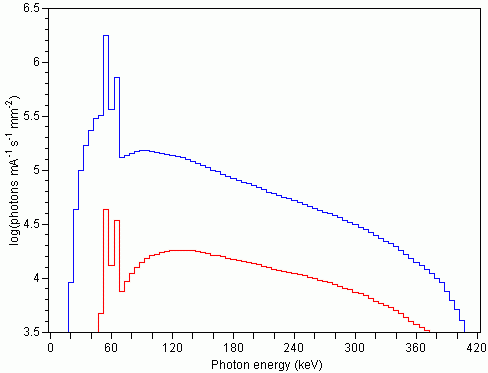
X-ray sources are not "monochromatmic" and produce photons across a wide range:

http://www.ctlab.geo.utexas.edu/wp-content/uploads/2015/06/F...

Re: First ever color X-ray on a human

#29
post #11

“The new device, based on the traditional black-and-white X-ray, incorporates particle-tracking technology developed for CERN's Large Hadron Collider.” Now i have an easy to understand example to make my skeptical friends understand how CERN’s research benefits us in myriad ways.

Fundamental science research always has applications decades in the future. It's pretty rare that practical applications are found "now".

There is a distinction to be made on the results of the fundamental research itself, and then the sideproducts of the engineering that enables that research. From the sounds of it, this Xray thingy belongs more in the latter category.

Re: First ever color X-ray on a human

#30

Photon counting sensors have been available for quite a while. This is unfortunately not new. It’s not ’color’ it’s multi channel imaging. X-ray tubes produce wide spectrum of x-rays, these type of sensors are able to put different bands to different buckets. Coloring is arbitrary and conveniently chosen in the example to look like visible wavelength response as if the patient was dissected. It does not work for more…

Exactly. Researchers have been doing tomography with energy-dispersive detectors for decades, especially at synchrotrons. They often represent that data in 3D with false color indicating material properties. If there is something particularly novel about this work, it's not clear from the article, which reads like a rehash of a University PR piece.
Post reply on HN