Live data from Hacker News

NIST to redefine the kilogram based on a fundamental universal constant

washingtonpost.com

21–30 of 90 posts

Re: NIST to redefine the kilogram based on a fundamental universal constant

#21

It's a little ironic that the article expressed the value of Planck's constant using an SI Unit with kilograms. > Based on 16 months' worth of measurements, it calculated Planck's constant to be 6.626069934 x 10⁻³⁴ kg∙m2/s.

Right - can somebody explain how this unit of kg-m2/s (weight diffusion? work-seconds?) can be used to define weight? Seem circular.

Because in order to measure something in terms of a constant, you cancel out all the other units except the one you're measuring.

I.e., if you know how to measure a second, you could define the meter based on the speed of light by creating light in a vacuum and timing it.

Meanwhile, you can't define a meter or a second in terms of pi, because it has no units. It's just a ratio of the surface area of certain classes of object or shape to thheir dimensions.
Re: NIST to redefine the kilogram based on a fundamental universal constant

#23

The kilogram is not the only unit that will be redefined based on universal constants. The seven base units[0] will transition to being based on elementary charge and the Planck, Boltzmann, and Avogadro constants[1]. [0] https://en.wikipedia.org/wiki/SI_base_unit#Seven_SI_base_uni... [1] https://en.wikipedia.org/wiki/Proposed_redefinition_of_SI_ba...

Slightly off-topic, but looking at the temperature section in your second link reminded me of the latest video from Linus Tech Tips[1] where he gets bashed for using the expression "degrees Kelvin". Personally, I don't see the problem. Since a kelvin is a hundredth of the difference between boiling and freezing temperatures of water, there is a notion of scale so the term "degrees" makes sense.

1. https://www.youtube.com/watch?v=60OkanvToFI

Re: NIST to redefine the kilogram based on a fundamental universal constant

#24

It's a little ironic that the article expressed the value of Planck's constant using an SI Unit with kilograms. > Based on 16 months' worth of measurements, it calculated Planck's constant to be 6.626069934 x 10⁻³⁴ kg∙m2/s.

Right - can somebody explain how this unit of kg-m2/s (weight diffusion? work-seconds?) can be used to define weight? Seem circular.

Right now the mass of the kilogram prototype is defined to be exactly 1 kg. If someone adds or removes matter from the prototype, then the numerical value we assign to the mass of everything else in the world would change, but the prototype would remain 1 kg. On the other hand, currently, the value of Planck's constant is known only to a certain level of accuracy.

Under the new system, Planck's constant would be defined to be exactly 6.626070040e−34 kg.m^2.s^-1, with no error bars, and the prototype would no longer be exactly 1 kg. If we refine our estimate for the physical value of Planck's constant, its numerical value of 6.626070040e−34 kg.m^2.s^-1 would not change, but the numerical value for everything's mass would.

This definition of 1 kg requires we first define 1 m and 1 s, but there are already good definitions for these quantities based on fundamental physical properties (namely, the speed of light and the frequency of the transition between the two hyperfine levels of ground state of the caesium-133 atom).

Re: NIST to redefine the kilogram based on a fundamental universal constant

#26
post #25

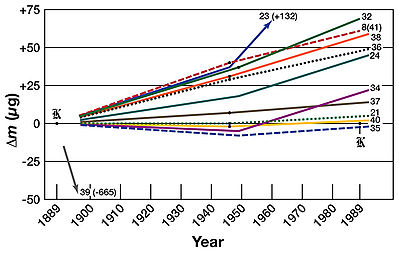
I always get a kick out of this: https://upload.wikimedia.org/wikipedia/commons/thumb/c/c9/Pr...

context?

It's how the mass of the International Prototype Kilogram and its copies have drifted over time:

http://www.bipm.org/en/bipm/mass/ipk/ (verifications tab)

Re: NIST to redefine the kilogram based on a fundamental universal constant

#27

The kilogram is not the only unit that will be redefined based on universal constants. The seven base units[0] will transition to being based on elementary charge and the Planck, Boltzmann, and Avogadro constants[1]. [0] https://en.wikipedia.org/wiki/SI_base_unit#Seven_SI_base_uni... [1] https://en.wikipedia.org/wiki/Proposed_redefinition_of_SI_ba...

Slightly off-topic, but looking at the temperature section in your second link reminded me of the latest video from Linus Tech Tips[1] where he gets bashed for using the expression "degrees Kelvin". Personally, I don't see the problem. Since a kelvin is a hundredth of the difference between boiling and freezing temperatures of water, there is a notion of scale so the term "degrees" makes sense. 1. https://www.youtube…

Battles over being "technically correct" are the most fierce, because the stakes are so low.

Re: NIST to redefine the kilogram based on a fundamental universal constant

#28

It's a little ironic that the article expressed the value of Planck's constant using an SI Unit with kilograms. > Based on 16 months' worth of measurements, it calculated Planck's constant to be 6.626069934 x 10⁻³⁴ kg∙m2/s.

Meters and seconds are already defined by physical constants, so once you know Planck's, you know kilograms.

Re: NIST to redefine the kilogram based on a fundamental universal constant

#29

It's a little ironic that the article expressed the value of Planck's constant using an SI Unit with kilograms. > Based on 16 months' worth of measurements, it calculated Planck's constant to be 6.626069934 x 10⁻³⁴ kg∙m2/s.

The constant is measured via experiments and because mass appears in the expression of the constant given above, a measure of the kg is obtained. I.e. the closer we approximate the constant (6.62...) the closer we get to determine what a kilogram actually weights (in relation to meters and seconds).

Re: NIST to redefine the kilogram based on a fundamental universal constant

#30
It does not make sense, practically. So they'll be using a balance with multiple moving parts made of multiple minerals that have to be precisely calibrated with margins of error adding up, instead of a simple platinum cylinder?

Although, it makes sense politically

Post reply on HN