Live data from Hacker News

Eve Evolved: Analysing Eve's New Economic Reports

massivelyop.com

21–30 of 47 posts

Re: Eve Evolved: Analysing Eve's New Economic Reports

#21
post #14
post #7

Eve's player-based economy is really badass, to the point that they have an economist on staff to generate reports like these. CCP found a great way to combat RMT (real money trading) rampant in MMOs where you buy in-game currency with real-world money with the introduction of PLEX (aka Pilot License). Basically, you can pay ~$15 for an in-game PLEX, which when "used" adds 30 days of game-time to your account subscri…

Seems like they've found a way to anchor their currency to something more tangible like USD, using fungible game time. Fascinating. Has anyone set up automated currency exchanges in the game?

Anchoring the in-game currency is one of the main strategies for preventing in-game currency inflation: https://www.youtube.com/watch?v=sumZLwFXJqE

Instead of paying player characters to grind, and therefore have players consume game content, why aren't we paying players to create game content?

Re: Eve Evolved: Analysing Eve's New Economic Reports

#22
post #2

"At the end of February 2016, the total liquid ISK in the EVE Online economy was 948.043 trillion ISK (equivalent to $16.45 million using PLEX conversion)." find this fact mind boggling!

Meh. It's a by-product of the typical hyperinflation you get when you try to devise an economy where everyone gets to print as much money as they care to. (Which is what MMO grinding for cash basically amounts to.) Their trying to peg ISK to real world money through PLEX is a typical strategy to try and counteract this, which also typically kind-of works, but only typically kind-of. https://www.youtube.com/watch?v=su…

PLEX was designed as a 'legal' mechanism to undercut (and, for the most part, terminated) the black market trade in "cash for ISK" and the accompanying problems caused by automation of ISK farming by those black market sellers. It also serves as a mechanism for players to 'sell' ISK for 'cash', in the sense that they won't have to pay the real cash monthly fee if they sell their ISK (or other liquid property) to someone else for a PLEX.

It is not, however, an ISK sink. The only way to buy PLEX with ISK is to trade with someone who bought theirs with cash. That ISK remains in the economy and is not destroyed by the trade. The actual mechanism is hinted at early on in the article:

> The main way ISK is removed from the game this month was the purchase of skills from NPC corps on the market, with 13.602 trillion ISK sunk into skill books over the period.

This is wrong, based on the 2015 Vegas report: LP stores are also an ISK sink, exceeding - in 2015 - the skill books. Anyways, the above article links to:

https://web.archive.org/web/20150129024846/http://massively....

Which tries to explain this, but is filled with broken links to forum posts. I eventually found this post from 2012 that concisely indicates actual ISK sinks in the game in dollar amounts:

http://twostep4csm.blogspot.com/2012/03/its-econmony-stupid....

And their 2015 economy post includes a graph of ISK velocity ("the estimated number of times one isk is spent to buy goods each month, in this case a 30 day moving sum of total trade over total active isk each day") as well as the "total ISK" growth over time:

https://community.eveonline.com/news/dev-blogs/eve-economy-u...

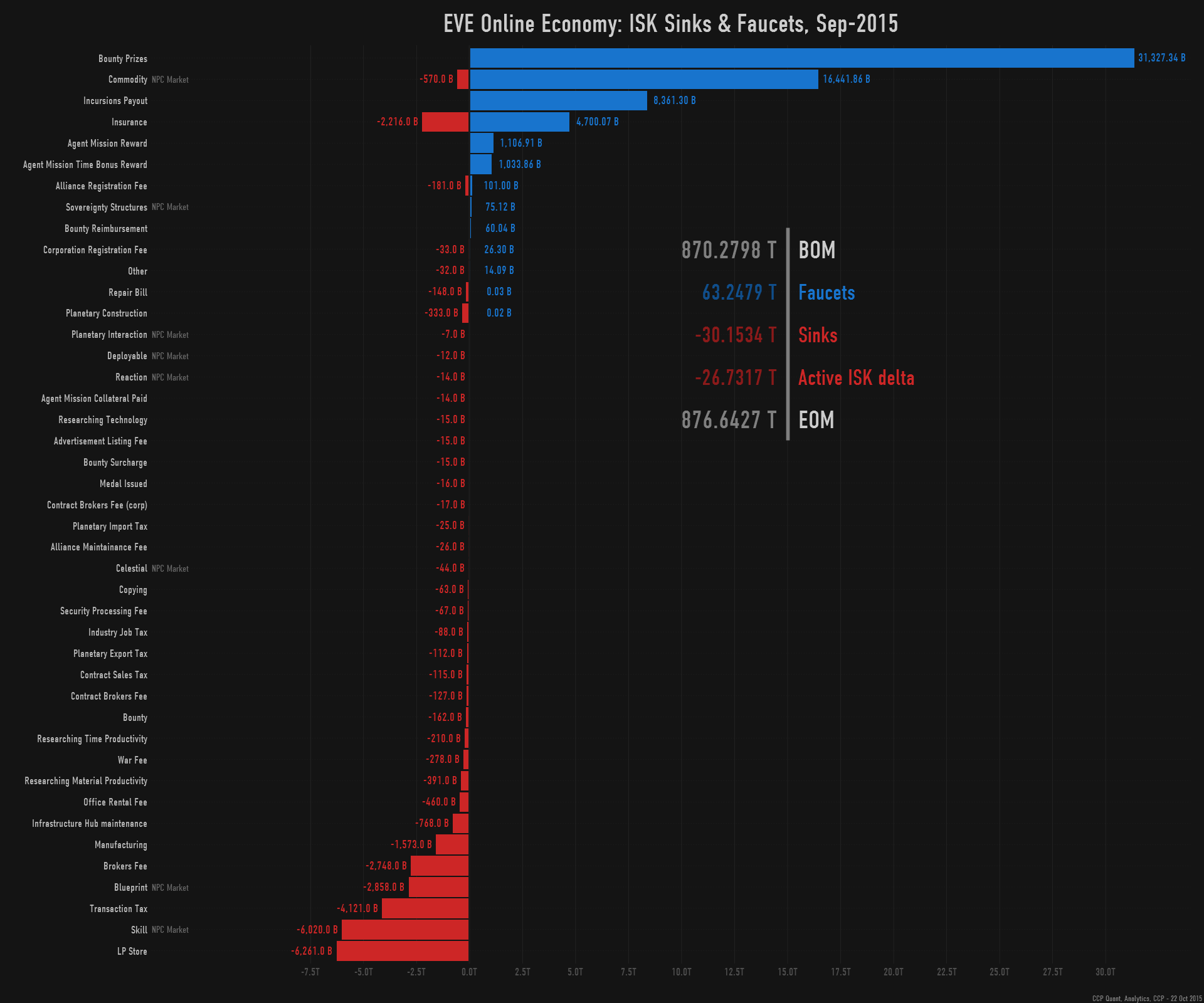
And finally, it links to this chart, clearly showing the ISK sinks and faucets for September 2015:

http://content.eveonline.com/www/newssystem/media/68738/1/si...

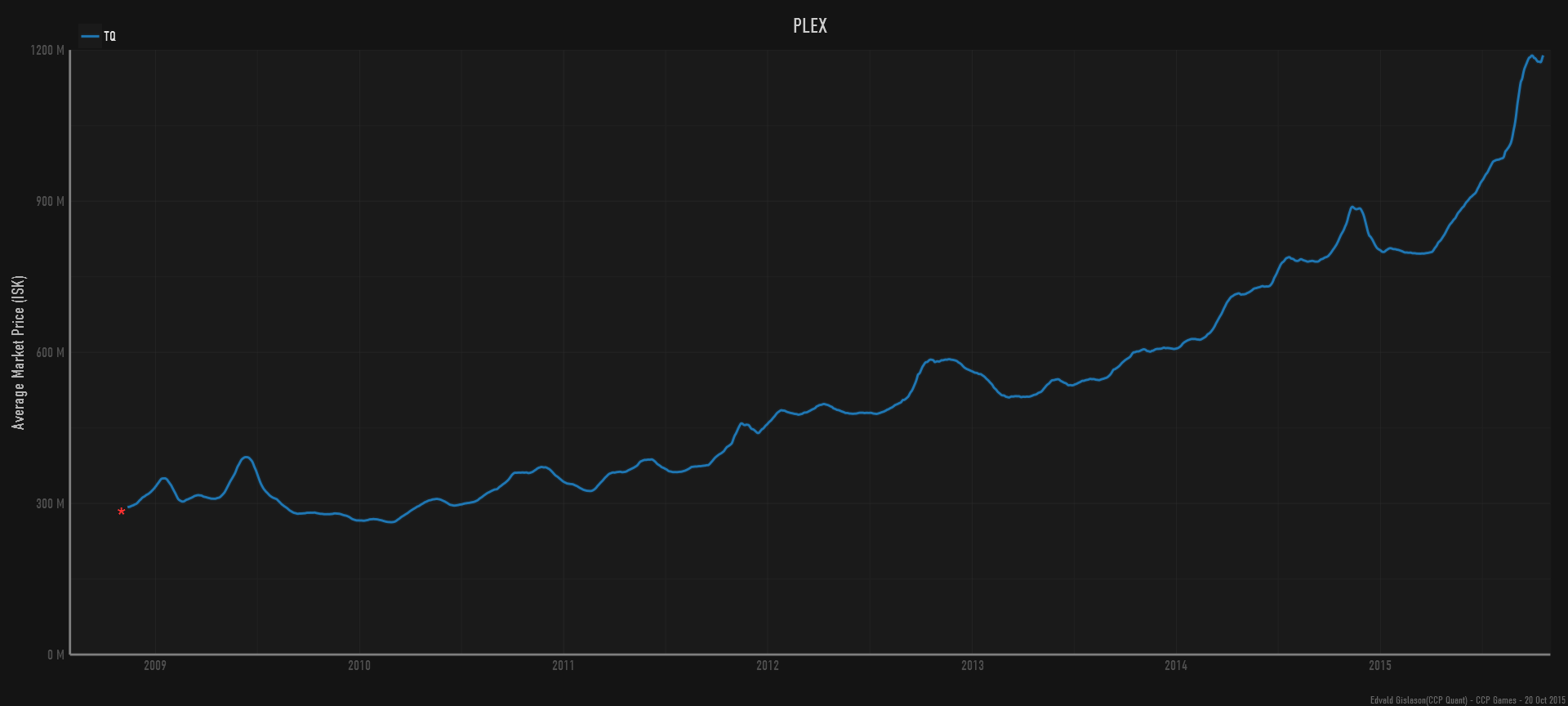
In the sample month shown above, the amount of ISK in the economy increased from 870T to 876T (0.7%). This is not a significant level of currency printing - but currency printing isn't part of the definition of inflation, 'spending power' is. Fortunately, they also include the price of PLEX over time in this post:

http://content.eveonline.com/www/newssystem/media/68738/1/pl...

Estimating by visual inspection only, the price of ISK rose unusually quickly between June 2015 and October 2015, from 900M to 1200M, where it promptly flatlined. They decline to explain why this is - however, the current price today, over a year later, is 1300M:

http://www.eve-markets.net/detail?typeid=29668&limit=14#hist...

So whatever inflation occurred during that window of time has apparently returned to normal levels. Looking up the definition of hyperinflation on the Internet (I'm not an economist), the generally accepted definition seems to be a monthly inflation rate of 50% of the price of a given good, assuming a fixed spending power.

While it's impossible to say above with certainty that spending power remained constant, assuming that, the price of ISK would have had to increase from 900M to 1350M in one month to count as hyperinflation by the usual definition. There have been no indications that the EVE economy has reduced the spending power of its users, given their continuing efforts to feed users a steady trickle of additional ISK in the economy each month. So with the current price of PLEX one year later not yet having reached 1350M, it seems safe to hazard a guess that 'hyperinflation' - in PLEX, at least - is not applicable to their economy.
Re: Eve Evolved: Analysing Eve's New Economic Reports

#23
post #10

Earlier quoted context omitted.

I'd be interested to know the parts of Eve's economic system only 'kind of work'. I just checked the isk price of plex, it's only about 40% higher than it was 3 or 4 years ago when I last played. The yearly graph looks like a nearly perfect sine wave. I just spot checked the ships I used to fly and all of them are the same price or slightly cheaper than they used to be. Frankly, for a system where the only way to get…

That's pretty good, and probably the best run MMO economy out there. However, there were still problems. Most of the great faucets are not risk free endeavors, and efficiently exploiting them requires expensive ships that are completely lost when you screw up or are murdered.* The really good faucets in nullsec when I was playing in the mid-oughts were largely dominated by big alliances. There wasn't as much opportun…

The lack of money printing wouldn't prevent groups of people from coalescing into big blobs and gaining a competitive advantage. In fact, I'd assert it makes it even worse.

Imagine a sufficiently large alliance in your idealized game that by hook and crook "surrounds" your central bank. All new money in the economy passes through them. Sure you can finely control inflation, but without helicopter money you have no knobs you can twist to control wealth inequality in such a situation. Even if you do use helicopter money tactics, you'll be in a constant arms race with the big alliances to try and distribute the money as far away from them as possible.

Long term players having big piles of cash really causes a lot of price dysfunction in my mmo experience. Eventually all the goods and materials that aren't required for end game play approaches a price of zero, where everything else gets more and more and more expensive as money loses value for the people who have it in abundance.

As for the arbitrage thing -- price in nullsec for capital goods was 10-20% higher than it was in empire. Having an operation that hauls replacement ships, mods etc out to nullsec, and nullsec resources back to empire was an easy way to make billions if you were set up to move enough volume. I could easily make more money moving goods in my carrier than using the carrier for combat.

Eve's combat system is a piece of design brilliance in and of itself. Battleships struggle under most circumstances to destroy frigates. Each ship size tier is loosely isolated from the other tiers by tracking constraints. Drones blur this a bit, but even though that guy spent 100m on that battleship and you spent 250k on your rifter -- he's probably not going to instapop you. Chances are he can't hit you. Your mobility makes you generally more of a threat to him than he is to you if you're tracking and tackling and people are backing you up!

In terms of other mmo's, FFXIV made some good decisions but suffers from inflationary currency problems because the lack of gil sinks. High level crafting uses tons of low level materials, so new crafters can still make a profit off turning iron into screws or whatever. They do it really broadly so there's a whole lot of goods and materials that still churn on their auction house for non 1,inf prices.

I haven't played WoW in a while, but low level ores and used to be pointless to the endgame players, so the prices on them zoomed towards zero.

I think eve is a pretty boring game, but I have never seen an mmo that did a synthetic economy better. If you manage it I'll be the first to carry your banner to future mmo economic discussions ;)

Re: Eve Evolved: Analysing Eve's New Economic Reports

#24
post #7

Eve's player-based economy is really badass, to the point that they have an economist on staff to generate reports like these. CCP found a great way to combat RMT (real money trading) rampant in MMOs where you buy in-game currency with real-world money with the introduction of PLEX (aka Pilot License). Basically, you can pay ~$15 for an in-game PLEX, which when "used" adds 30 days of game-time to your account subscri…

Eve's player-based economy is really badass, to the point that they have an economist on staff to generate reports like these. I just read somewhere that their economist left in 2014.

His name:

Eyjolfur Gudmundsson

Rector at University of Akureyri

IcelandComputer Games

Current: University of Akureyri

Previous: CCP

https://is.linkedin.com/in/dreyjog

----- Dr. EyjoG felt an itch to apply some of the lessons he’d learned at Eve to the world of higher ed. So when Akureyri advertised for a new president in 2014, he once more found himself jumping industries.

http://web.uri.edu/quadangles/the-virtual-economist/

Re: Eve Evolved: Analysing Eve's New Economic Reports

#25
post #7

Eve's player-based economy is really badass, to the point that they have an economist on staff to generate reports like these. CCP found a great way to combat RMT (real money trading) rampant in MMOs where you buy in-game currency with real-world money with the introduction of PLEX (aka Pilot License). Basically, you can pay ~$15 for an in-game PLEX, which when "used" adds 30 days of game-time to your account subscri…

When did they add this? World of Warcraft introduced a similar system a year or two ago.

Re: Eve Evolved: Analysing Eve's New Economic Reports

#26
post #25
post #7

Eve's player-based economy is really badass, to the point that they have an economist on staff to generate reports like these. CCP found a great way to combat RMT (real money trading) rampant in MMOs where you buy in-game currency with real-world money with the introduction of PLEX (aka Pilot License). Basically, you can pay ~$15 for an in-game PLEX, which when "used" adds 30 days of game-time to your account subscri…

When did they add this? World of Warcraft introduced a similar system a year or two ago.

Plex was ~8 years ago. But, they had older system GTC going back to I think 2004 or 2006.

The real issue is some people could make that much cash in 30-90 min, but only really needed 1-3 plex per month, which kind of destabilized the system.

Re: Eve Evolved: Analysing Eve's New Economic Reports

#27
post #2

"At the end of February 2016, the total liquid ISK in the EVE Online economy was 948.043 trillion ISK (equivalent to $16.45 million using PLEX conversion)." find this fact mind boggling!

Meh. It's a by-product of the typical hyperinflation you get when you try to devise an economy where everyone gets to print as much money as they care to. (Which is what MMO grinding for cash basically amounts to.) Their trying to peg ISK to real world money through PLEX is a typical strategy to try and counteract this, which also typically kind-of works, but only typically kind-of. https://www.youtube.com/watch?v=su…

Rather than avoiding printing money, I'd suggest considering using feedback loops to try to control the economy.

One of the core problems with a simulated economy is that it can't ever really be a real economy as long as it has significant chunks of the economic transactions coming from programs rather than people. There's always a border between the humans and the machines, and I think a lot of the silliness of MMO economies comes from that border, and the way it can be exploited, rather than the economic issues themselves.

For instance, in the real world, there is no such thing as a fixed price. You can't wake up one day, harvest a bushel of apples, and take it down to the fruit stand down the street to sell for $5, regardless of all other economic conditions. That bends the economy. In the real world, you can't buy an unbounded number of apples for $10 a bushel. That bends the economy. In the real world, if you sell a bushel of apples, it doesn't essentially disappear from the Prime Material Plane, it has to be transported to someone else who wants it, without destroying the apples, before they go bad. That bends the economy.

The inaccuracies are fundamentally unfixable in some sense, but they could probably be mitigated by trying to put in a feedback loop where things get more expensive as more people buy them, and get cheaper as fewer people buy them. If done correctly, this would also prevent the problem where you have to explicitly create and manage sinks; you let the economy figure out the sinks for you.

It would also almost certainly be dynamically unstable, with some things being under- or over-priced all the time in various cycle... but this can be seen as advantage for a game as much as it can be seen as a disadvantage. Some very clever thinking might even let you exert some control over the cycles and do things like try to ensure they don't all end up in sync (i.e., consider the equations for simple harmonic motion and how you can affect the "k" constant for different commodities).

The other thing I'd consider would be implementing storage fees (which themselves float) to prevent hoarding and gathering excessive wealth, probably structured as a progressive tax, too. Or at the very least, make it a knob you can crank and tell people it may change on a day-by-day basis.

Re: Eve Evolved: Analysing Eve's New Economic Reports

#28
post #14

Earlier quoted context omitted.

Seems like they've found a way to anchor their currency to something more tangible like USD, using fungible game time. Fascinating. Has anyone set up automated currency exchanges in the game?

Anchoring the in-game currency is one of the main strategies for preventing in-game currency inflation: https://www.youtube.com/watch?v=sumZLwFXJqE Instead of paying player characters to grind, and therefore have players consume game content, why aren't we paying players to create game content?

One of the issues is it tends to make boring games. I had a conversion with one of EVE's old developers who basically said, the company did not really care about growing the player base as long as they can keep going. In the end it's different largely because they are not trying to be a 'successful' company, instead of kind of a profitable hobby.

City of Heroes had some player based content, which also fell flat on it's face. That was in part due to engine limitations but also the difficultly in making interesting content instead of just a lot of new content.

Re: Eve Evolved: Analysing Eve's New Economic Reports

#29

Earlier quoted context omitted.

Eve's player-based economy is really badass, to the point that they have an economist on staff to generate reports like these. I just read somewhere that their economist left in 2014.

His name: Eyjolfur Gudmundsson Rector at University of Akureyri IcelandComputer Games Current: University of Akureyri Previous: CCP https://is.linkedin.com/in/dreyjog ----- Dr. EyjoG felt an itch to apply some of the lessons he’d learned at Eve to the world of higher ed. So when Akureyri advertised for a new president in 2014, he once more found himself jumping industries. http://web.uri.edu/quadangles/the-virtual-ec…

See also: Yanis Varoufakis

http://www.ibtimes.co.in/valve-economist-yanis-varoufakis-ap...

Re: Eve Evolved: Analysing Eve's New Economic Reports

#30
post #26
post #25

Earlier quoted context omitted.

When did they add this? World of Warcraft introduced a similar system a year or two ago.

Plex was ~8 years ago. But, they had older system GTC going back to I think 2004 or 2006. The real issue is some people could make that much cash in 30-90 min, but only really needed 1-3 plex per month, which kind of destabilized the system.

EVE has had formalized rules and forums for GTC trading dating back to roughly 2004 or so, at least. There was nothing automated but it was 100% officially sanctioned and scamming in a GTC-for-ISK in the official forum would get you banned.

That actually made it rather unique in EVE, where the official line was "trust no-one" and social engineering was officially encouraged. Actually hacking is over the line, but subterfuge, social engineering, and privilege exploitation have brought down superpower alliances in EVE.

Most famously: BOB. The Mittani sends his regards. (RIP vilerat - your horrible tattoo will never be forgotten)

Post reply on HN