The auction model for ads basically ruins internet searches in transactional categories. If you want to win at the "italian restaurant" search game, you have to bid the highest for the ad, which means you must have the highest margin. The best way to win is to open a restaurant with ridiculously high margins (over priced wine and cheap ingredients). Want the "cheapest car insurance"? Google is zero help. It sends you…
I've long ago taken this approach to all ads myself. Whenever I'm forced to see an ad (because I block or skip ads as much as I possibly can) then I make a mental note not to buy from that company. Whenever I go to buy something, I always go for a brand I've never seen in an ad. I find that this on average saves me money.
How Google is Killing Organic Search
191–200 of 220 posts
Re: How Google is Killing Organic Search
#192Earlier quoted context omitted.
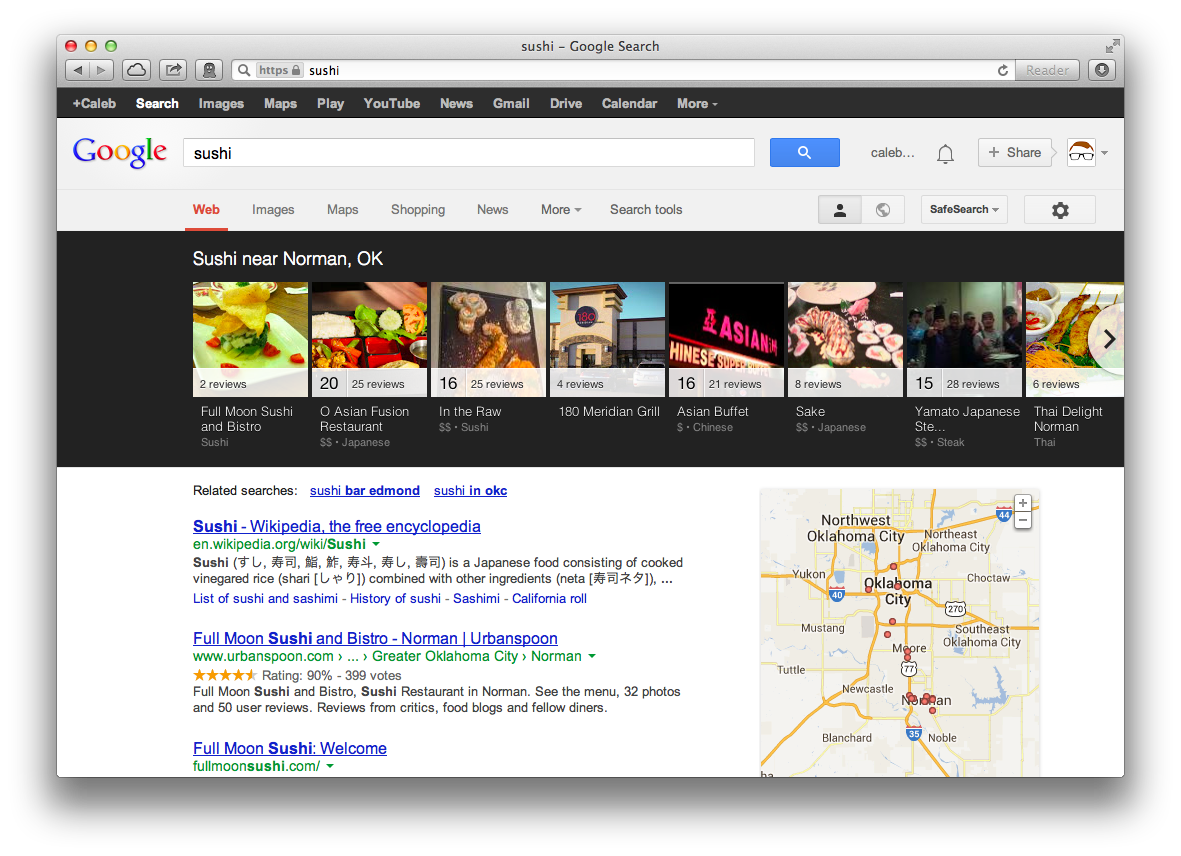
It used to be, when you clicked a link on Google, you left Google to go elsewhere. Now, you search for something like sushi, then go to Google Maps, then see the phone number, then call. I'm not _necessarily_ saying this is bad or unwanted, but it's a vast philosophical and product shift for Google. And it has implications for the trustworthiness and long-term usefulness of Google. I do not welcome a future where Goo…
Or you can go to the restaurant's website through the link either on the SERP or Maps page... 8/10 though I don't want to see what Wordpress template a restaurant is using this week, I just want to know if it's open, what other people think about it and how to get there. I find this SERP to be vastly more useful than how it used to be. Restaurant owners should too, I no longer will skip visiting your place because yo…
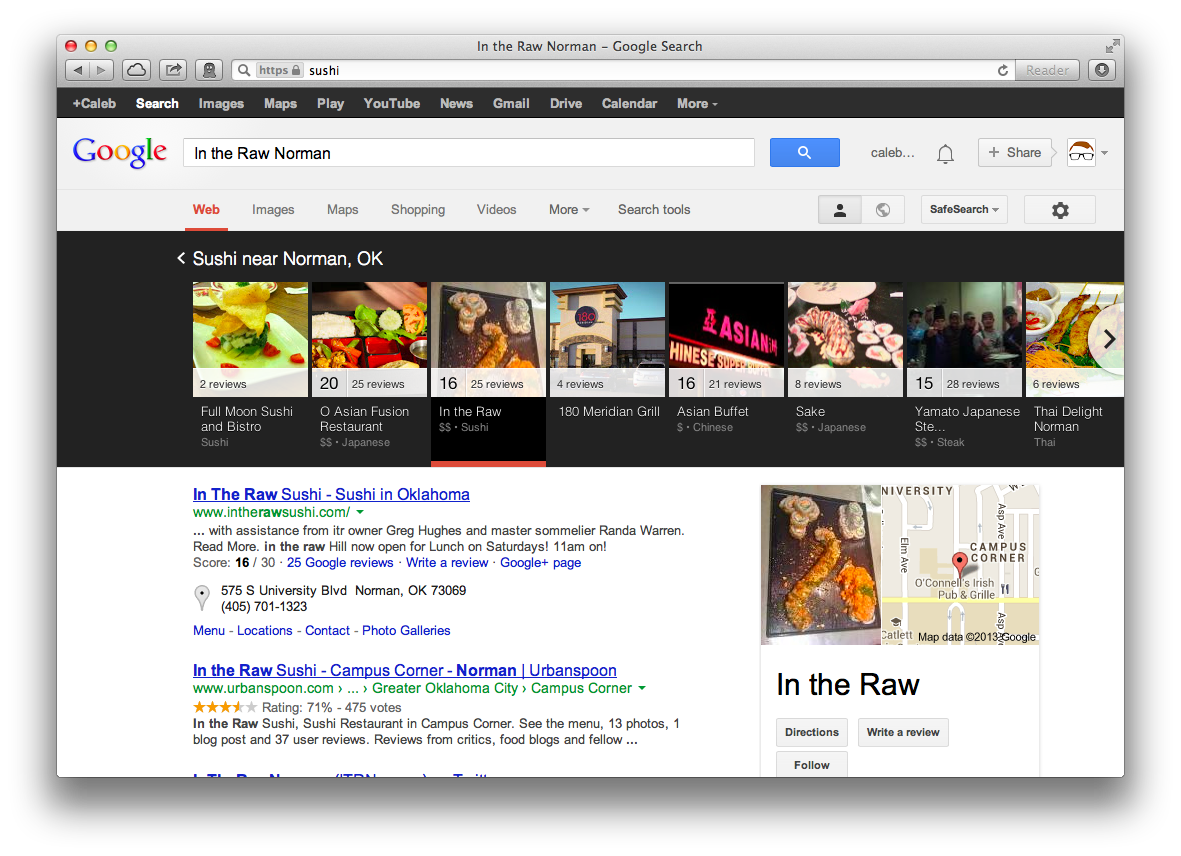
There are no links to restaurant's websites on that SERP page. Except one link to a Facebook page nearly falling off the bottom of screen.
If you click the photos or the red balloons on the map you won't go to the restaurant's webpage, but to another page on Google that presumably has more information. Sometimes the link to the restaurant's webpage isn't there either and I have to use yet another query (name of restaurant + location) to find the actual webpage.
The point/complaint of the article is that Google's results seems to be less and less coming from the Web as their index and more and more from information sources that Google controls.
Even though the change for the typical end-user might be small ("I can find the same stuff"), if continued, it signals a huge change in what Google is. It used to be a service to help you execute a text search over billions of documents, which I still think is a very neat thing to be able to do.
Re: How Google is Killing Organic Search
#193Earlier quoted context omitted.
It used to be, when you clicked a link on Google, you left Google to go elsewhere. Now, you search for something like sushi, then go to Google Maps, then see the phone number, then call. I'm not _necessarily_ saying this is bad or unwanted, but it's a vast philosophical and product shift for Google. And it has implications for the trustworthiness and long-term usefulness of Google. I do not welcome a future where Goo…
It's not really a philosophical shift at all, but a realization of the types of results Google has always wanted to give. People have this idea that Google always was, and always should be, intended to direct people to web sites, when all along the company has said they want to organize the world's _information_. Web sites just happened to be the easiest thing to do first, but the fact that they bought a mapping comp…
Not another website listing them, not dots on a map with phone and address (although that is also useful), I want the actual sites, so I can compare them, see their menus and whatever else they have decided to share with visitors.
I don't think I ever got a result like that from Google when searching for + , it's always been just a few restaurants mixed with way more restaurant-listing-sites.
But currently Google sort of tries to hide them, it takes you a few clicks before you get to a link to a restaurant site. So no quickly opening 5 of them in background tabs, for instance.
Re: How Google is Killing Organic Search
#194Earlier quoted context omitted.
I've found DDG to be better at finding obscure content, and the Goog to be better at finding what I call "canonical" content. For example, if I search for "binary tree" I probably want Wikipedia followed maybe by StackExchange. Google does that, while DDG sends me deep into the netherworld.
One awesome thing about DDG is their !bang searches. It won't automate an unknown search, but if you know the first thing you're going to want is the Wikipedia entry you just search ["binary tree" !w]; for related StackExchange questions ["binary tree" !so]; you can even do a straight goggle search ["binary tree" !g]. For the available !bangs check out - https://duckduckgo.com/bang.html
All you need to do on a website with a search box is to right-click on that search box -> Add Keyword for this Search... and then add a shortcut.
The cool thing about it is that it is extensible. You don't need to settle for the fixed "bangs" that DDG provides. For example, I have a "dex" shortcut for searching an online dictionary of my native language.
Also, it takes less time to add a shortcut of interest than it is to read the DDG documentation page to find out the right bang for you.
If you care about privacy, then this is also a no-brainer, since you don't go through a third-party server anymore.
Re: How Google is Killing Organic Search
#195Earlier quoted context omitted.
The best way to win is to open a restaurant with ridiculously high margins (over priced wine and cheap ingredients). That's a rather terrible example: a restaurant that had over priced wine and cheap ingredients would fail miserably in short order, regardless of how many Google ad auctions they won. If you really want the cheapest car insurance, you need to find a company that doesn't advertise, and is non-profit I d…
> a restaurant that had over priced wine and cheap ingredients would fail miserably in short order, regardless of how many Google ad auctions they won. unless if there's so many restraurants, and the quality of wine is so subjective that most customers cannot really differentiate it. Then exposure is really the only thing a (time poor) customer can rely on, and thus, by massively spending on advertising, and not on i…
That would make it even more of a money arms race. Ultimately you want something like personal recommendations where people attach their own reputations to their recommendations; google is trying to push something on these lines with google+.
Re: How Google is Killing Organic Search
#196Earlier quoted context omitted.
Well, thereby hangs a tale. But the short answer is that, by and large, Google seems to be aggressively uninterested in scraping that kind of structured/semantic data from the public Web. In fact it even seems to have been active in trying to prevent that kind of data from finding its way into webpages at all: remember the arcane but nasty scrap about metadata in HTML5? Well, this is what that was all about.
Scraping/doing it semantically has copyright implications (Re: Europe) so realistically the Google-owned approach is the most viable one.
User-agent: * Disallow: /
Re: How Google is Killing Organic Search
#197Earlier quoted context omitted.
You provide payment using the card. The card expires and can't - supposedly - be used beyond the expiry date to make a payment. There is no expectation of continued payment beyond the expiry date. Guessing the new expiry date in order to exact a payment is taking an unauthorised payment. It can't be authorised because the card-holder can't authorise payments beyond the expiry date. Taking a payment that isn't authori…
No, you provided initial payment using the credit card account, but you signed up for the service until you cancel it, not until your method of payment expires. Even if you cancelled the card outright, you're generally technically (and legally) still on the hook for a subscription if you don't go and cancel. Read the ToS for just about any recurring subscription. It's your obligation to cancel, not their obligation t…
You have a remarkably apologetic attitude towards a scumbag industry.
Just to be clear, here's the modus operendi for the retention industry-
1) Trick or outright scam people into recurring subscriptions. I never told Consumer Reports I wanted my subscription to recur, and it provides absolutely zero value to me that they did so. If they hid text somewhere for this, it is a clear and obvious example that the industry desperately needs onerous rules and restrictions prohibiting this, such as a customer yearly opt in and double-positive recurrence opt-in (rather than some hidden subtext that oh by the way we have your credit card so have fun cancelling sucker).
2) Hide methods of cancelling said subscription behind as many layers as possibly: It is shocking how easy it is to sign up for many things versus what is needed to cancel the same (as if charges on my credit card are less of an issue for me than the possibility that online access might be temporarily delayed). In Consumer Reports case, you could not email or fill out an online form -- the single and only option was a limited hours telephone number that required lengthy wait times. They know that many people will avoid the time sucking tax. Xbox Live had a particularly hilarious system where not only did you have to phone a call center and sit on hold, your cancellation had to be immediate (despite the fact that all payments were for future services, when you disabled recurrence they immediately downgraded your account) which of course is meant to delay people from jumping through the hoops until the last day when they might forget or give up and boom, another month.
While much noise was raised about Apple shaking down the subscription industry on the iOS platform, they will have to simply eat that cost because people like me have absolutely zero trust in the industry, and I greatly respect how Apple not only constantly reminds me of subscriptions, they make cancelling any of them the easiest thing in the world, so those services that want subscribers need to actually work
Recurrence is a tax on the world. It is inefficient and obnoxious companies that turn their business model towards unsavoury tactics rather than actually providing value that keeps people from wanting to be their customer.
1) By reading this post you agree to subscribe to future posts at the economical cost of $14.49 per month, billed bi-annually.
Re: How Google is Killing Organic Search
#198Earlier quoted context omitted.
I find this interesting. I didn't think of Google local listing as not organic but I did the search in the article[1] and sure enough it takes a lot of the real estate. Perhaps, Google could publish a standard way to write your own self-hosted Places page? We will still have questions on how the ranking will work and whether Google will prioritize its own Google+ place pages over self-hosted place pages but I think t…
Well, thereby hangs a tale. But the short answer is that, by and large, Google seems to be aggressively uninterested in scraping that kind of structured/semantic data from the public Web. In fact it even seems to have been active in trying to prevent that kind of data from finding its way into webpages at all: remember the arcane but nasty scrap about metadata in HTML5? Well, this is what that was all about.
Re: How Google is Killing Organic Search
#199Measuring the usefulness of a page by percentage of screen real estate only seems useful if the user is looking or clicking randomly around the screen. The structure, layout, and clarity of communication are far more important. > 7% is all that’s left for the entrepreneurs and restaurantuers who believed Google over the years when they were told that good business with well structured pages would be able to get in fr…
> Measuring the usefulness of a page by percentage of screen real estate only seems useful if the user is looking or clicking randomly around the screen. You should tell Google that. They claim to be penalizing web sites with too many ads "above the fold": http://searchengineland.com/google-may-penalize-ad-heavy-pag... The bigotry in this has been pointed out by many people already ... Google is basically forcing oth…
Re: How Google is Killing Organic Search
#200Earlier quoted context omitted.
Or you can go to the restaurant's website through the link either on the SERP or Maps page... 8/10 though I don't want to see what Wordpress template a restaurant is using this week, I just want to know if it's open, what other people think about it and how to get there. I find this SERP to be vastly more useful than how it used to be. Restaurant owners should too, I no longer will skip visiting your place because yo…
> Or you can go to the restaurant's website through the link either on the SERP or Maps page... There are no links to restaurant's websites on that SERP page. Except one link to a Facebook page nearly falling off the bottom of screen. If you click the photos or the red balloons on the map you won't go to the restaurant's webpage, but to another page on Google that presumably has more information. Sometimes the link t…
Initial search: http://files.calebegg.com/sushi-search.png
After clicking an item: http://files.calebegg.com/sushi-result.png
At least use the damn feature before you join in bashing it.