OCR is not a great name for these models. While they can do traditional OCR such as digitize and scanned PDF for example, they do so much more.
>they do so much more I'm not familiar. What else are they good for?
They can take something like an image of a graph and provide a description of it. From my understanding, these are multimodal models with reasoning capabilities.
Yeah, but handling macOS is a infrastructure-capacity sucks, Apple really doesn't want you to so tooling is almost none existing. I've setup CI/CD stacks before that needed macOS builders and it's always the most cumbersome machines to manage as infrastructure.
AWS literally lets you deploy Macs as EC2 instances, which I believe includes all of AWS's usual EBS storage and disk imaging features.
Alright, so now the easy thing is done, now how do you actually manage them, keep them running and do introspection without resorting to SSH or even remote desktop?
AWS literally lets you deploy Macs as EC2 instances, which I believe includes all of AWS's usual EBS storage and disk imaging features.
Alright, so now the easy thing is done, now how do you actually manage them, keep them running and do introspection without resorting to SSH or even remote desktop?
How do you manage any EC2 instance “without resorting to SSH”? Even for Linux EC2 instances, the right answer is often tools like Ansible, which do still use SSH under the hood.
Looks great, but looking at the benchmark, can’t help but think about how crazy good dots-ocr is as a model. Too bad they’re not as open as the Deepseek team because its so crazy good and would love to know how it was trained.
If you look you'd notice that it's the same Haoran Wei behind DeepSeek-OCR and GOT-OCR2.0 :p
Classical OCR still probably make undesirable su6stıtutìons in CJK from there being far too many of similar ones, even some absurd ones that are only distinguishable under microscope or by looking at binary representations. LLMs are better constrained to valid sequences of characters, and so they would be more accurate. Or at least that kind of thing would motivate them to re-implement OCR with LLM.
Huh... Would it work to have some kind of error checking model that corrected common OCR errors? That seems like it should be relatively easy.
It's harder then it first seems. The root problem is that for text like "hallo", correcting to "hello" may be fixing an error or introducing an error. In general, the more aggressive your error correction, the more errors you inadvertently introduce. You can try and make a judgement based on context ("hallo, how are you?"), which certainly helps, but it's only a mitigation. Light error correction is common and effective, but you can't push it to a full solution. The only way to fully solve this problem is to look at the entire document at once so you have maximum context available, and this is what non-traditional OCR attempts to do.
Huh... Would it work to have some kind of error checking model that corrected common OCR errors? That seems like it should be relatively easy.
It's harder then it first seems. The root problem is that for text like "hallo", correcting to "hello" may be fixing an error or introducing an error. In general, the more aggressive your error correction, the more errors you inadvertently introduce. You can try and make a judgement based on context ("hallo, how are you?"), which certainly helps, but it's only a mitigation. Light error correction is common and effect…
Okay, but there way more common errors that should be easy to fix. "He11o", "Emest Herningway", incorrect diacritics like the other person mentioned, etc.
The paper is more interesting than just another VLM for OCR, they start talking about compression and stuff. E.g. there is this quote >Our work represents an initial exploration into the boundaries of vision-text compression, investigating how many vision tokens are required to decode text tokens. The preliminary results are encouraging: DeepSeek-OCR achieves near-lossless OCR compression at approximately 10× ratios,…
Text tokens are quantized and represent subword units, vision tokens only exist in the embedding space. The way text tokenization works in LLMs is that you have a "lookup table" of (small) token ids to (large) vector embeddings. To pass text to the LLM, you split it at token boundaries, convert strings to token ids, and then construct the "context", a matrix where each row is a vector taken from that lookup table. Tr…
That's not really true, the latest autoregressive image models create a codebook of patches that are then encoded as tokens and image is assembled out of them.
My impression is that OCR is basically solved at this point. The OmniAI benchmark that's also referenced here wasn't updated with new models since February 2025. I assume that's because general purpose LLMs have gotten better at OCR than their own OCR product. I've been able to solve a broad range of OCR tasks by simply sending each page as an image to Gemini 2.5 Flash Lite and asking it nicely to extract the content…
OCR for printed documents is super robust, but handwriting, low res, and aligned recognition (not just image to "hello world" but also having "h is here in space e is here in space...) are all still well behind "basically solved."
I figured out how to get this running on the NVIDIA Spark (ARM64, which makes PyTorch a little bit trickier than usual) by running Claude Code as root in a new Docker container and having it figure it out. Notes here: https://simonwillison.net/2025/Oct/20/deepseek-ocr-claude-co...
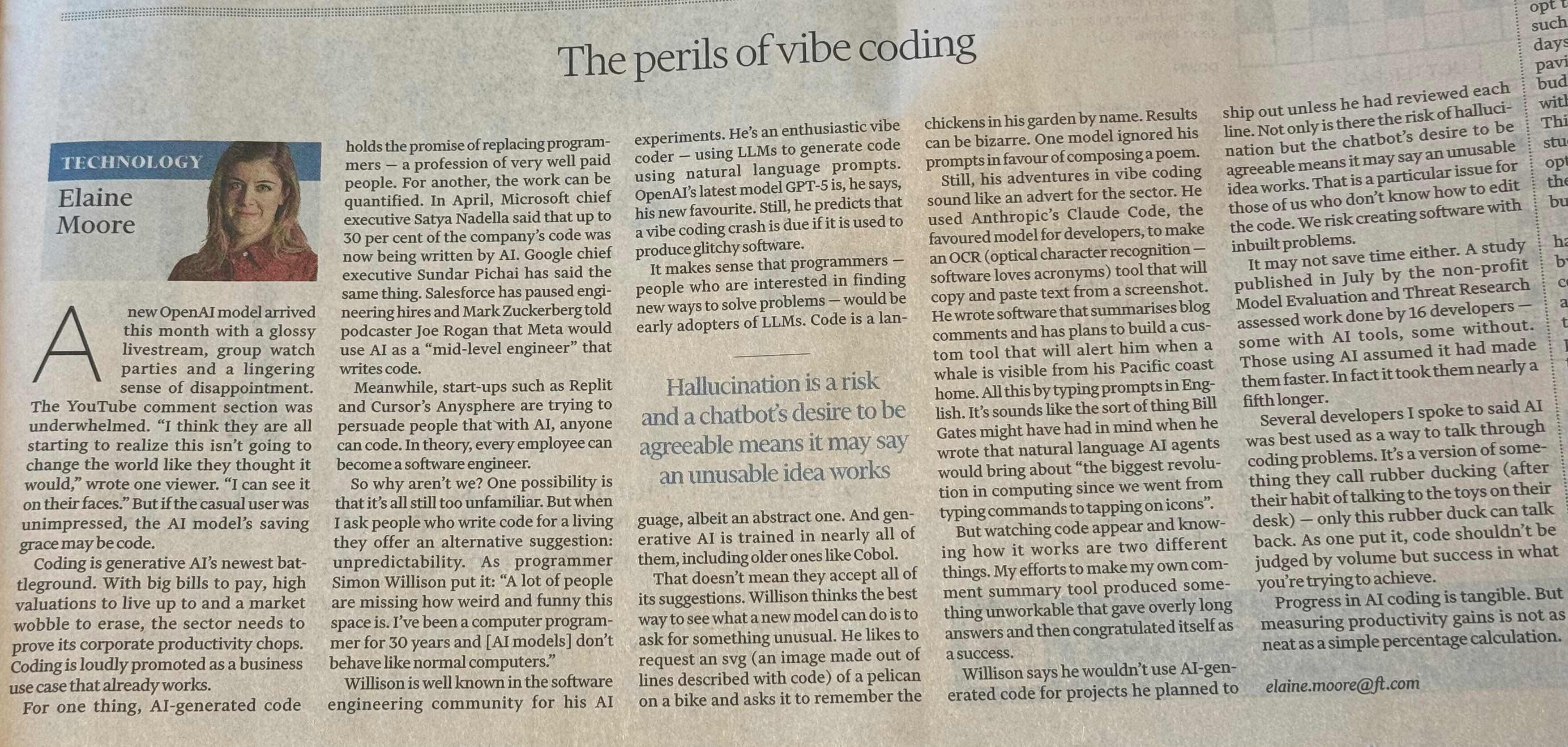
I figured out how to get this running on the NVIDIA Spark (ARM64, which makes PyTorch a little bit trickier than usual) by running Claude Code as root in a new Docker container and having it figure it out. Notes here: https://simonwillison.net/2025/Oct/20/deepseek-ocr-claude-co... Here's a result I got https://github.com/simonw/research/blob/main/deepseek-ocr-nv... - against this image: https://static.simonwillison.n…
Looks like this did really solid, with the exception of the paragraph directly below the quote. It hallucinated some filler there and bridge it with the next column.