Live data from Hacker News

Feds help health insurers hide their dirty secret: denials on the rise

nypost.com

191–200 of 301 posts

Re: Feds help health insurers hide their dirty secret: denials on the rise

#191
This is an opinion piece. Its main claim is that the ACA requires denial rates to be available to consumers but they aren't.

Additionally, it reports that denial rates have increased 10x in 10 years, based on the following chain:

- "UnitedHealthcare nixed 1.1%, Humana 1.9%, Aetna 1.5% in 2013, per the American Medical Association."

- "By 2022, major insurers were refusing to pay, on average, 15% of claims, according to a national survey of hospitals and health-care providers by Premier, an insurance consultant."

- "The figure continues to shoot upward, with some companies today denying almost _half_ of all claims, according to researchers at the Kaiser Family Foundation."

Furthermore, "few people appeal, but of those that do 41% obtain a reversal", which suggests the denials may be unfair.

I certainly would like to know the denial rates when selecting an insurance provider. As the article says, "You aren't really insured if your insurer can deny valid claims with impunity."

Given that the ACA requires this information be provided, it certainly ought to be provided. Then we'd have a much clearer picture.

It's an opinion piece on a news site known for inflammatory articles but it reports some interesting information. It would be much nicer if it included references to the research it's based on, but it seems pretty reasonable to me.
Re: Feds help health insurers hide their dirty secret: denials on the rise

#192
post #59

I think we need more thorough analysis. Are the denied claims denied in error? The appeals success rate probably indicates that most of the appealed denied claims were denied in error... but appealed claims are a biased sample of denied claims, so it doesn't tell us much about the overall denied claims. In my experience, I've seen some denied claims, because the provider submitted a wrong code. Then the provider subm…

"A key congressional committee asked insurance giant Cigna on Tuesday to provide corporate documents so that lawmakers can examine the company’s practice of denying health care claims without ever opening a patient file." https://www.propublica.org/article/cigna-health-insurance-de...

[deleted]

Re: Feds help health insurers hide their dirty secret: denials on the rise

#193

Earlier quoted context omitted.

Roger that. I’m against vigilante killings because I don’t want to live in that kind of a society. But a couple days later, Anthem decided to end their insane time limits on anesthesia. I’m hoping the public’s reaction to all these events has put a bug in the ear of politicians who ran partly on the idea of “repeal the ACA”: maybe this isn’t a great time to start slashing coverage. People seem pretty upset about it r…

I agree with your general points, but if we can trust Vox, the Anthem situation wasn't quite what people thought. The policy was to prevent overpayment to anesthesiologists, because they get paid partly by the hour and there's evidence that they tend to inflate their times. The policy would not have increased costs to patients, because of this: > “Say there is a contract between an insurance company like Anthem and a…

Vox might be right but under no circumstances would a company admit "hey we're changing this unpopular decision because we're personally afraid of being killed". Tying good patient outcomes to dead CEOs would be literally suicidal for Anthem execs.

Re: Feds help health insurers hide their dirty secret: denials on the rise

#194
post #65

Earlier quoted context omitted.

There are lots of people who get freaked out and go to the hospital for every little thing. We used to have a term for that: "hypochondriac." Now it's become socially acceptable, so you don't hear the term as much. Everyone knows Americans pay the most for medical treatment, but the life expectancy is not that high. If you know your behavior isn't good for you, but you can't stop yourself, well, that's an addiction.

> Everyone knows Americans pay the most for medical treatment, but the life expectancy is not that high. Sure. > If you know your behavior isn't good for you This doesn't follow. Our healthcare system might be worse than some but that does not imply it's bad for you. That same logic would imply getting punched in the face is good for you because it's better than getting shot.

> Our healthcare system might be worse than some but that does not imply it's bad for you.

Well, if you have that mindset, then you'll never achieve anything better, will you? It's not necessarily bad for us, so we'll just keep doing it.

It's like the people who vote for the same set of loser politicians every 4 years and then complain that nothing ever changes.

Re: Feds help health insurers hide their dirty secret: denials on the rise

#195

It shouldn't even be legal for health insurance providers to deny claims. It's essentially them practicing medicine without a license, because they're making calls about what healthcare a person needs or doesn't need, only a person's doctor(s) should be able to make those decisions.

Otoh some medical providers like to over bill and over treat.

Yes, insurance companies deny claims, but this is mostly because they don't have the money to pay for things most of their money is spent on care in the first place: they're forced to optimize and people get hurt in the process. Providers do far more damage.

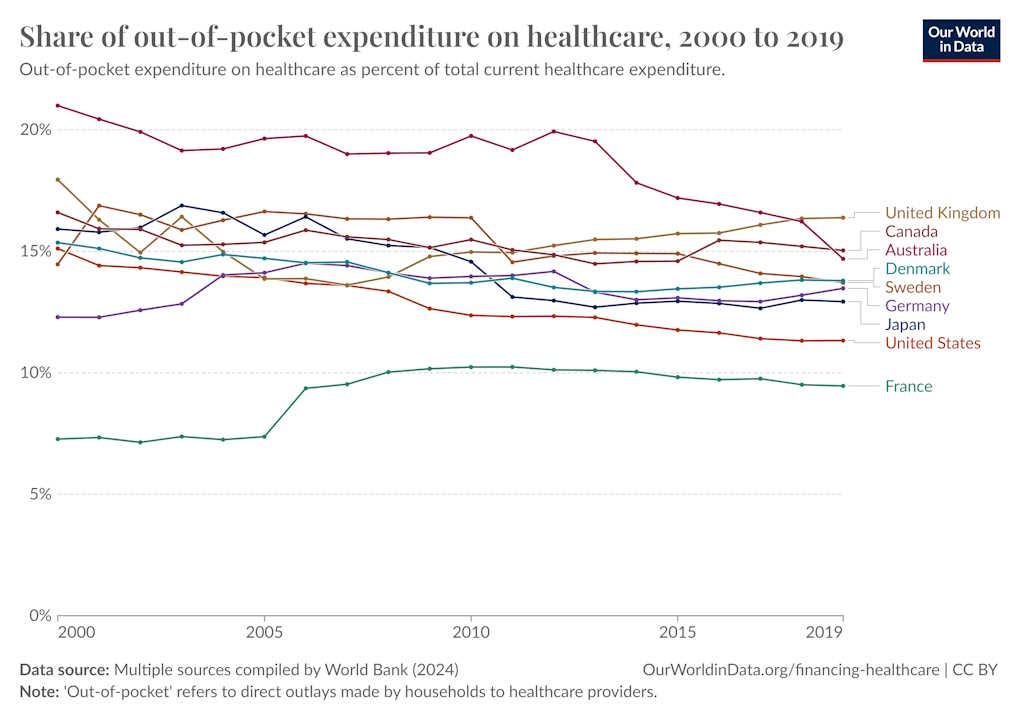
UHCs profit margins are only 6%, their operating costs are extremely low[0], and if you look across G7 insurers in the US pay more than the government does in every country but France![1] Compare this to HCA which makes an average margin of 10% with far higher administrative costs. The CEO of HCA makes $20M, Brian Thompson made $10M by contrast.

This is not to say we (and insurance companies) don't spend astronomically more than other countries: providers are to blame for this, and I have seen their nonsense first hand:

- They keep people alive overnight to charge insurance more

- Some hospitals use ML (!) to optimize ICD codes for billing. Most do this by hand: there's literally a job and training to be an ICD coder.

- They allow people to deteriorate (e.g. dialysis) to charge more (no preventative care.) I have seen a hospital only provide preemptive care to patients at risk of dialysis because they were part of their own insurance pool

- Their administraive expenses are far higher.

- They test and provide unnecessary care.

- Physician shortage is in part caused by limited residency spots, a dumb bachelors requirement, and high tuition costs. These barriers to entry are imposed by physicians.

- Uneccesary tech and equipment upgrades (e.g. we need to replace your knee with a new knee)

- Having to deal with tons of different insurance companies: not their fault but they don't know how to handle this efficiently.

[0]: https://www.reddit.com/r/dataisbeautiful/comments/194wucn/oc...

[1]: https://substackcdn.com/image/fetch/f_auto,q_auto:good,fl_pr...

Re: Feds help health insurers hide their dirty secret: denials on the rise

#196

Earlier quoted context omitted.

You were not denied a colonoscopy, but anesthesia during a colonoscopy, which is not medically necessary[1]. Tough line to draw though. 1: https://www.mayoclinichealthsystem.org/hometown-health/speak... .

It does seem like the parent is confused. I haven't heard of any jurisdiction where putting someone under for colonoscopies, outside of extreme cases, is the standard expectation. Not even for fancy private hospitals, way too high of a risk-reward ratio.

I think we're confusing general anesthesia (not generally used for colonoscopies in the US) with sedation with something like propofol which is pretty common.

Re: Feds help health insurers hide their dirty secret: denials on the rise

#197
In December 2021, the American Hospital Association issued the following statement regarding United Healthcare's plans to closely scrutinize medical claims for ER visits. [0]

UHC subsequently reversed itself and delayed the plan for 6 months. That was in 2021-2022. It's now 2024-2025.

Around that time many insurers, not just UHC, began implementing AI-assisted claims adjudication. It was a bumpy ride with a steep learning curve and probably took a couple of years to fine-tune the algorithms and learning models.

Especially as the Covid-19 claims tsunami subsides.

No matter tho', every claim paid is considered a loss by insurers. Every claim denied is considered a small step towards mitigating those losses.

In the U.S., medical reimbursement is a push and shove, shove and push battle fought inch by inch with high-speed data systems. It has been that way for a long time.

[0] https://www.aha.org/special-bulletin/2021-12-29-aha-expresse...

Re: Feds help health insurers hide their dirty secret: denials on the rise

#198

Earlier quoted context omitted.

I'm trying to figure out if these deaths caused by insurance denials could actually be considered murder. I think they would definitely qualify as being premeditated, but can you consider them "killing"? They are causing death due to omission of expected care, but can the omission of something like medical care be considered the cause of death?

Depends on your philosophy I suppose. For example, Christianity teaches that failing to do good is itself a sin. So that suggests that an omission could be considered to make someone guilty. I suspect that all modern legal systems have the concept of negligence which could result in someone being considered guilty for someone's death. I imagine in that case whether that's "murder" would come down to whether you mean…

And guilt isn't a single bucket or item to be handed out to one person. Most if not all moral systems and laws admit of varying degrees of responsibility and culpability and work within that framework (see situations where a bank robbery goes wrong and one robber kills someone and the getaway driver is also charged as an accessory to the killing).

Re: Feds help health insurers hide their dirty secret: denials on the rise

#199
post #26

Earlier quoted context omitted.

Well, if a killing is ethically justified, it isn't murder. So yes, they're at least begging the question with that statement for sure.

> Well, if a killing is ethically justified, it isn't murder. Are you saying this as an opinion, or is this an established thing? I thought murder was an "unlawful killing without justification or valid excuse" (paraphrased from Wikipedia), whether one finds it ethical or not is sort of beside the point. Especially because there is no objectively correct ethics. But, I'm not a lawyer, this is just my understanding.

I would say you have to be careful and specific - as "murder" is usually the domain of the law and "ethically justified* is the domain of ethics.

It's quite easy to come up with situations where the law declares a killing as unequivocally murder yet everyone agrees it was ethically justified. The opposite can happen too.

Re: Feds help health insurers hide their dirty secret: denials on the rise

#200
post #26

Earlier quoted context omitted.

> Well, if a killing is ethically justified, it isn't murder. Are you saying this as an opinion, or is this an established thing? I thought murder was an "unlawful killing without justification or valid excuse" (paraphrased from Wikipedia), whether one finds it ethical or not is sort of beside the point. Especially because there is no objectively correct ethics. But, I'm not a lawyer, this is just my understanding.

I would say you have to be careful and specific - as "murder" is usually the domain of the law and "ethically justified* is the domain of ethics. It's quite easy to come up with situations where the law declares a killing as unequivocally murder yet everyone agrees it was ethically justified. The opposite can happen too.

[deleted]
Post reply on HN