Live data from Hacker News

Do judges give out tougher sentences when hungry? A study too good to be true

inews.co.uk

191–200 of 210 posts

Re: Do judges give out tougher sentences when hungry? A study too good to be true

#191

Earlier quoted context omitted.

peer review only really took off in the last few decades and it has been a disaster. Nothing about my post says anything about the scientific method, it's about sham fields that lack rigor and use cartels of influence to push each others pet theories to support their own ideologies.

Well this is somewhat ironic, but “citation needed” on that first statement.
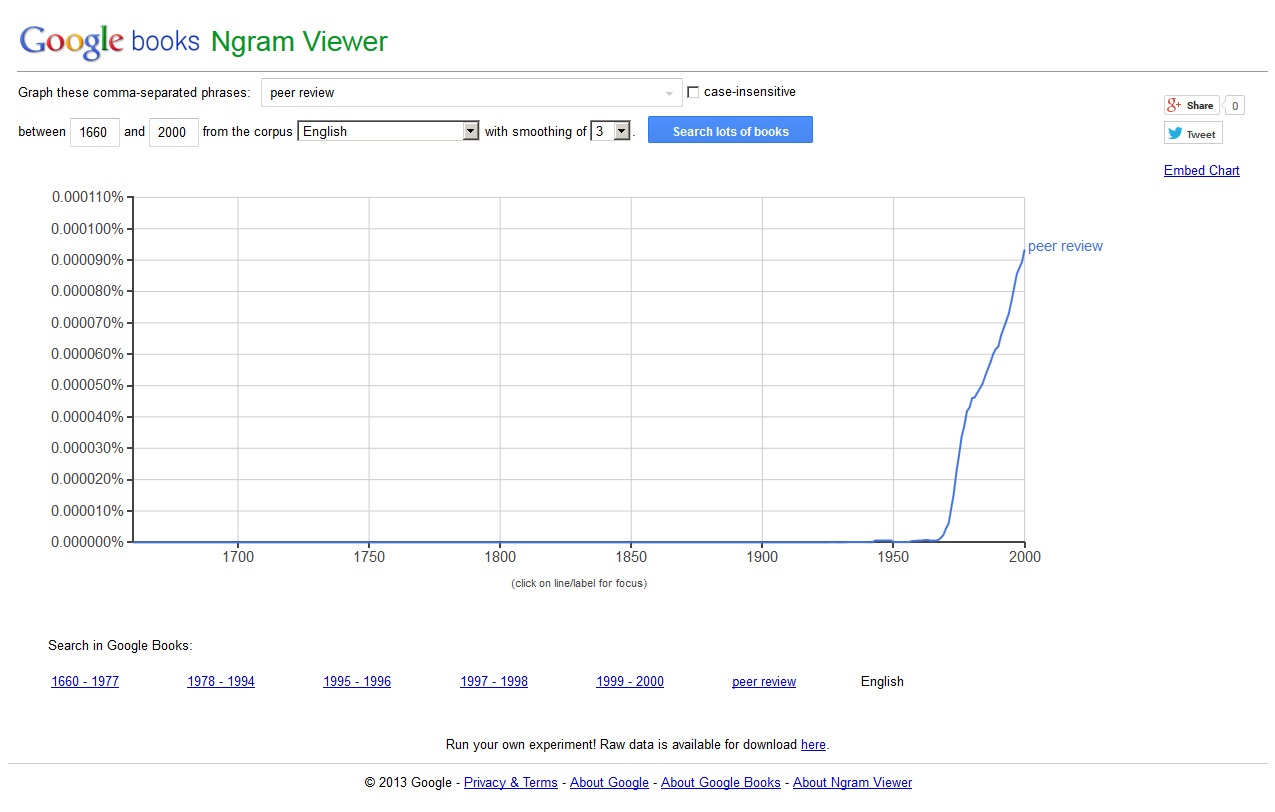
simplest is a visualization of the term usage - https://scalar.usc.edu/works/the-art-of-academic-peer-review...

but looking at the criticism and history sections of the wikipedia page will cover it in more detail. It basically promotes gatekeeping and group think, as seen with the Alzheimer's research issue which wasted billions of dollars and slowed progress by decades via effectively an academic cartel. Funding becoming tied to publication which relies on peer review made things worse

https://en.wikipedia.org/wiki/Scholarly_peer_review

Re: Do judges give out tougher sentences when hungry? A study too good to be true

#192
post #61

I always wondered about the original study whether they controlled for the fact that courts control their case calendars. I can't count the number of times I've had a client's case shuffled to the back of the line because the judge didn't want to deal with it (or wanted to make me or the client wait longer). Also, Muslim countries commonly offer amnesty or executive clemency at the Eid to people who have been convict…

> if I am a judge adjudicating a case for theft and I know that the defendant will be pardoned on the Eid, I might acquit or pronounce a light sentence. Why? Wouldn't that undermine the meaning of Eid?

Think of it more like gambling for credibility. Theft is still wrong during Ramadan, but if I know that everyone convicted of petty theft will be pardoned in a month, do I impose the standard sentence? If I do, it's spiteful judge vs. generous executive. If I give a light sentence, I steal the march on the pardon and get to be the benevolent judge.

Re: Do judges give out tougher sentences when hungry? A study too good to be true

#193
post #31

Earlier quoted context omitted.

Same here. My hunger plateaued after two days, but didn't go away, just became a bit more bearable. 12 days was the longest fast I've done.

12 days with no food? Like just water and electrolytes etc.? This is some spartan discipline.

Is it discipline? Or a medical condition? For example, I wouldn’t say someone with anorexia has impressive discipline. I can’t think of any reason rooted in reality why someone would fast for almost 2 weeks straight.

Re: Do judges give out tougher sentences when hungry? A study too good to be true

#194
This is the sort of thing that, if more research is done into this, has the potential to lead to pretty wide ranging challenges to previous decisions. Many courts would rightly rule that such an arbitrary decision making process is unconstitutional. Though I have a feeling such challenges would ultimately fail as those bringing the challenge would likely be required to prove that their particular adverse decision was affected by the factors talked about in this article. I would think that would be virtually impossible in most cases.

Re: Do judges give out tougher sentences when hungry? A study too good to be true

#196

Can't even read the damn website without getting a pop-up to register an account. Refresh, continue to read... Boom, pop-up... Try an i subscription for just £1 per month. /sigh

Use "reading mode" in your browser to avoid the popup. Same as NY Times.

Re: Do judges give out tougher sentences when hungry? A study too good to be true

#197

Earlier quoted context omitted.

Yeah, as somebody who has experimented with fasting, I think it's a huge mistake to think that Ramadan fasters would respond like hungry non-fasters. Fasting is a common religious practice because it is both a challenge and a discipline. To get good at fasting, you have to work to unlearn habits of instant gratification and learn to consciously lean against the urgings of the body. A fasting practice develops real sk…

There is intermittent fasting research that has shown that fasting after a few days can end up decreasing sleep time and increase all-day energy. My own fasting experience shows this increase in energy and reduction in sleep as getting better and showing more energy in arguments. Some say this would be making me angrier but it isn't. It is making me more forceful at the argument.

Or, you’re getting cranky because you’re hungry.

Re: Do judges give out tougher sentences when hungry? A study too good to be true

#198
post #91

Earlier quoted context omitted.

That’s not the spirit of Ramadan.

Really? https://www.birminghammail.co.uk/whats-on/whats-on-news/rama... https://www.amnesty.org/en/latest/press-release/2017/06/tuni... https://www.lexology.com/library/detail.aspx?g=0de064b1-c214... It seems in a lot of Muslim countries you can go to jail for just eating normally during Ramadan.

That seems irrelevant given that these offenses are but a minute share of the total judicial cases.

Re: Do judges give out tougher sentences when hungry? A study too good to be true

#199

Earlier quoted context omitted.

Data is also overrated. Data is often highly convoluted, with multiple causes in one correlation. We want to understand the way things work, and correlation can give us hints. But so can individual experience. But "data" is often used as the truth. So yeah individual experience here is valid. Hunger is not as simple as every hour you eat you get more hungry, and that's valid to deduct from personal experience.

Data is indeed often opaque, but it's the only way you can make a rigorous argument that something is characteristic of the natural world. To borrow a phrase, data driven conclusion on a hypothesis are the worst form of conclusion, except for all the other methods you can name.

No its not, thats exactly my point. You cant make a conclusion like that at all. It just points you that there might be recurring charateristic but not that there actually is one or what it is.

Re: Do judges give out tougher sentences when hungry? A study too good to be true

#200
post #141

Earlier quoted context omitted.

> It's perfectly plausible to me that Ramadan-observing judges would better at judging while hungry while non-fasters would get worse. I don't know for judges, but I live in a dominantly religious society and I haven't noticed the virtues promised by observing strict religious fasting. In fact, people have been jailed by (probably fasting) judges for eating out of sight [1]. [1] https://www-lepoint-fr.translate.goog/…

If the laws says you should fast, it wouldn't be a virtue (edit, to be more precise: it would even be wrong) for a judge to not punish someone for breaking the law, unless the law gives the judges this liberty. Now I am not saying I agree with this law, I am Christian and according to how I and those I live with practice it, fasting is strictly individual, something I personally would even try to hide according to Je…

That quote is quite interesting. I went to see if it's any different in other versions is bible, but it's always pretty much the same.

Maybe expressing that you're fasting could be seen as bad. As if you're trying to boast about it, how you're better then others.

Which made me that, if people that eat a vegan diet (or similar) kept it to themselves and not force it onto others, then perhaps there wouldn't exist the culture of "I ate a steak in front of vegans" or "I don't mind if you're vegan, but please let me eat in peace".

Post reply on HN