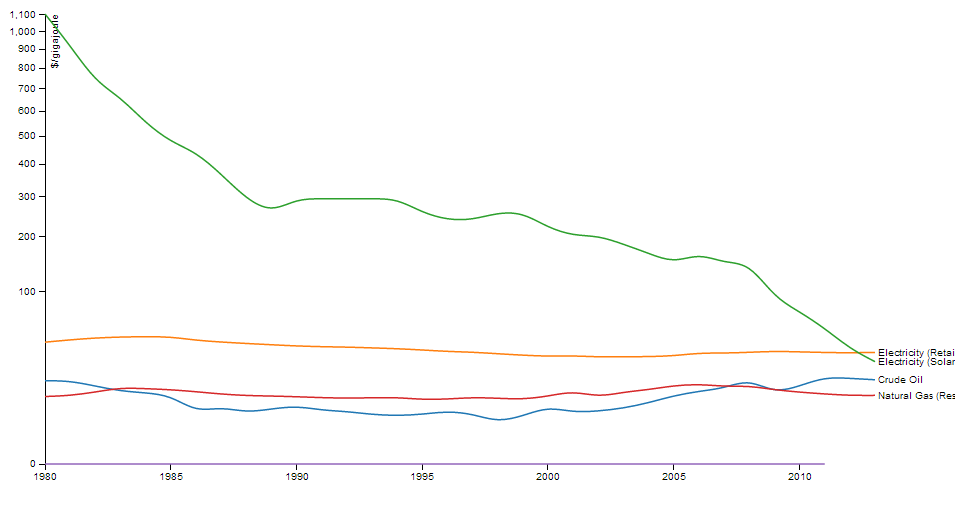
There's a lot of misunderstanding of agriculture in this thread. 1) No, land is not expensive. In agricultural areas, land is quite cheap. Organizing shelves of crops vertically solves for a problem that isn't actually a problem. 2) The sun is free and electricity isn't cheap. Putting plants indoors and then buying electricity to create light is going to be expensive compared to using the free sun. (The absurdity of…
> 3) Shipping is cheap. It may make us feel good that a salad's greens were created on a roof-top in Brooklyn, but using some of the most expensive real-estate on Earth to save a few cents on shipping is beyond economically irrational. Short-term economical considerations aren't the only considerations. Cities that can't sustain themselves through local resources are vulnerable to strategic attacks on infrastructure,…
Is Vertical Farming Really the Future of Agriculture?
191–200 of 291 posts
Re: Is Vertical Farming Really the Future of Agriculture?
#192There's a lot of misunderstanding of agriculture in this thread. 1) No, land is not expensive. In agricultural areas, land is quite cheap. Organizing shelves of crops vertically solves for a problem that isn't actually a problem. 2) The sun is free and electricity isn't cheap. Putting plants indoors and then buying electricity to create light is going to be expensive compared to using the free sun. (The absurdity of…
Re: Is Vertical Farming Really the Future of Agriculture?
#193Re: Is Vertical Farming Really the Future of Agriculture?
#194Earlier quoted context omitted.
Asking out of genuine curiosity, does it actually matter if harvesting takes 5 or 10 days? If electricity is cheaper, it might make sense for the job to take a bit longer but be cheaper? Human labour is not involved (with automated vehicles) so price should only be dependent on actual power consumption.
Yes, something like letting your crops get rained on just before harvest can ruin them and make them rot in storage. Although purposefully planting crops with slightly different yield times could alleviate the problem. Currently though crop harvests are a huge rush to get all of it collected as soon as possible because it all tends to ripen around the same time, if a few plants ripened or finished it usually causes s…
The next step would be, to figure out how to grow just the parts of the plants that we need. I'm guessing internally, plants use some kind of hormone-like signalling mechanism that lets different parts of the plant know what to do. Why do we need a full tree (in particular, bark) when we could just grow apples directly along with a few leaves to "power" them?
Re: Is Vertical Farming Really the Future of Agriculture?
#195Earlier quoted context omitted.
Electricity will essentially be free within 30 years
Based on what?... I have always thought that nuclear fusion would make electricity almost completely free though
Re: Is Vertical Farming Really the Future of Agriculture?
#196There's a lot of misunderstanding of agriculture in this thread. 1) No, land is not expensive. In agricultural areas, land is quite cheap. Organizing shelves of crops vertically solves for a problem that isn't actually a problem. 2) The sun is free and electricity isn't cheap. Putting plants indoors and then buying electricity to create light is going to be expensive compared to using the free sun. (The absurdity of…
Re: Is Vertical Farming Really the Future of Agriculture?
#197Earlier quoted context omitted.
Most meat will be lab grown within a decade. Livestock meat will become a luxury
Within a decade? I'd be surprised if even 0.1% of meat is lab grown in 2028.
Re: Is Vertical Farming Really the Future of Agriculture?
#198Earlier quoted context omitted.
Very long cables at normal supply voltages (240V/380V) suffer too much voltage drop over any distance (say) >150m. Remember that we're talking of multi-kilometre distances, not a mere hectare or two. Not only that, but anyone who has used an electric lawnmower on a larger area will tell you that cables are a fucking hazard to navigation when you're trying to move a machine trailing a cable. They constantly get tangle…
We run trains over multiple kilometres with overhead wires why can’t we do it with tractors???
Trains run in straight lines, farm equipment has various widths and it's not just 'tractors' and you're going up and down rows of farmland that might be tens or hundreds of acres wide and that aren't always in the shape of a square or rectangle (it's often far easier to work around large glacial boulders or trees for example, as well as ditches/running water/property lines etc). You'd have to string millions and millions, if not billions and billions, of miles of electrical cable across fields.
There's 915 million acres of active farmland in the U.S., that's 1.4 million square miles/3.7 million square kilometers. The larger combines can be about 40ft wide so if every scrap of farmland was in literally-square acre parcels you're going to need 5.2 power lines minimum to cover the width of a literally-square acre so you're easily talking 5 million miles of power lines.
Re: Is Vertical Farming Really the Future of Agriculture?
#199Earlier quoted context omitted.
Very long cables at normal supply voltages (240V/380V) suffer too much voltage drop over any distance (say) >150m. Remember that we're talking of multi-kilometre distances, not a mere hectare or two. Not only that, but anyone who has used an electric lawnmower on a larger area will tell you that cables are a fucking hazard to navigation when you're trying to move a machine trailing a cable. They constantly get tangle…
We run trains over multiple kilometres with overhead wires why can’t we do it with tractors???
You run overhead wires where you know you will repeatedly have a large demand for power, and you pay for it once in the capital outlay to put up the wires and other scaffolding.
In other words, you want to do this where (average demand / (fixed capital cost (which correlates to peak demand)) is relatively high. The middle of the farm field is the exact opposite of that: power demand is bursty and very infrequent, so utilization will be a few orders of magnitude lower.
Re: Is Vertical Farming Really the Future of Agriculture?
#200There's a lot of misunderstanding of agriculture in this thread. 1) No, land is not expensive. In agricultural areas, land is quite cheap. Organizing shelves of crops vertically solves for a problem that isn't actually a problem. 2) The sun is free and electricity isn't cheap. Putting plants indoors and then buying electricity to create light is going to be expensive compared to using the free sun. (The absurdity of…
In a word no. I spent twenty years as a fertilizer agronomist and I'm very familiar with the costs of producing a crop. The numbers simply do not work. Even when they tried in Detroit and got buildings for five cents on the dollar they couldn't make it work. The investors funding these enterprises do not understand agricultural economics. I keep investigating these stories looking for some kind of 'breakthrough tech'…