Live data from Hacker News

'Big Void' Identified in Khufu's Great Pyramid at Giza

bbc.co.uk

191–200 of 246 posts

Re: 'Big Void' Identified in Khufu's Great Pyramid at Giza

#191

Earlier quoted context omitted.

Not at all. Most of the pyramids, and many many other burials were ransacked by graverobbers and scavengers in antiquity - in a lot of cases, even while there were still pharaohs. It's assumed that a lot of them were robbed immediately , by the same workers who built them - in fact, even as early as the Middle Kingdom, there was a thriving trade in robbed grave goods for the explicit purpose of reuse in another buria…

> by the same workers who built them who were, by and large, slaves ... > Essentially, humans have always been garbage. I don't really consider them too garbage-y for trying to give even a little F.U. to their masters.

If I remember my old books correctly, they were not slaves, they were peasants who were paying tax as labour instead of money or produce. Like conscription, but for civilian work.

So there is still compulsion here, and the workers would often have had similar emotions and incentives as slaves. The fact that the workers had more freedom probably gave them more ability to act on that than if they had been proper slaves.
Re: 'Big Void' Identified in Khufu's Great Pyramid at Giza

#192

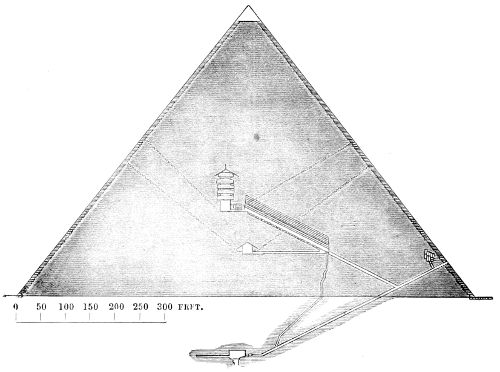
Fun coincidence: Noticed the newest book on Project Gutenburg is: A HISTORY OF ARCHITECTURE IN ALL COUNTRIES, FROM THE EARLIEST TIMES TO THE PRESENT DAY. By JAMES FERGUSSON, D.C.L., F.R.S., M.R.A.S., FELLOW ROYAL INST. BRIT. ARCHITECTS, So I click on it, and the very first building is the Great Pyramid, complete with diagram: https://www.gutenberg.org/files/55870/55870-h/55870-h.htm#Pa... 1893.

http://www.gutenberg.org/files/55870/55870-h/images/

So what ones should I look at? :-)

Re: 'Big Void' Identified in Khufu's Great Pyramid at Giza

#193
post #135

Earlier quoted context omitted.

Yeah but I am pretty worried about us fucking it up these days.

Me too. If this is a worry of yours, though, may I suggest, in no way rhetorically, going into the "not fucking it up" business? The pay is generally terrible, but nothing beats making your own hope.

I would like to find a "hacker news" for the "not fucking it up" business, please. Especially for the part where we try to keep the military and police from being automated.

Re: 'Big Void' Identified in Khufu's Great Pyramid at Giza

#194
post #144
post #121

Earlier quoted context omitted.

This is something I think about a lot. How do we build a "data pyramid" that can be interpreted by future generations. I feel like much of our culture will be lost to bit rot.

Wikipedia could be encoded into DNA and them spliced into species that are very long lived, geologically speaking, such as horseshoe crabs. Absent any negative selection against "wiki DNA", they could remain readable in millions of years time.

I guess my issue with this line of thought is - how do you include the "playback device" along with the media?

So many assumptions must be made about the theoretical future inhabitants that would "discover" our culture would be capable of technologically.

How do we send the VHS tape, along with the player, instructions for how to setup the player, play the tape, output to a sensing device of some sort, and only _then_ you can possibly read only part of the data if you get that far?

I don't think I will even have photos of my kids or anything from about the last 10 years or so by the time I am in my mid fifties (not as far away as I would wish).

Edit: mobile make bad spells

Re: 'Big Void' Identified in Khufu's Great Pyramid at Giza

#195

Fun coincidence: Noticed the newest book on Project Gutenburg is: A HISTORY OF ARCHITECTURE IN ALL COUNTRIES, FROM THE EARLIEST TIMES TO THE PRESENT DAY. By JAMES FERGUSSON, D.C.L., F.R.S., M.R.A.S., FELLOW ROYAL INST. BRIT. ARCHITECTS, So I click on it, and the very first building is the Great Pyramid, complete with diagram: https://www.gutenberg.org/files/55870/55870-h/55870-h.htm#Pa... 1893.

http://www.gutenberg.org/files/55870/55870-h/images/ So what ones should I look at? :-)

This one: http://www.gutenberg.org/files/55870/55870-h/images/i_129.jp...

Re: 'Big Void' Identified in Khufu's Great Pyramid at Giza

#196
post #121
post #82

Amazing this stuff still yields secrets after thousands of years. Meanwhile the 3.5" floppy disks in my parents attic on which I've kept all my teenage Turbo Pascal source code have long lost all their data.

This is something I think about a lot. How do we build a "data pyramid" that can be interpreted by future generations. I feel like much of our culture will be lost to bit rot.

One line of thought I was going down recently was information encoded by printing very specific and precise three-dimensional "monoliths" that display information based on postion of the nearest star (which I assume would still be Sol, and would still be around in this distant future).

To give an illustration of what I am trying to describe, I am imagine something like the cover of GEB (https://images.gr-assets.com/books/1331382003l/24115.jpg), but on a multi-dimsensional scale.

Full disclosure: [7] ;)

Re: 'Big Void' Identified in Khufu's Great Pyramid at Giza

#197

Earlier quoted context omitted.

A) proper digging shouldn’t destroy the monument. B) removal of parts of the structure is how we know what’s in it at all. The same is true for any othe other monuments that are structures. We had to dig through the valley of the kings to find the tombs. If we don’t breech the obstruction, we won’t understand the thing.

It seems like this is itself a demonstration there are alternative techniques.

There are new techniques for discovering things. Once we know there is a void, at present, no number of muons will help us see details. Perhaps we’ll learn how they built the thing. There are a great many marvels from Egypt that defy our current understanding of their tech.

Re: 'Big Void' Identified in Khufu's Great Pyramid at Giza

#198

The more we learn about the Giza Pyramids, the more they look like some technological device. I highly doubt the common "understanding" that their designed use was a fancy mausoleum for dignitaries. I have no doubt they have been used for this purpose, but unlikely to be the original intent.

Why? There is no evidence for that, is there? Also, look at the great cathedrals of the middle ages - people built them during several lifetimes and at huge expense, and the only "practical" purpose was to have a space for religious services. That and maybe the hope for eternal life after death etc...

There's a cathedral in Catalonia that began construction in 1882. Its practical purpose is to attract tourists to Barcelona; maybe some day it'll be fully completed as a place of worship.

Re: 'Big Void' Identified in Khufu's Great Pyramid at Giza

#199

Earlier quoted context omitted.

> by the same workers who built them who were, by and large, slaves ... > Essentially, humans have always been garbage. I don't really consider them too garbage-y for trying to give even a little F.U. to their masters.

If I remember my old books correctly, they were not slaves, they were peasants who were paying tax as labour instead of money or produce. Like conscription, but for civilian work. So there is still compulsion here, and the workers would often have had similar emotions and incentives as slaves. The fact that the workers had more freedom probably gave them more ability to act on that than if they had been proper slaves…

> they were peasants who were paying tax as labour

When you put it like that, it sounds an awful lot like slavery.

Re: 'Big Void' Identified in Khufu's Great Pyramid at Giza

#200

Earlier quoted context omitted.

It seems that peoples through the ages have respected the pyramids enough to leave them mostly intact and undisturbed, giving us the unique heritage that we have today. I can't help but contrast this with the British explorers who just started blowing through it with explosives and pulling stuff out wholesale.

Not at all. Most of the pyramids, and many many other burials were ransacked by graverobbers and scavengers in antiquity - in a lot of cases, even while there were still pharaohs. It's assumed that a lot of them were robbed immediately , by the same workers who built them - in fact, even as early as the Middle Kingdom, there was a thriving trade in robbed grave goods for the explicit purpose of reuse in another buria…

Or, humans have always had to focus on their own self-preservation and only recently have we had the luxury to care for the past at the expense of the present.
Post reply on HN