Live data from Hacker News

Tesla Motors Announces a New Home Battery

offgridquest.com

181–190 of 220 posts

Re: Tesla Motors Announces a New Home Battery

#181

Earlier quoted context omitted.

"you're going to have to undo all of this" Why can't "all of this" be packaged into one idiot-proof box with connections to the grid, your off-grid system, and your house?

You mean like a generator transfer switch? http://www.generac.com/all-products/transfer-switches/home-b...

That's a device that you probably don't want to use with your solar installation since it will not handle the grid-present resynchronization at the end of a power outage correctly which could cause your renewable energy system to be re-connected to the grid at 180 degrees out of phase worst case when grid power is restored. The result will be a big bill for a large number of power FETs or IGBTs depending on the tech used in your inverter.

So you can't just add an automatic transfer switch to retro-fit this to an existing inverter, but there are plenty of inverters where an option for an external module can be purchased or where an automatic transfer switch is built into the inverter itself:

http://ww3.wholesalesolar.com/newsletter/MAGNUM-AC-COUPLED-L...

These inverters will first synchronize with the grid before they connect.
Re: Tesla Motors Announces a New Home Battery

#182

Earlier quoted context omitted.

> where some users are trying to game the system by charging a big battery array during low cost hours, and then "selling" it back to the grid during peak hours (at inflated, subsidized prices). The idea that a utility wants a heads-I-win-tails-you-lose kind of situation is annoying at best and downright infuriating at worst. If they're willing to sell power for $X now and willing to buy it later for $Y, what does it…

If they're willing to sell power for $X now and willing to buy it later for $Y, what does it matter the method? In the UK, to encourage adoption of residential solar panels there is a scheme of "feed in tariffs" where you can generate renewable energy and receive a guaranteed, above-market-rate price for it. The goal of this is to reduce carbon emissions. For example, you can buy residential electricity for 15p/kWh […

Honestly, let them! They'll go bankrupt soon enough. And they'll achieve peak shaving in the process.

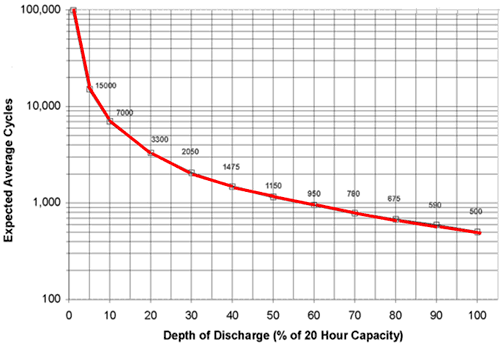
Lead acid batteries cost about $100/kWh of nameplate capacity, more like $200/kWh of usable storage. At a 50% depth of discharge you're going to get about 1000 cycles out of the battery.

http://www.mpoweruk.com/images/dod.gif

So assuming 100% charge, discharge, charger and inverter efficiency (reality is more like 60% through that whole cycle) a person stands to make about $0.06 per kWh per cycle (in the UK anyhow) and they can only get 1000 cycles.

$0.06 * 1000 = $60 per kWh per battery lifetime

That's only 1/3 of the cost of the batteries, completely neglecting the capital cost of the charger and inverter and the time spent to set the whole thing up. Further, once you take the realizable efficiencies into account, it's more like $40 not $60 so they're losing money even faster.

This is a problem that -- at least for now -- LITERALLY solves itself.

Re: Tesla Motors Announces a New Home Battery

#183

Earlier quoted context omitted.

Such as these? http://www.batterystuff.com/batteries/golf-cart-products/ I don't really see orders of magnitude jumps in power/$. Or am I looking for the wrong thing?

No, more like these: http://pics.camarades.com/v/jacques/renewables/batteries/IM0... Sold in bulk. That's a 48KWh bank and it cost about $US 5K

This is roughly 2.5 times cheaper than the marine battery I found first, definitely not orders of magnitude.

This is $5k for 2 kW * 24 hours. So 3 of these at $15k total would roughly replace my $700 generator + $10 worth of gasoline for emergency situations.

To truly run my house where it would be adequate at 20 kW or 24 hours or so, I'd need 10 of these at $50k. To run my house of for a week (where I live, the last major power outage lasted three weeks), I'd need $350k. For that amount of money, I can just buy a very nice house in Florida and go down there when the power goes out.

Now, if I go top of the line, I can get a 22kW generator (http://www.homedepot.com/p/Generac-22-000-Watt-Air-Cooled-Au...) for $4,700 + gasoline at $2.30/gallon where I live. This will not even require me to go out and start the thing as it kicks on automatically, much like a battery backup does.

Battery powered houses just don't make sense cost-wise, and at this price disparity it's not a question of spending a little more: $350,000 vs $4,700. That's two orders of magnitude. It's not the clean option, but given that it's standby power, I'd rather see us invest in more efficient power plants (nuclear and wind) than home batteries.

Re: Tesla Motors Announces a New Home Battery

#184
Seems like just yesterday [1] I was saying they could do this if they wanted to. :-)

The first challenge is to make the operational cost of a solar + battery system less than the cost of buying your power straight from the grid. The second is to include capital costs in that calculation and still come out at break even or ahead.

[1] https://news.ycombinator.com/item?id=9055177

Re: Tesla Motors Announces a New Home Battery

#185

So, where does lithium come from? It comes from the Earth, of course, but it doesn't require strip mining or blowing the tops off mountains like other resources do...most often, lithium is found in briny underground ponds. The liquid is pumped out and left to dry in the sun. TANSTAAFL https://duckduckgo.com/?q=lithium+pond+photos&iax=1&ia=image... Mining is mining. There isn't a "green" form. Tearing holes in the ear…

The house off the grid is built on industrial infrastructure. So what? It's a matter of degree. I helped my parents build their off-the-grid house. It's solar-powered, but uses batteries for backup storage. It collects and filters rainwater, recycles and purifies its own sewage, and is made mostly of recycled materials (in the style of what's called an "Earthship," but with a more traditional, house-like form factor)…

> The house is still much less ecologically destructive than the vast majority of dwellings worldwide, both in terms of ongoing damage and initial construction.

The isn't even close to being true. The majority of dwellings worldwide lack what you would call basic utilities and are constructed using local materials, many of which are recycled.

Perhaps you meant the West?

Even then, it's not true. Solar panels, batteries, modern insulation, etc ... these create a ton of pollution during manufacture. Not to mention drilling wells and installing septic tanks as opposed to hooking up to public utilities.

Re: Tesla Motors Announces a New Home Battery

#186
post #147

Earlier quoted context omitted.

Energy density is a big one. To store 5 kW * 24 hours (barely enough to power my house's essentials), I would need 286 of these ( http://www.amazon.com/VMAX857-Battery-Performance-minnkota-t... ). They are not small. Also, that would cost me nearly $32,000 in just batteries. My ideal setup for this would be something like 20 kW * 7 days. That would fill my basement pretty easily.

~30kwh is the national average for daily use. 120 is crazy high unless your blasting an AC or heat all day. At 12 cents a kilowatt hour that's a $438 monthly bill. Even 30 is pretty damn high. For someone living off grid with a purpose built/renovated structure ~5kwh a day gives you quite a lot to work with.

True, but you want to be able to handle peak usage too. When 2 kW well pump kicks in, I don't want the lights to dim. AC is 3-5 kW and more to start, and so on.

Yeah, if your goal is to live off the grid to save the planet, that's a different story. Then the only question is how much will your Lithium based battery (mining, manufacturing, transport, recycling) affect the planet vs buying wind power from your local utility. If you want to do a little good and save a little money, putting batteries in your house is not the right thing to do. If you want to be independent of the grid in case of emergencies get a wood stove and a gas (or better diesel) generator. All around, I don't see where whole house battery backup fits into any scenario. I see data centers using these batteries, not residences.

Re: Tesla Motors Announces a New Home Battery

#187
post #68

Earlier quoted context omitted.

Also many municipalities don't allow battery 'grid-tie' with the option of 'off the grid' living. For example, Connecticut has laws which don't allow houses to have batteries that would allow a house to be self sustaining and have a connection to the grid. This is because if you have batteries which cause a back flow during a power outage to the power station, an electrical worker could get shocked down the road. The…

A properly wired transfer switch fully cures that risk.

A couple of my architect friends -- and they are good competent architects who spend the proper portion of their fees to hire competent consulting engineers -- designed an emergency services center a few years ago. The hurricane came - the project was in Florida - the utility cut grid power per protocol and the automatic transfer switch didn't flip to onsite power. Neither did the backup automatic switch.

The person trained to operate the manual switch was on a scheduled vacation (hurricane season in the US is six months it ain't reasonable to prohibit vacations). It took over an hour to get the system back online. Now keep in mind that all of this was with emergency services grade equipment trained professional staff and regular inspections and testing. And everybody wasn't away on vacation by policy.

Proper wiring is a necessary, but not sufficient condition. Power grid failures are many sigma events.

Re: Tesla Motors Announces a New Home Battery

#188
Tesla could offer an "attachment" to their cars that let them serve as a home battery when parked.

You'd have to let it charge up before going driving, but for home owners who don't drive much, that could be very cost effective.

Unless I'm missing some complication?

Re: Tesla Motors Announces a New Home Battery

#189

Earlier quoted context omitted.

If they're willing to sell power for $X now and willing to buy it later for $Y, what does it matter the method? In the UK, to encourage adoption of residential solar panels there is a scheme of "feed in tariffs" where you can generate renewable energy and receive a guaranteed, above-market-rate price for it. The goal of this is to reduce carbon emissions. For example, you can buy residential electricity for 15p/kWh […

Honestly, let them! They'll go bankrupt soon enough. And they'll achieve peak shaving in the process. Lead acid batteries cost about $100/kWh of nameplate capacity, more like $200/kWh of usable storage. At a 50% depth of discharge you're going to get about 1000 cycles out of the battery. http://www.mpoweruk.com/images/dod.gif So assuming 100% charge, discharge, charger and inverter efficiency (reality is more like 60…

And they'll achieve peak shaving in the process.

Peak shaving is if you powered your own home off of your battery pack during peak times. The whole issue is that gamers -- who are essentially ruining "the commons" and pissing in the drinking well -- are instead abusing a system.

Again, no home battery pack is helping the power company. The rates are hugely subsidized to encourage green energy. The people who abuse it simply ruin it for everyone else.

Re: Tesla Motors Announces a New Home Battery

#190

Earlier quoted context omitted.

Honestly, let them! They'll go bankrupt soon enough. And they'll achieve peak shaving in the process. Lead acid batteries cost about $100/kWh of nameplate capacity, more like $200/kWh of usable storage. At a 50% depth of discharge you're going to get about 1000 cycles out of the battery. http://www.mpoweruk.com/images/dod.gif So assuming 100% charge, discharge, charger and inverter efficiency (reality is more like 60…

And they'll achieve peak shaving in the process. Peak shaving is if you powered your own home off of your battery pack during peak times. The whole issue is that gamers -- who are essentially ruining "the commons" and pissing in the drinking well -- are instead abusing a system. Again, no home battery pack is helping the power company. The rates are hugely subsidized to encourage green energy. The people who abuse it…

You're right of course that it's not peak shaving, which is about shedding load. That was incorrect of me to state.

But it is peak generation, which is just as valuable.

> Again, no home battery pack is helping the power company.

Please re-read my comment where I detail the economics of pulling power off the grid at low price and selling it back at high price is actually net-negative for the individuals doing so. From this we can assume that it's net-positive for the utility company because they're basically getting "free money" from the people who aren't good enough at math to see that what they're doing is economically wasteful.

> The people who abuse it simply ruin it for everyone else.

The people who "abuse" it are paying $0.20/kWh of cost to make $0.06/kWh of revenue. That's REVENUE, not PROFIT. This is a losing strategy, it loses $0.14/kWh, at least according to the math I did.

It's entirely possible that my analysis is wrong for some reason, but rather than just stating "they're ruining it for everyone!" maybe you could rebut my reasoning or something? Just stating something as a fact doesn't make it so.

Post reply on HN