Earlier quoted context omitted.
In my use case I'm talking about arrays of them, think 8. RAID can parallelize platter really nicely in that configuration. But on modern ram/cpu (epyc 9654s), you'll still see the disk dragging you down. NVME drags me down more. Maybe the key is a bunch of small ones. Like 20 512GB modules... That may be brilliant. It's way cheap
That sounds like you might be having quite specific needs. Some reviews have graphs showing how the drives behave in various situations, so that could help you. However, what I've found perusing those reviews is that there's a huge price gap between this class of drives (9x0 pro, wd 8xx and the like) and "enterprise" drives which seem to have more stable performance.
I tested four NVMe SSDs from four vendors – half lose FLUSH'd data on power loss (2022)
181–190 of 261 posts
Re: I tested four NVMe SSDs from four vendors – half lose FLUSH'd data on power loss (2022)
#182Under long term heavy duty, I've routinely seen cheap modern platter outperform cheap brand name NVME. There's some cost cutting somewhere. The NVMEs can't seem to sustain throughput. It's been pretty disappointing to move I/O bound workloads over and not see notable improvements. The magnitude of data I'm talking about is 500-~3000GB I've only got two NVME machines for what I'm doing so I'll gladly accept that it's…
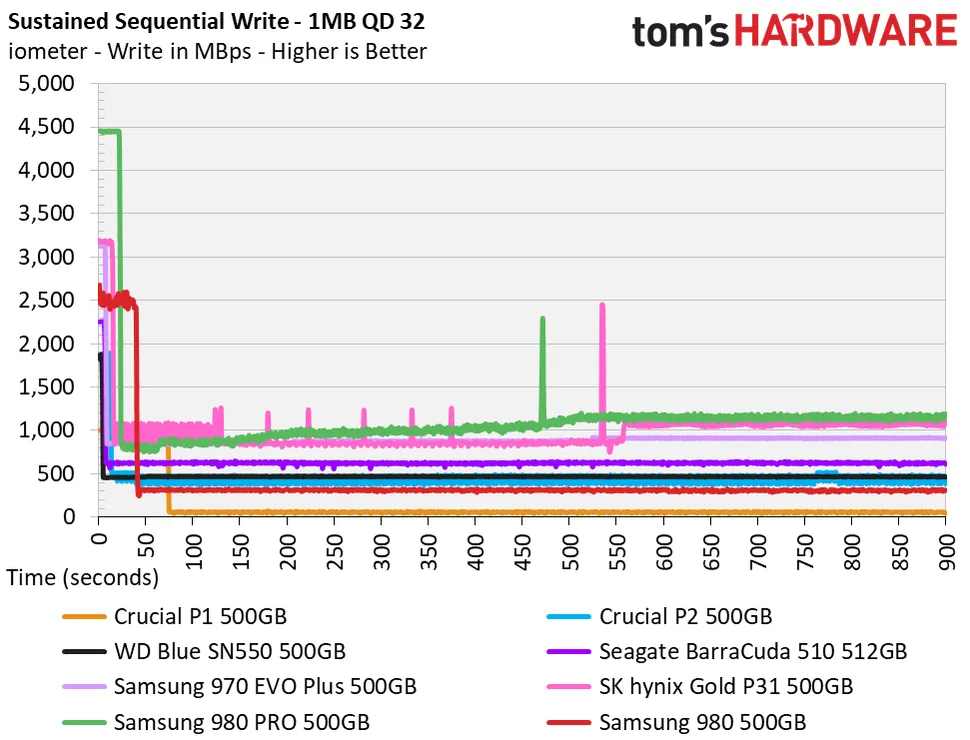
I can't say I've ever seen a recent SSD (that isn't otherwise faulty) get slow enough to say it is outperformed by a traditional drive, even just counting the fastest end of the disk, but I've certainly seen them drop to around the same speed during a bulk write.
--
[1] unlike this sort of thing: https://www.tomshardware.com/news/low-performance-external-m...
[2] get SLC-only⁴ drives, not QLC-with-SLC-cache or just-QLC, and so forth
[3] bulk data processing tasks such as video editing are where you'll feel this significantly, unless your number-crunching is also bottlenecked at the CPU/GPU
[4] SLC-only is going to be very expensive for large drives, even high-grade enterprise drives tend to be MLC-with SLC-cache. SLC>MLC>TLC>QLC…
[5] this can be quite difficult in the “consumer” market because you'll sometimes find a later revision of the same drive having a completely different memory and/or controller arrangement despite the headline model name/number not changing at all – this is one reason why early reviews can be very misleading
Re: I tested four NVMe SSDs from four vendors – half lose FLUSH'd data on power loss (2022)
#183Misleading headline since after testing eight more drives, none more failed. 2/12 is not nearly as dramatic as “half”, and the ones that lost data are the cheap brands as one would expect.
SK Hynix is a major brand and the P31 is a great midrange SSD... except for the fact that it seemingly doesn't care about your data.
Is it? I passed on an offer for a drive carrying that name, and got something else for slightly more, the other day as I didn't know the name.
Perhaps their noteworthiness varies internationally? Or do they mainly sell to manufacturers rather than direct to the likes of me?
Re: I tested four NVMe SSDs from four vendors – half lose FLUSH'd data on power loss (2022)
#184Earlier quoted context omitted.
As somebody who worked as a PC technician for a while until very recently, I've run chkdsk and had to repair errors on NTFS filesystems very, very, very often. It's almost an everyday thing. Anecdotal evidence is less than useful here.
So anecdotal evidence is not useful, as proven by your anecdotal evidence? :) FWIW I've found NTFS and ext3/4 to be of similar reliability over the years, in general use and in the face of improper shutdown. Metadata journaling does a lot to preserve the filesystem in such circumstances. Most of the few significant problems I've had have been due to hardware issues, which few filesystems on their own will help you wi…
However, I'm also not making a statement about NTFS's reliability vs ext3/ext4. In the years that I worked in that position, I maybe dealt with Linux systems 3 times.
Reminder of the original statement:
> NTFS is an extremely resilient yet boring filesystem, I cannot remember the last time I had to run chkdsk even after an improper shutdown.
I never said anything about catastrophic failure of an NTFS filesystem. I have experienced that, but it was comparatively rare (still happened though). I have, however, have had to run chkdsk fairly often to correct errors. Sometimes user data was affected to some degree, but it was often a matter of system stability and getting Windows back to running without issues.
I still find that NTFS is reasonably resilient and have no qualms with it. I just want to push back against the idea that nothing ever goes wrong with NTFS, which was implied by your statement that you can't remember the last time you used chkdsk.
Re: I tested four NVMe SSDs from four vendors – half lose FLUSH'd data on power loss (2022)
#185Re: I tested four NVMe SSDs from four vendors – half lose FLUSH'd data on power loss (2022)
#186Earlier quoted context omitted.
Where are you seeing counterfeits? AliExpress, Ebay, Amazon?
Probably chinese sellers on all those sites. I've noticed a common thread with people who complain about counterfeits is that they're literally buying alphabet soup brand fakes from chinese FBA sellers instead of buying products directly sold by amazon or from more traditional retail channels.
AMEN to that !
And the most annoying thing is that those of us who know to avoid FBA is that Amazon have removed the "sold by Amazon" search filter tick-box.
So whilst in the past you could tick a box and be presented with a list of products which are direct-sold rather than FBA, you cannot do that anymore.
According to some Reddit posts, you can still do it if you hack the URL and add an "emi=$obscure_value" GET-param. But I'm guessing sooner or later Amazon will kill this work-around too.
Re: I tested four NVMe SSDs from four vendors – half lose FLUSH'd data on power loss (2022)
#187Earlier quoted context omitted.
>So, what to do if the original title is misleading? I'd suggest posting an alternative, non-misleading source instead, or if none exists, don't post at all.
Then this very interesting piece would never never come to my attention. Which is surely the worst outcome.
Re: I tested four NVMe SSDs from four vendors – half lose FLUSH'd data on power loss (2022)
#188Earlier quoted context omitted.
So anecdotal evidence is not useful, as proven by your anecdotal evidence? :) FWIW I've found NTFS and ext3/4 to be of similar reliability over the years, in general use and in the face of improper shutdown. Metadata journaling does a lot to preserve the filesystem in such circumstances. Most of the few significant problems I've had have been due to hardware issues, which few filesystems on their own will help you wi…
There's a difference between your personal experience and my experience in a professional role handling multiple customer devices every day. However, I'm also not making a statement about NTFS's reliability vs ext3/ext4. In the years that I worked in that position, I maybe dealt with Linux systems 3 times. Reminder of the original statement: > NTFS is an extremely resilient yet boring filesystem, I cannot remember th…
I should have been a bit clearer there: I only mentioned those specific filesystems because those are the ones I have a lot of experience with, rather than intending to bang the drum for them (or one in favour of the other). I expect other much-tested journaled filesystems could be substituted into the same sentences.
> your original statement
GPP was not me.
Re: I tested four NVMe SSDs from four vendors – half lose FLUSH'd data on power loss (2022)
#189I have very little trust in consumer flash these days after seeing the firmware shortcuts and stealth hardware replacements manufacturers resort to to cut costs.
Re: I tested four NVMe SSDs from four vendors – half lose FLUSH'd data on power loss (2022)
#190Earlier quoted context omitted.
I think it's important to be able to have a rough idea of how you'd be using this. If this drop in performance means I could use a cheaper drive, I'm all for it. But some drives are truly awful. My work laptop came with a cheap Samsung drive that would quickly drop to around 200 MB/s. At first, I thought I had somehow badly configured Linux or something (I'm running zfs with native encryption). Then I went and checke…
In my use case I'm talking about arrays of them, think 8. RAID can parallelize platter really nicely in that configuration. But on modern ram/cpu (epyc 9654s), you'll still see the disk dragging you down. NVME drags me down more. Maybe the key is a bunch of small ones. Like 20 512GB modules... That may be brilliant. It's way cheap
https://www.tomshardware.com/reviews/samsung-980-m2-nvme-ssd... (https://cdn.mos.cms.futurecdn.net/mzdXcBUJUuxkbYfmQigqQE-970...)
In a 900 second timeframe, the 980 Pro drops down to a bit above 1GB/s, while the worst is somewhere in the tens of MB/s. So there are significant differences in SSD performance profiles which you can only find out about from reviews like this.
Similar results here:
https://www.anandtech.com/show/16504/the-samsung-ssd-980-500...