Lets just attach the rest of the components to the GPU and screw the gpu directly into the case.....
We Need New Motherboards Before GPUs Collapse Under Their Own Gravity
181–190 of 362 posts
Re: We Need New Motherboards Before GPUs Collapse Under Their Own Gravity
#182Every time I see the sizes of GPUs increase, I'm reminded of this from over 2 decades ago: https://vgamuseum.ru/wp-content/gallery/bitching-fast/bitchi...
415 Bungholiomarks ought to be good enough for anyone.
Re: We Need New Motherboards Before GPUs Collapse Under Their Own Gravity
#183Earlier quoted context omitted.
What if GPU makers made motherboards?
I vaguely recall Nvidia motherboards were junk in the late 2000's.
They made motherboard chipsets (nforce, iirc?), not motherboards, unless I missed something.
I think by the late 2000’s, though, their discreet gpus on laptops were problematic because they got so hot they detached from the motherboards or fried themselves. In a lot of cases, these systems shipped with these gpus and intel processors with integrated igpus.
This happened to a thinkpad t400 I had a while ago, the nvidia graphics stopped working and I had to disable it/enable the intel gpu in the bios (maybe even blind).
Iirc this snafu was what soured relations between apple and nvidia.
Re: We Need New Motherboards Before GPUs Collapse Under Their Own Gravity
#184Earlier quoted context omitted.
This is the one I used on my last two builds, be aware it is a bit of a chonker. The main reason I choose it over the others is look at all them 5 1/4 bays, the whole front of it is 5 1/4 bays. 5 1/4 bays for days. do you know how many stupid drive bays, fan controllers, sd slots, switches etc you can fit in this case... By my count all of them. https://www.newegg.com/rosewill-rsv-l4500u-black/p/N82E16811... https://…
The one you linked looks like it only has three 5.25 bays at most?
not sure, perhaps(cookies?) you are seeing a different chassis type, the one I ment to link to is "4U, 15 Bays & 8 Fans" it comes with three 3u(5.25) internal drive bays(5 drives each). honestly they suck, pull them to get access to the 5.15 bays.
Re: We Need New Motherboards Before GPUs Collapse Under Their Own Gravity
#1851. While I agree we're beginning to reach absurd proportions, lets really analyze the situation and think about it. 2. Are there any GPUs that actually have performed physical damage on a motherboard slot? 3. GPUs are already 2-wide by default, and some are 3-wide. 4-wide GPUs will have more support from the chassis. This seems like the simpler solution, especially since most people rarely have a 2nd add in card at a…
Gpu sag is a big issue in gaming computers. I had a small (by comparison and of more contemporary graphics cards) rx480 and bought a cheap 10 dollar graphics card brace to reduce its strain on the pci slot in 2021 to help reduce its chances of failure during the shortage. I use the brace to hold up my new ampere card now (which is maybe twice the length of the rx480).
Re: We Need New Motherboards Before GPUs Collapse Under Their Own Gravity
#186I'm surprised this isn't mentioned here more clearly: Some high end cases like the be quiet silent base I'm using have the option to mount the graphics card vertically, basically parallel to the mainboard, in a separate anchor slot. It needs an additional connector cable (~$20), but other than that is easy to setup, looks better with a look-in case (the illuminated fans face the glass side) and the weight pulls on a special anchor point just for that with no electronics involved. Plus the card itself is more sturdy in that orientation and there is no issues with bending through its own weight. It might even be beneficial ventilation-wise as the graphics card no longer causes a horizontal divide (basically creating separate ventilation-zones on the top and bottom of the card).
Yes, the cable will add approximately ~0.3ns of additional latency due to the added 10cm of distance.
This is how it looks like:
https://www.hardware-journal.de/images/Bilder/2018/test/be-q...
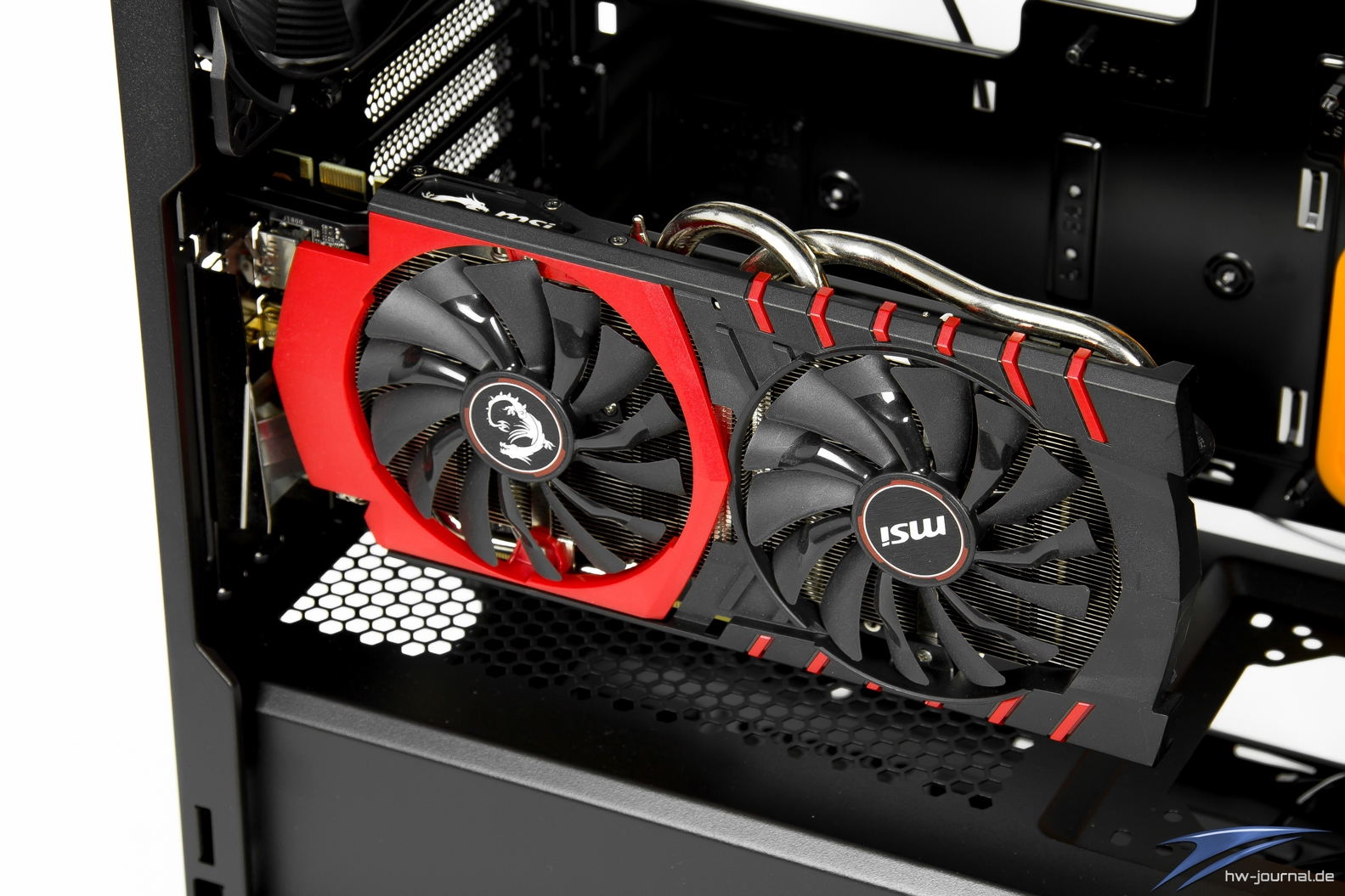
https://www.hardware-journal.de/images/Bilder/2018/test/be-q...
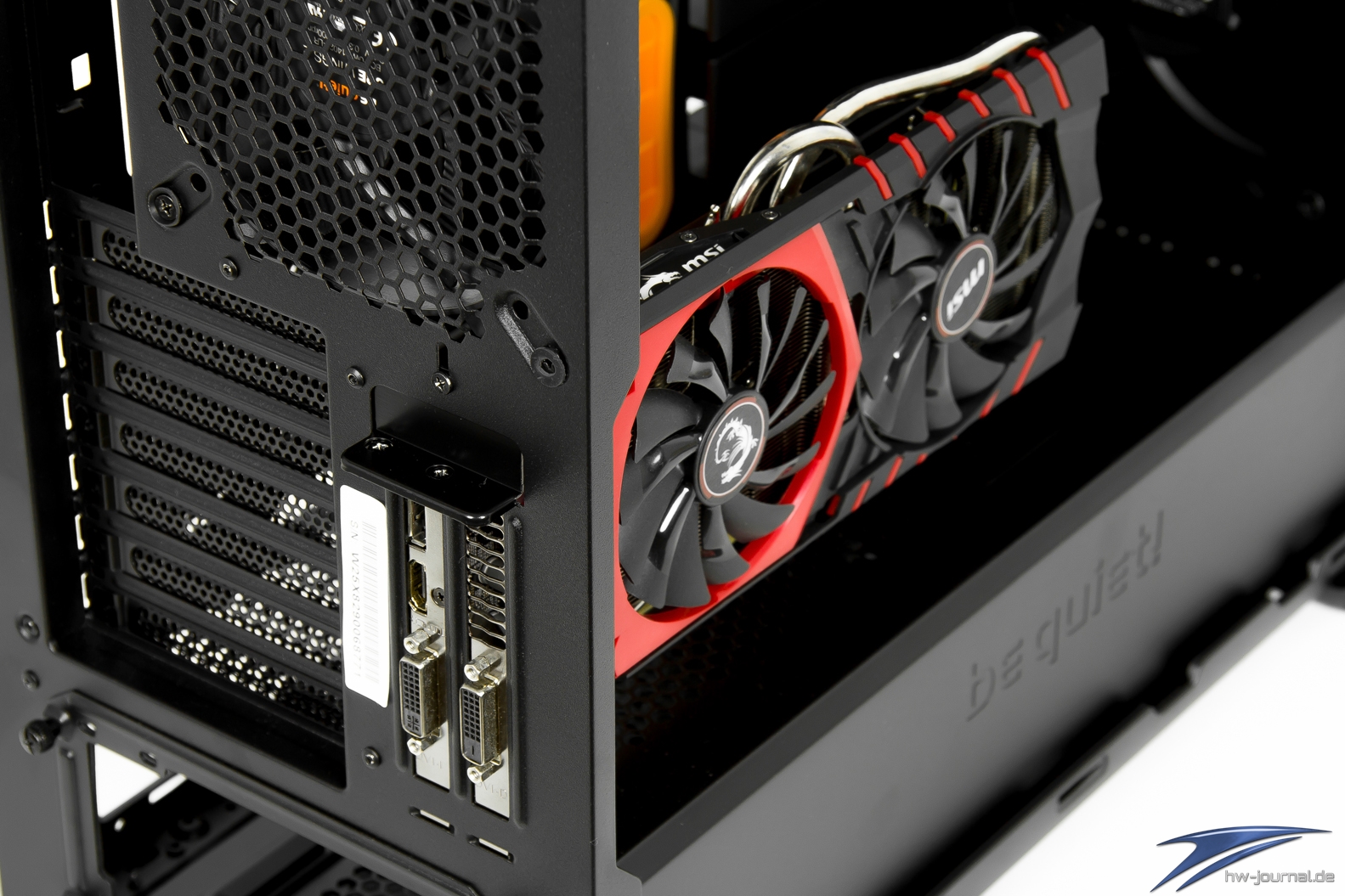
Re: We Need New Motherboards Before GPUs Collapse Under Their Own Gravity
#187Earlier quoted context omitted.
In reality, there is no reason GPUs should be add-ons. Just star designing motherboards with integrated GPUs of sufficient size. Case closed.
The main reason is that CPUs get old much slower than GPUs, but “current” socket generations change quickly. Another reason is a combinatorial explosion of mobo x graphics card features, which is already hard.
Gpus get old slowly too, but youtube influencers convince gamers their current card isn’t enough often ans effectively (I’m not excluded from this group)
Re: We Need New Motherboards Before GPUs Collapse Under Their Own Gravity
#188What if a 4-slot-wide GPU had 3 'dummy' slots that plug into the other unused PCI slots, no electrical connection, and only acted as support?
Re: We Need New Motherboards Before GPUs Collapse Under Their Own Gravity
#189I think this problem will resolve itself. Nvidia pulled out all of the stops with the 4090 because they thought (hoped) they were going to be able to sell it in an insatiable market that was begging for the biggest most powerful die possible, mostly because of mining. Gamers have no appetite for such a monstrosity (the gpu equivalent to national lampoon’s family truckster), and there aren’t really any games on the horizon that requires the 4090’s sheer power. Nvidia is probably going to have no choice but to make smaller, cooler dies with more modest gains relative to lovelace in their next generation because thats what the market will force them to do.
Re: We Need New Motherboards Before GPUs Collapse Under Their Own Gravity
#190Earlier quoted context omitted.
The most expensive part of GPU operation (power-wise) isn't computation, it's actually moving information around. Moving the GPU further away from the CPU and storage is going to lead to worse latency and power requirements. Over the next 10-15 years, we'll probably see CPU+GPU packages become mainstream instead of CPU (with basic integrated graphics) and a separate GPU.
The most expensive part of GPU operation (power-wise) isn't computation, it's actually moving information around I doubt that. Compare the GPU temperature (a good proxy for power consumption) when playing a game or doing GPGPU stuff vs playing a video (without GPU acceleration, so it's just acting as a framebuffer). The former involves far more computation, and gets the GPU much hotter.
No. There was an internal nvidia presentation from a few years ago that stated that moving data was the hard part. (I can't find the presentation any more, but if anyone can find it, please post it below.)
Previously graphics cards were essentially designed with a single area of the card handling computation, and another area holding memory. Data would need to be moved from the memory, to the computation area, then back again if there were changes that needed to be stored.
As the computation and the memory demands became larger, those areas had to handle more, but so did the bus between those two areas. What was a negligible overhead for the bus became more pronounced as it had to handle more data.
Eventually the energy overhead of transporting that much data across that distance started constraining what was possible with graphics cards.
That is why graphics card architectures have shifted over time to place memory cache units next to computation units. The less distance the data needs to travel, the smaller the power requirements. It's also led to the investment and adoption of stacked memory dies (why grab data from 5cm away in the x-y plane when we can stack memory and grab data 5mm away in the z-direction).