Live data from Hacker News

Nvidia Grace CPU

nvidia.com

181–190 of 197 posts

Re: Nvidia Grace CPU

#181
post #173
post #170

Earlier quoted context omitted.

There is not a single page on the whole internet that states Gflops and Watt on the same page, I did 2 googlings: "apple g13 gflops" and "apple g13 watt"... the results where completely disturbing seen this info should be clearly available. Like when you google 1030 gflops and watt you get all links on google linking to pages stating both figures and they are the same... M1 comes is MANY flavours with different watt…

Well, it seems like you made up your mind without doing any testing or educating yourself, so I am not quite sure what I can do to help you. Already your entirely nonsensical comment of “needing to sign the executable” speaks volumes. Why did I never need to sign anything despite building software on M1 machines daily for the last year? I wonder…

All code that runs on Apple silicon must be signed. If you don't explicitly sign your executable, the linker will inject an ad-hoc signature into your binary for you.
Re: Nvidia Grace CPU

#182
post #169

Earlier quoted context omitted.

Spend some time looking at optimised compiler output on godbolt on both architectures. ARM has some really nice tricks up its sleeves. I’ve been using ARM since about 1992 though so I may be biased.

So does Intel ;)

Yes and no. Look at some of the loop optimisations possible on ARM compared to x86-64. I've had x86-64 run 8 instructions that ARM does in 1 instruction.

Re: Nvidia Grace CPU

#183
post #182

Earlier quoted context omitted.

So does Intel ;)

Yes and no. Look at some of the loop optimisations possible on ARM compared to x86-64. I've had x86-64 run 8 instructions that ARM does in 1 instruction.

This applies equally well, or dare I saw even better, on x86. (Arm tends to catch up because of higher IPC.)

Re: Nvidia Grace CPU

#184
post #182

Earlier quoted context omitted.

So does Intel ;)

Yes and no. Look at some of the loop optimisations possible on ARM compared to x86-64. I've had x86-64 run 8 instructions that ARM does in 1 instruction.

I remember PPC and its rlwinms and co. My ARM isn’t that good, though I can read it.

But some of those x86 instructions take 0.5 cycles and some of them take 0 if they’re removed by fusion or register renaming. It has worse problems, like loop instructions you can’t actually use but take up the shortest codes.

Re: Nvidia Grace CPU

#185
post #173

Earlier quoted context omitted.

Well, it seems like you made up your mind without doing any testing or educating yourself, so I am not quite sure what I can do to help you. Already your entirely nonsensical comment of “needing to sign the executable” speaks volumes. Why did I never need to sign anything despite building software on M1 machines daily for the last year? I wonder…

All code that runs on Apple silicon must be signed. If you don't explicitly sign your executable, the linker will inject an ad-hoc signature into your binary for you.

Sure. But it does not affect you as developer in any form or fashion. It's just a thing the linker does. You can still distribute your binaries, disassemble them etc. as you ever would.

Re: Nvidia Grace CPU

#186
post #139

Earlier quoted context omitted.

Current MacBook Pro 14"/16" use the M1 Pro/M1 Max instead of the M1 that the Air and 13" MacBook Pro have, so definitely a different (and later iteration) CPU: https://www.apple.com/macbook-pro/

It's the same CPU with a different core distribution.

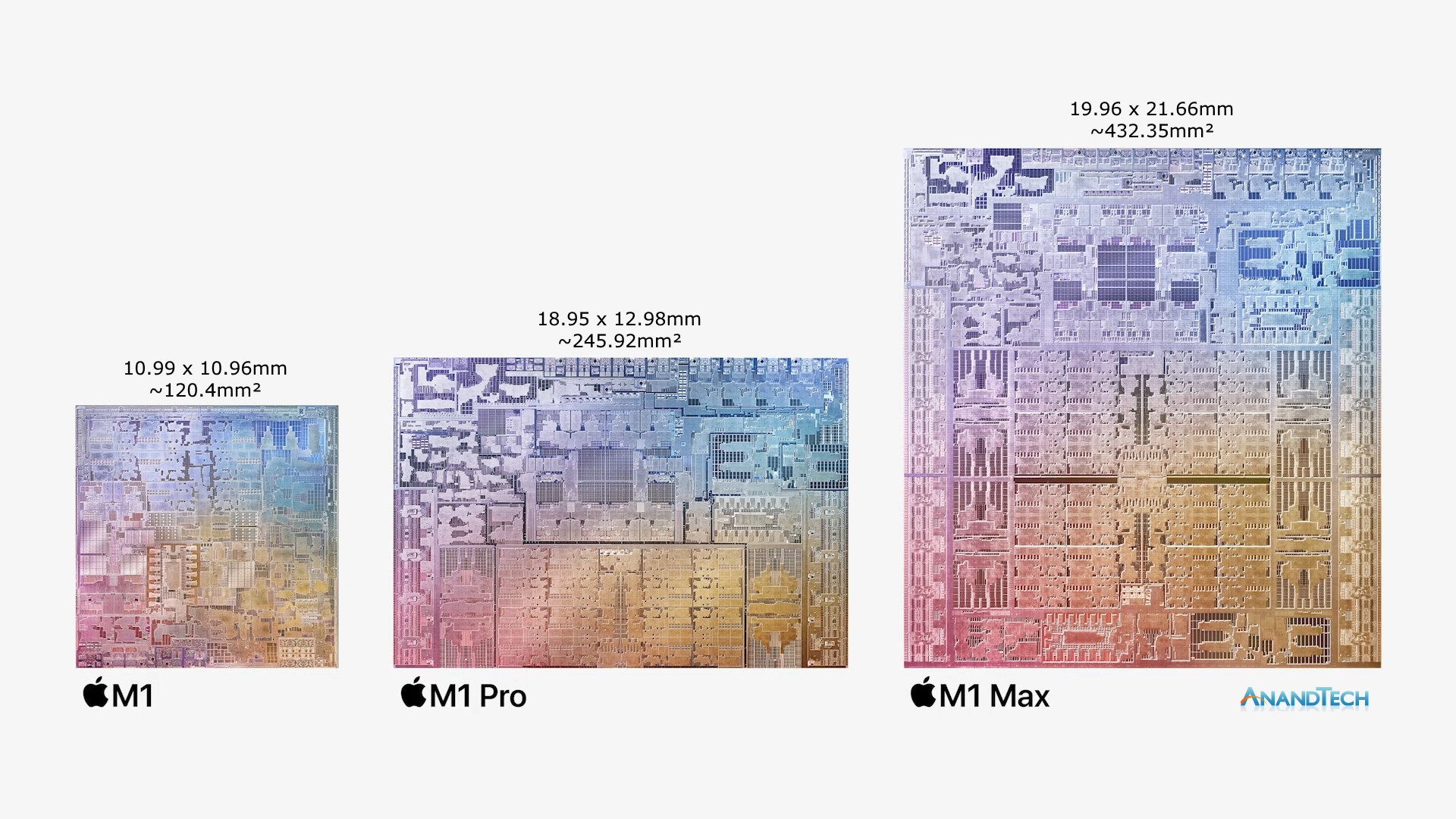
No, that's incorrect. Here's an image that illustrates the physical differences between the M1, M1 Pro, and M1 Max, including their vastly different die sizes: https://images.anandtech.com/doci/17019/Die-Sizes.jpg

Re: Nvidia Grace CPU

#187

Earlier quoted context omitted.

Where do you see these are Apple designed CPUs? There doesn't seem to be anything indicating that, and that would be massive news.

Err sorry, I thought we were talking about the Apple M1 as in another comment subthread here, but that wasn't this one actually. But my point still stands I think, isn't this CPU designed by Nvidia, also just with an ARM-licensed ISA? Similarly AMD you mentioned in your list shares its ISA with Intel, and yet the CPUs are completely different.

The CPU is custom but the cores are off-the-shelf Arm cores.

Re: Nvidia Grace CPU

#188
post #86

Earlier quoted context omitted.

There is constant production and deliveries being made, just no standing inventory.

Can you enter a queue to purchase them? If not it's just a cat and mouse game to get one.

Direct retail / individual sales are always the least important and the first to get restricted amounts of supply so that large orders can be filled. There is a queue and lots of orders are moving through it, you personally just don't see this.

Depending on the product, volume orders for high-end ICs are typically running between 52 and 72 weeks of lead time at the present, and it's been this way for many months now. So the orders that are getting filled today for parts were placed in early 2021 in most cases.

This is generally very difficult for retailers, because they have had to come up with capital to have a year's worth of orders in the pipeline. So they've been having to stock fewer things -- only what they are absolutely sure will sell -- and can't use real-time sales data to estimate the next month's order.

Welcome to the new normal, it'll be this way for at least another year or two, minimum (until new factories get built plus pre-pandemic levels of productivity, for the most part).

Re: Nvidia Grace CPU

#189
post #179

Earlier quoted context omitted.

In order for an Apple Silicon Mac Pro to make any sense whatsoever, its SOC will need have to have support for off-package memory and substantially more PCI-E lanes than the M1 Ultra. Therefore it seems all but certain to me that it will debut the M2 chip family. Apple isn't going to give up the substantial performance benefits of on-package unified memory in order to support DIMMs. Therefore I predict that we'll see…

I would love to be wrong but I dont think DIMM will be a thing on Mac any more. Not only does it not make economical sense for Apple with additional DDR5 memory controller support and testing, they can now also charge substantial premium for memory.

DIMMs likely won't be a thing anywhere before too long. They're too large and problematic to deal with for the latest memory interfaces (which previously had only been found on GPUs). There's only so much you can miniaturize before the connectors become a real problem - and we can now put an entire "computer" in a single package.

I'm interested to see when the PC form factor goes away completely, likely 1-2 generations of product from now.

Re: Nvidia Grace CPU

#190
post #139

Earlier quoted context omitted.

Current MacBook Pro 14"/16" use the M1 Pro/M1 Max instead of the M1 that the Air and 13" MacBook Pro have, so definitely a different (and later iteration) CPU: https://www.apple.com/macbook-pro/

It's the same CPU with a different core distribution.

Let's call it an oversimplification, the SoCs are definitely different. OP sounded like they were thinking about MacBook Air and the 13" MacBook Pro, and not taking the newer models into account.
Post reply on HN