Live data from Hacker News

Add 10 GbE to your system with an M.2 2280 module

cnx-software.com

181–190 of 259 posts

Re: Add 10 GbE to your system with an M.2 2280 module

#181
post #174

Earlier quoted context omitted.

Even 100GbE is hardly seen on company datacenters. Yes, it's cheaper than before, but still more expensive than 10G, and that's extra cost multiplied by all the devices that need to have the improved hardware to take advantage. Plus, most servers won't saturate a 10G link without tweaks on the setup. For 100G it's even worse, I think it will take a long time to see them on datacenters outside of core links or for com…

> Plus, most servers won't saturate a 10G link without tweaks on the setup. That doesn't seem right. When I got my first 10G server, it was running dual Xeon E5-2690 (either v1 or v2), and I don't recall needing to tweak much of anything. That was mostly a single large file downloaded over http, so not super hard to tweak anyway, but server chips are a lot better now than sandy/ivy bridge. It could only get 9gbps out…

> That was mostly a single large file downloaded over http, so not super hard to tweak anyway

Well, my point is that most servers don't just download single large files over HTTP. Even if you only look at storage servers, going into multiple files and connections you can easily find issues and have downgraded performance if you don't prepare the system for the workload.
Re: Add 10 GbE to your system with an M.2 2280 module

#182
I thought I'd never needed 10GbE until I tried to copy couple of large VMs from one a server to a new one. Once I upgraded, I realized that my ISP provided bandwidth was actually 1.2 gb/s instead of the 1 gb. Somehow the default 1gbps port was the restricting factor.

Re: Add 10 GbE to your system with an M.2 2280 module

#183
post #176

Earlier quoted context omitted.

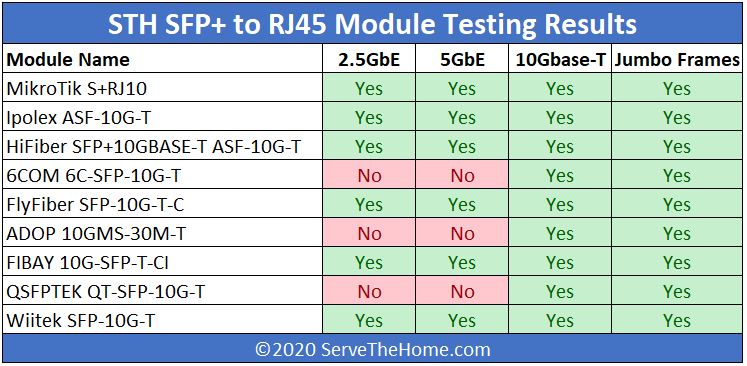
Yes (or at least I've noticed it on mine) but worth noting 99% of 10G RJ45 SFP+ transceivers only support 10G and nothing else. Typically it's only fixed copper interfaces that support negotiating different speeds. The MikroTik adapters are a bit special in that they are more a 2 port transparent bridge where the inside facing portion of the module always runs at 10g and the outside facing portion auto-negotiates. Th…

Super interesting re Mikrotik adapters. Those (S+RJ10) are exactly what I run, so very relevant, thank you!

I think it's a mixed bag of cats, the support for 2.5/5/10G - somebody made an useful table for that: https://www.servethehome.com/wp-content/uploads/2020/03/STH-...

The whole article: https://www.servethehome.com/sfp-to-10gbase-t-adapter-module...

Re: Add 10 GbE to your system with an M.2 2280 module

#184
post #183
post #176

Earlier quoted context omitted.

Super interesting re Mikrotik adapters. Those (S+RJ10) are exactly what I run, so very relevant, thank you!

I think it's a mixed bag of cats, the support for 2.5/5/10G - somebody made an useful table for that: https://www.servethehome.com/wp-content/uploads/2020/03/STH-... The whole article: https://www.servethehome.com/sfp-to-10gbase-t-adapter-module...

Very informative table and article, thank you.

Re: Add 10 GbE to your system with an M.2 2280 module

#185

Some people are saying that they don't feel the need for > 1 Gbps in a home network. As a counter-point, I'm regularly limited by 1 Gbps PHY limits. During the 2 years of the pandemic I've been working from home with gigabit Internet. Why gigabit? Because that's the "speed limit" of the Ethernet PHY in the fibre broadband box, and also my laptop's ethernet port. My laptop can write to disk at multiple GB per second,…

I use a map-maker app for creating game levels, the data is stored on a central server when it's saved.

A 4kx4k map layer section, in RGBA is 64MB. Each layer on the map has multiple types of mask applied (brushed alpha, brushed noise-function,...) so there's another 64MB of XXXX data per layer. A map can have (say) 10 layers on it, so we're up to 1GB, and then there's the data for ephemeral layers ("stamped" images at co-ords and scale, alpha,rotation). The stamps themselves are usually stored in an 8kx8k layer so that's another 256MB

When your 'save' action is 1.5GB of data, a 10Gbe network is much preferred over a 1 Gbe network...

All of this is rendered down for production of course, but during development, each layer is kept separate along with its masks.

Re: Add 10 GbE to your system with an M.2 2280 module

#186
post #179

Earlier quoted context omitted.

I believe Docker has even throttled/blocked corporate users doing excessive layer pulls from Hub (and suggested they sign up for X plan). Reasonable, IMHO.

That's a recent thing, as I understand it. After Hub switched to their enterprise plan setup. ZEIT had a pretty aggressive cache anyway, for the short time it was implemented (before ZEIT moved away from docker hosting, at least).

I always thought it was a little strange given that layers are easily CDN-cacheable indefinitely. That said I'm sure they're using something like a CDN but even the cheapest bandwidth gets expensive at level of scale.

Re: Add 10 GbE to your system with an M.2 2280 module

#187

Earlier quoted context omitted.

Indeed, a 4K video can hardly saturate 100Mbps link https://www.reddit.com/r/PleX/comments/eoa03e/psa_100_mbps_i...

I am confused, as the link appears to say the opposite. > Conclusion: >The majority of 4K movies (75%) I tested have bitrates over 100 Mbps and many seconds where bitrates spiked over 100 Mbps. Some have 100s of seconds where bitrate spikes over 100 Mbps, and will most certainly cause problems if played with bandwidths less than 100 Mbps on devices that don't buffer well such as the LG TV or Roku TV. To make sure you…

The highest average bandwidth shown was 73 mbps. You probably need 150mbps to comfortably play 1 4k move, but once you are looking at the effect 4k movies have on higher bandwidths, average bandwidth becomes more relevant. You could pretty easily stream 10 4k movies over a 1gbps channel since the odds that all of them will be over 100mbps at the same time is low (and even if it happens briefly, it will be handled by buffering).

Re: Add 10 GbE to your system with an M.2 2280 module

#188

Earlier quoted context omitted.

Indeed, a 4K video can hardly saturate 100Mbps link https://www.reddit.com/r/PleX/comments/eoa03e/psa_100_mbps_i...

I am confused, as the link appears to say the opposite. > Conclusion: >The majority of 4K movies (75%) I tested have bitrates over 100 Mbps and many seconds where bitrates spiked over 100 Mbps. Some have 100s of seconds where bitrate spikes over 100 Mbps, and will most certainly cause problems if played with bandwidths less than 100 Mbps on devices that don't buffer well such as the LG TV or Roku TV. To make sure you…

> certainly cause problems if played with bandwidths less than 100 Mbps on devices that don't buffer well such as the LG TV or Roku TV

"If" is doing some heavy lifting there.

The linked post shows that the average bitrate of every sampled 4k movie was less than 75 Mbps. The author even bolded "on devices that don't buffer well such as the LG TV or Roku TV"

Re: Add 10 GbE to your system with an M.2 2280 module

#189

Some people are saying that they don't feel the need for > 1 Gbps in a home network. As a counter-point, I'm regularly limited by 1 Gbps PHY limits. During the 2 years of the pandemic I've been working from home with gigabit Internet. Why gigabit? Because that's the "speed limit" of the Ethernet PHY in the fibre broadband box, and also my laptop's ethernet port. My laptop can write to disk at multiple GB per second,…

> Azure that can easily do 20 Gbps out to the Internet

I have tested Azure and AWS speed out to the internet and they too won't get 20/100 Gbps. That high bandwidth is for connecting instances within the AZ. Once any of the traffic has to go over the internet it's much lower.

> I'll regularly pull down 50-200 GB to my laptop for some reason or another

This is a serious failure in your workflow. You should be looking at reducing that size considerable in terms of a docker image.

Re: Add 10 GbE to your system with an M.2 2280 module

#190

Earlier quoted context omitted.

How do you regularly pull 50-200 GB? This sounds like terrible practices or implementation at work. I've never seen docker images of that size that can't be shrunk with multistage, or docker shrink. I can see how someone could get to that size with just baking in all their models to the image itself but yuck.

windows docker images are incredibly bloated. I don't think I've seen one that size, but the base image for a windows container is like 17GB by itself, if I remember correctly. Basically just pulling down an entire Hyper-V image.

> windows docker images are incredibly bloated

They are no-where near that size ...

Post reply on HN