Live data from Hacker News

Plastc Card

plastc.com

171–180 of 356 posts

Re: Plastc Card

#171
post #35

What need does this address? Are cards taking up too much room in people's lives? This solution doesn't reduce the height or width of the encumbrance at all, and reduces the depth only by n*.76mm, where n is the number of cards that will be replaced. I don't get it. Also, http://c2.com/cgi/wiki?TheZenOfProgramming

In theory, this could enable one time use magnetic stripe data, which would solve many security problems. I could get this instead of waiting until all merchants support chip and pin (which is never going to happen in the US).

>I could get this instead of waiting until all merchants support chip and pin (which is never going to happen in the US).

It's going to be supported unless the merchant is happy eating fraudulent charges, which will make them a hotspot for people committing fraud. There's various dates for when that liability kicks in[1]. General trend is 2015 for PoS and 2017 for gas station pumps.
[1]: http://en.wikipedia.org/wiki/EMV#United_States

Re: Plastc Card

#173
post #168

Earlier quoted context omitted.

Interesting that the list of banks is nearly the same as that of ApplePay. I'm glad there are some forward-thinking enough banks willing to push technology forward.

Or they just found a way to implement ApplePay on their card.

Implementing Apple Pay isn't a technical feat. There's a standard for it.[1] As long as the banks let you access their token generation service, it's straightforward. However, I haven't heard of anyone other than Apple getting that permission. It'll happen soon enough, but the chances that these guys are the first seems slim to me.

[1] http://clover-developers.blogspot.com/2014/09/apple-pay.html

Re: Plastc Card

#174
I think most people in the market for something next-generation are going to be looking for more than just "how do I consolidate onto 1 physical card". They're going to want to fundamentally improve the payment system with a completely cardless, PIN-less (save for unlocking it once in the morning), wrist-based device.

Plastc is $155 and you still have to:

1. pull something out of your wallet

2. select a virtual card

3. enter a PIN to unlock it

4. share your real card number with the merchant with all the fraud potential that carries

5. sign the receipt or enter your card's PIN (another PIN!)

Apple Watch is going to leapfrog all that so hard.

- it lives on your wrist

- it stays unlocked as long as it's on your body

- you just tap, no signing or card PINs

- it uses tokenization so you never have to worry about stolen card numbers

- it does craptons more stuff than payments too

One advantage Plastc has is it will work everywhere right away while Apple Pay needs NFC terminals. But those upgrades are happening thanks to chip-and-PIN.

Re: Plastc Card

#175
post #67
post #28

Earlier quoted context omitted.

Question is what exactly does "participating" means. Banks generally hate anything that takes away their branding. Less sleek of this -- i.e. reprogrammable Visa cards -- have been around for a few years but banks never supported them, again because of branding.

It looks like it displays the logo, so it isn't out of the question for banks (now starting to be scared at being disintermediated) to maybe throw in some "support" (aka tepidly allow access). After all, apple pay also reduces branding ( and Apple takes a cut), and threatens a lot of the industry as what you pay with becomes a minor manner (and also massively encourages a single default card).

Does Apple Pay actually reduce branding that much? I bet I'm not the only one who saw the Apple Pay demo and noticed that it displays a nice, large, full-color image of the card being used. Cards with a certain cachet, then (AmEx black, other high-end cards) will still be quite prominently displayed. Indeed, a backlit display might even make more of a brand impression than the physical card, in some situations.

I also am not certain that Apple Pay "massively encourages" a single default card. It looked quite easy in the demo to display multiple cards and switch between them. Looked easier than taking a card out of a crowded wallet and putting it back in, actually.

Re: Plastc Card

#176
post #4

Looks interesting. Was thinking of waiting until a v2 just to let them work through security issues. Seems like the website itself has some front-end glitches - like the "About" page for example (this code visible: )

Sorry yeah my bad, was in the middle of re-writing git history when this got pushed, took a few minutes to revert :) No security problems on frontend, in fact it was the parser protections which kicked in, preventing <?php from parsing etc.

Cool thanks - like the website and glad to hear you fixed it so quickly.

Re: Plastc Card

#177
post #16

They say this supports chip-and-PIN, but I don't believe them until they explain how. If I have a chip-and-PIN card from my bank, the chip has an unreadable secret used to generate one-time cryptograms to verify the authenticity of the card. There's no way to get that secret onto my Plastc card. You'd need partnerships with banks to get a new secret the way Apple Pay does. Without those, this sounds like it'll be use…

That was my exact concern. Chip and PIN is kind of broken. Someone else linked to sources, so I won't. From what I remember researching about a year or two ago, was that one of the attacks on Chip and PIN was to generate fake transactions with the card. If you replay those transactions to a POS terminal in the same order, they will be valid. If you use the actual card before the captured transactions, it throws off the order, making the captured ones invalid. My guess is that this card is either taking advantage of this vulnerability, or making some kind of deal with individual banks.

Re: Plastc Card

#178

I really like the idea, but at $155 this is a luxury item for people who have disposable income. Also, with the release of Apple Pay, I truly think eventually all brick and mortar businesses will support paying with your phone.

s/phone/iphone/?

Re: Plastc Card

#179
post #110
post #30

Earlier quoted context omitted.

I'm calling shenanigans after reading their specs. Here are my reasons: NFC + EMV secure elements are issued by banks and can't be reprogrammed. You can't switch between them on the fly. You can only house "multiple" EMVs if you can by some grace of god magic convince the different banks, and Amex to take your card to their facility and program it with their secure info and then give it back to you. E-ink displays ar…

"E-ink displays are WAY thicker than they can fit in there" No, I have in my pocket a PayPal Security Key: it is the same size and thickness and flexibility as a credit card, yet it houses an e-paper display: https://www.paypal-community.com/t5/image/serverpage/image-i... They have been on the market for 5+ years, so the technology is there. Plastc has a bigger display, but there is no doubt it can fit in a credit ca…

You have a segmented e-ink display in there.

They have a full pixel display. They are different. E-Ink displays are 1.18mm thick per their spec sheet and you have to add some mechanically stiff backing to that.

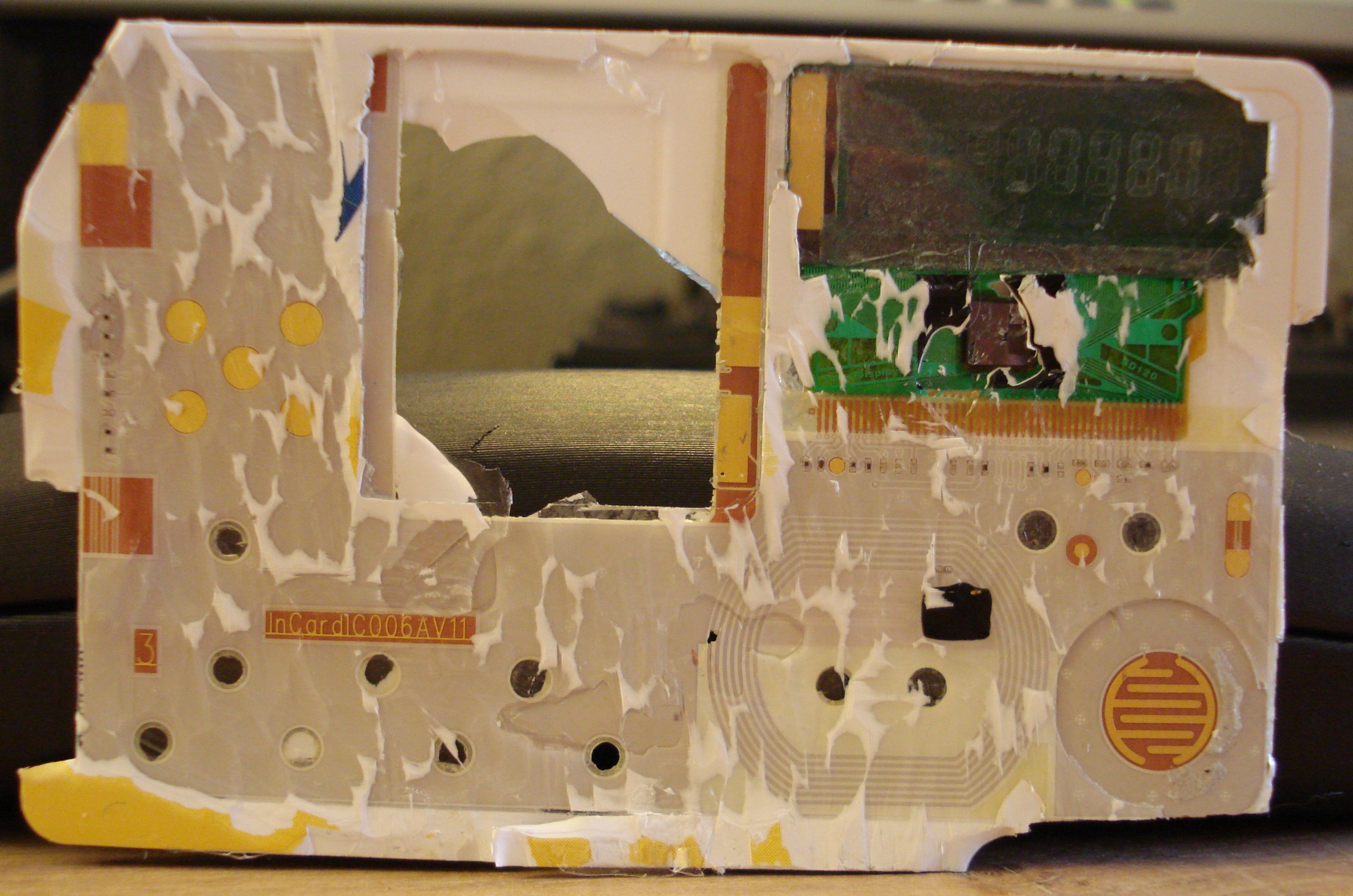
Looking at a detailed photo [1] it looks like a STN segmented LCD but I could be wrong.

Incidentally, do you have a pair of callipers handy? Could you measure the PayPal Security Key?

I don't think it is the same thickness as a credit card.

[1] http://www.stahlke.org/dan/displaycard/front.jpg

Re: Plastc Card

#180
post #16

They say this supports chip-and-PIN, but I don't believe them until they explain how. If I have a chip-and-PIN card from my bank, the chip has an unreadable secret used to generate one-time cryptograms to verify the authenticity of the card. There's no way to get that secret onto my Plastc card. You'd need partnerships with banks to get a new secret the way Apple Pay does. Without those, this sounds like it'll be use…

> You'd need partnerships with banks to get a new secret the way Apple Pay does

If this is using the EMVCo tokenization stuff, which it is widely believed that Apple is using, I don't think they would have to partner with banks. They'd just have to register with a Token Service Provider.

Here's an interesting article on this: http://www.aviso.io/apple-pay-brings-new-problems-acquirers/

Post reply on HN