Live data from Hacker News

Methane may not warm the Earth quite as much as previously thought

sciencenews.org

161–170 of 450 posts

Re: Methane may not warm the Earth quite as much as previously thought

#161
post #66

Earlier quoted context omitted.

All plants we eat are fertilized. We can stop fertilizing and all die.

[flagged]

Different activists have different goals. Assuming societal death is a goal is extremely uncharitable and wrong for the majority of activists.

For example, I believe that carbon emissions and the resulting climate change is the biggest climate issue we face.

I live in California, many people here are against damming because it will damage the natural environment where the reservoirs form. I think the reservoir damage is worth the “carbon cleanliness” of hydro power. Other people care more about preserving untouched nature more than the climate. They have different goals.

Still others think we should reduce consumption of resources like plastics because of their environmental impact. They may prefer more expensive or energy intense production methods and recycling methods.

Most activists won’t say something else is bad. Eg I think recycling is good, but I would prefer lower greenhouse emissions over lower trash. FWIW I don’t eat meat. It’s better for the environment, because it’s reduce emissions. It’s also less wasteful of water which is environmentally expensive. I don’t eat almonds for the same reasons. But I’d rather expend water if it reduced emissions, but I’m not sure of any examples where those are opposed, maybe with certain fabrics and their cost of production?

My jobs is also to reduce methane emissions at natural gas facilities, because in 2023 we need gas so let’s try to make it less polluting.

Re: Methane may not warm the Earth quite as much as previously thought

#162
post #137

Earlier quoted context omitted.

> I think climate change is a problem (not a crisis) but it's important to note that if a scientist questions climate science, he becomes a pariah. People who have never done science really like this idea of the general scientific community being some sort of secret society that agrees to support eachothers ideas. If you put 5 scientists in a room, you can't get them to agree on >anything<. The idea that disagreement…

I know scientists who are climate change skeptics. However, what gets published ("the consensus") isn't the same as "what scientists think". This isn't only true in science, it's true in virtually all parts of human societies. It's hard to go against the grain and you're naive if you think doing so doesn't blight careers.

Who is preventing the skeptics from posting their arguments anonymously to arxiv for us to see how the arguments hold?

Re: Methane may not warm the Earth quite as much as previously thought

#163

Earlier quoted context omitted.

I don’t understand this logic or the wording. Methane = increase in Co2 Reducing methane = no effect But reducing Co2 yes? Why wouldn’t reducing methane change anything? Following your logic reducing Methane is reducing Co2, no?

The argument is that there is a set quantity of co2/methane in circulation. The meat industry supposedly isn't increasing the amount on a yearly basis. By that logic the only climate change relevant source of greenhouse gases are ones that introduce new ones into the circle, which is pretty much only burning fossil fuel. It's a pretty old argument that holds some truth, (the fossil fuels are the biggest issue) but is…

Are you saying that the claim is that meat industry is extracting as much Co2 as they contribute?

Re: Methane may not warm the Earth quite as much as previously thought

#164

Earlier quoted context omitted.

Except climate change is happening, and there's no doubt about that because knowing it's happening isn't relying on models, it's relying on thermometers (and to a lesser extent ice cores to confirm that it's human-driven rather than a natural change). How bad climate change will be, yeah I suppose there is a little fuzzyness there. But given how bad it COULD be (think: complete extinction of humanity, or an end of ci…

The temperature has changed repeatedly without any evidence of human involvement over those longer time periods we can observe. And the levels of CO2 etc. have changed as well, during time periods when it could not possibly have been blamed on humans. I grew up in Canada, in an area with lots of farms... and I remember the high school trips to different geographical features such as moraines which are the residue of…

https://m.youtube.com/watch?v=OWXoRSIxyIU

13 misconceptions about global warming

an 8 year old video

Re: Methane may not warm the Earth quite as much as previously thought

#165
It is kind of astonishing to me to witness the discussion in these comments proceeding civilly and with actual regard to the science. In my experience this is vanishingly rare. It's extremely refreshing. At risk of ruining that civility, I'd like to address some aspects of climate scepticism various other comments are touching on.

It is not difficult to see that a reasonable person may ask that if the UN is correct in saying 30% of climate change is due to methane[1] and this paper is correct in saying methane is 30% less effective at warming than we thought, then isn't this whole climate change problem potentially ~9% smaller than we thought? And isn't that actually pretty big? Big enough to potentially have policy implications?

I'm quite sure it's not that simple but nevertheless as a starting point for discovery it's a decent question. It's also a question that will be met with astonishing levels of derision on social media, mainstream media, and in society more generally. Merely asking it will have large international media outlets like the BBC openly describing the questioner as a 'climate sceptic/denier' which, while some may wear it as a badge of honour, actually serves the purpose of shaming them publicly for wrongthink. Social media will of course be far worse in this regard.

We now live in a world where it is popularly considered valid to provide a political (to put it kindly) response to a scientific question. It is, of course, both invalid and indefensible.

I have no ideological aversion to the idea that climate change is real and a serious threat, but the quality of societal discourse on the topic has become so poor and so overtly political that there is absolutely no basis upon which I can accept either of those assertions as _actually scientifically_ true (short of becoming a climate scientist and spending the next however many years personally reviewing all the literature). For me to accept these assertions as fact would be indistinguishable from a declaration of religious faith. It isn't going to happen.

Moreover the conduct of the pro-climate change 'lobby' from the IPCC to the BBC to Just Stop Oil activists has, on the whole, fallen so far short of the standard demanded by the severity of the problem they espouse that I simply don't believe them very much anymore. In my view--and I claim no authority on this matter, this is just how I see it--climate change may well be real and an existential threat, but it may also be a bureaucratic fantasy mistakenly grown from kernels of misunderstood or mistaken truths that has gotten so completely out of control that it's now controlling us. It could also be somewhere in between, or something else entirely: I don't know and I cannot know so long as society keeps excluding valid voices with valid questions.

I suppose I'm a climate sceptic then...but when it comes to deciding between being a sceptic or taking a leap of devotional faith, what choice do I have? Luckily it seems to me the way forward is the same in any case: the pro-climate change people, being the ones comprehensively 'winning' the 'argument' at the moment, need to show a little humility and engage in open debate with the well-meaning sceptics without the ad-hominem attacks, the gaslighting, the censorship, etc. It really is that simple, and the fact it’s so forcefully resisted should, in my view, give us all pause for thought.

[1]: https://www.unep.org/news-and-stories/story/methane-emission...
Re: Methane may not warm the Earth quite as much as previously thought

#166

Earlier quoted context omitted.

The deniers are mostly denying that the impact of human activities on climate is real. They are just attacking the models as a convenient scapegoat which is weird because everyone know the models can be criticised but there is undeniable evidence for human emitted CO2 having an impact so it’s mostly a waste of time. If you really want to criticise the models, demographic hypotheses are far more questionable than anyt…

World population has grown at exactly the same rate for the last 70 years: https://ourworldindata.org/world-population-growth If modellers were caught by surprise by this then they are clueless. But they weren't because population doesn't factor into models. They go straight from projections of CO2 levels, which have also grown at a constant rate: https://gml.noaa.gov/ccgg/trends/ So it's not clear why you bring up p…

> World population has grown at exactly the same rate for the last 70 years

Did you actually look at what you linked?

The main graph is only China and India and already shows a net inflection for China in the past few years. It will keep slowing. Read about population-lag effect.

The second graph nicely confirms that contrary to what you pretend population growth has started slowing globally.

There is no consensus about how much it will slow and when the peak will be reached. IPCCC had to adjust their hypotheses in the past because the lowest credible estimation where falling outside the lowest considered by the first climate model and some specialist argue we should look at even lower prediction. People in developing nations have stopped having large families faster than we thought.

> So it's not clear why you bring up population growth. It's not relevant.

If you don’t see how population size affects consumption, production and in fine pollution, I can’t do much for you.

> What is it and how is this impact measured in an undeniable way. It can't be temperatures because they don't track CO2 levels.

You are clearly arguing in bad faith or are clueless about the research surrounding climate change. In both case, I think it would be a waste of my time arguing further.

Re: Methane may not warm the Earth quite as much as previously thought

#167
post #137

Earlier quoted context omitted.

I know scientists who are climate change skeptics. However, what gets published ("the consensus") isn't the same as "what scientists think". This isn't only true in science, it's true in virtually all parts of human societies. It's hard to go against the grain and you're naive if you think doing so doesn't blight careers.

Who is preventing the skeptics from posting their arguments anonymously to arxiv for us to see how the arguments hold?

Well for one thing it's a waste of time to work on research that won't advance your career.

Also, I'm not saying "heterodox scientists have secret, bulletproof analyses to disprove climate change," I'm saying that there are significant incentives against publishing climate-crisis-skeptical research. I'm unsure how anyone can disagree with that. Acknowledging it doesn't mean denying climate change is real or accepting that its risks are exaggerated.

Re: Methane may not warm the Earth quite as much as previously thought

#168

Earlier quoted context omitted.

The reason your comment is bad isn't you pointing out some "truth". The reason is your comment being misleading. You pretend, the accuracy of climate models was insufficient for any relevant conclusions to be made. That is just nonsense. The interesting part is people clinging onto anything calling that impending climate catastrophe (or its human cause) into question. Individual subjective short-term benefits outweig…

You're talking about changing literally trillions of dollars worth of economic activity, per year, now and supposedly for the next 50 or 100 years, across the whole of Western civilization. The requirement for the math being absolutely "spot-on" in this case is extremely high. Is it?

If the police isn't sure if someone is driving 190 or 220 miles per hour in a 45 zone, should we just not ticket the person?

Or perhaps a "scientist" has spotted a suspected cancer in your brain but they can't quite pinpoint whether it's a 20x increase from normal size or a 28x increase. Based on the 28 assumption, you'll be in a wheelchair within seven years, but it might also be ten years. It's entirely preventable by doing the surgery but that costs money today plus minor lifestyle changes. Before doing a costly operation and bothering with, say, a daily pill and no alcohol, one could choose to wait while they refine their equipment over the next decades and then measure again before taking serious action. Can't trust dem scientists anyway, maybe it wasn't a problem in the first place.

That's the logic I'm seeing here. A "times worse than CO2" value for one of the elements might have been off by 30% so we should just assume nothing is wrong in the first place and not change our society away from burning carbon. Maybe it's just a coincidence that ~five of the past ten summers are the hottest of all the summers whose temperature we've measured... yeah I agree: maybe. It's a possibility, no matter how remote. But I'd rather not wager with billions of lives impacted by the outcomes that are part obvious (sea level rise) and part the prediction from yet more models. We needed to act yesterday if the models are anywhere near the truth and it's going to get exponentially harder to fix the longer we wait (because reducing emissions year-on-year is a lot easier than cutting+capturing at a moment's notice). If it turns out to be a dud, we can continue to dig up the remaining oil and have a big feast, everyone happy. If not, it's a good thing we acted and we're probably still not going to be able to prevent some level of habitat damage for the species we call human, but at least it won't be as bad as when we wait for more precise information on a problem where the conclusion remains unchanged.

(That's besides the healthy years of life provided by having cleaner air; I don't know how that would compare against e.g. cobalt mining.)

Re: Methane may not warm the Earth quite as much as previously thought

#169

Earlier quoted context omitted.

World population has grown at exactly the same rate for the last 70 years: https://ourworldindata.org/world-population-growth If modellers were caught by surprise by this then they are clueless. But they weren't because population doesn't factor into models. They go straight from projections of CO2 levels, which have also grown at a constant rate: https://gml.noaa.gov/ccgg/trends/ So it's not clear why you bring up p…

> World population has grown at exactly the same rate for the last 70 years Did you actually look at what you linked? The main graph is only China and India and already shows a net inflection for China in the past few years. It will keep slowing. Read about population-lag effect. The second graph nicely confirms that contrary to what you pretend population growth has started slowing globally. There is no consensus ab…

Did you bother changing the graph to show world population instead of just looking at the default selection? Here is the link to assist you in this:

https://ourworldindata.org/explorers/population-and-demograp...

It is a straight upwards line.

But as I said, they don't care about population, only CO2 levels, which also go up in a straight line.

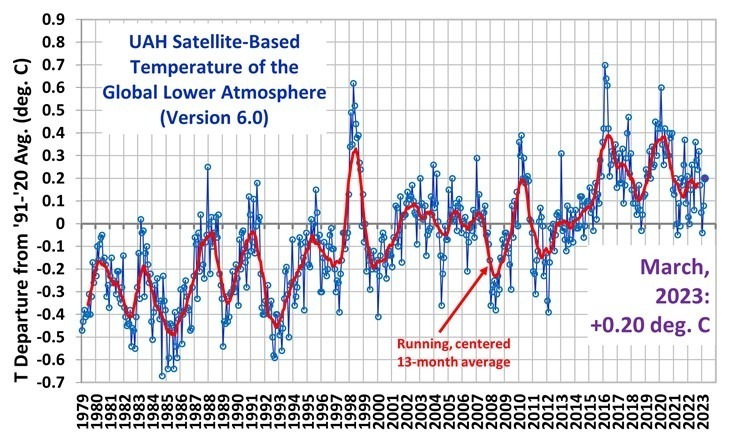
It would indeed be a waste of time for you to argue further, because you don't seem able to respond to the points being made. Here is a graph of temperature as measured by satellites. It consists of long flat periods, punctuated by sudden rises. This is not correlated with CO2, which grows smoothly.

https://www.drroyspencer.com/wp-content/uploads/UAH_LT_1979_...

Now, do you care to respond to the data that's being cited?

Re: Methane may not warm the Earth quite as much as previously thought

#170

Earlier quoted context omitted.

The argument is that there is a set quantity of co2/methane in circulation. The meat industry supposedly isn't increasing the amount on a yearly basis. By that logic the only climate change relevant source of greenhouse gases are ones that introduce new ones into the circle, which is pretty much only burning fossil fuel. It's a pretty old argument that holds some truth, (the fossil fuels are the biggest issue) but is…

Are you saying that the claim is that meat industry is extracting as much Co2 as they contribute?

Specifically with respect to the methane cow farts, yes. That carbon comes from their plant diet (be it grass in a field or grain in a feeding lot), and the carbon in those plants came from the atmosphere.

This isn't counting the fossil fuels the industry also burns, or the carbon released during the production of fertilizers used when growing that feed. But the carbon in the feed itself all comes from the atmosphere, and therefore the carbon in the methane emitted by cows comes from the atmosphere.

Post reply on HN