Earlier quoted context omitted.
A thing photographers / image-effects people think about a lot: pixels aren't little squares; they're sample points . If you've ever played around with graphics-rendering — UV coordinate sampling, convolution, etc — then you know that you can think of a (2D) raster image as really being a grid of samples of what color you get when you look at the UV coordinate represented by the center of that grid-point on some unde…
Pixels are very much and in very many cases much more a square than a sample. Cameras integrate lightfall over an area, and though consumer formats munge that data, they surely do not do so in a way that is best approximated by a zero-width point sample. Pixels on most modern displays, albeit not those from the era of the famous 1995 paper, have especially at low resolution visible squareness; not as squares precisel…
You didn't really grasp what I was trying to say, I think. When I say "pixel art", I'm not referring to an art style where you draw things under the constraint that you have to draw them using chunky squares. That aesthetic may as well be created as a bunch of SVG rectangles, or even 3D-modelled as voxel cubes with an orthographic camera. (And, in modern "pixel art", it often is. The art assets of many modern "2D" games are often slightly-3D-extruded voxel-cube models, despite the camera + shaders obscuring this. And some games, such as Fez, take advantage of this.)
Rather, by "pixel art", I'm referring to representational art created as low-resolution hand-dotted pontillist raster images throughout the 70s-90s, made that way due to the technical constraints of storage and/or reproduction, with the intention to "compress" information from higher-resolution assets into a small space through stylistic summarization/abridgement.
Examples:
- the icons of Windows 9x (http://www.iconconstructor.com/tutorials/what_is_icon/icon_g...)

- the original Rollercoaster Tycoon (https://launchpadlab.com/wp-content/uploads/2020/04/ux.jpg)
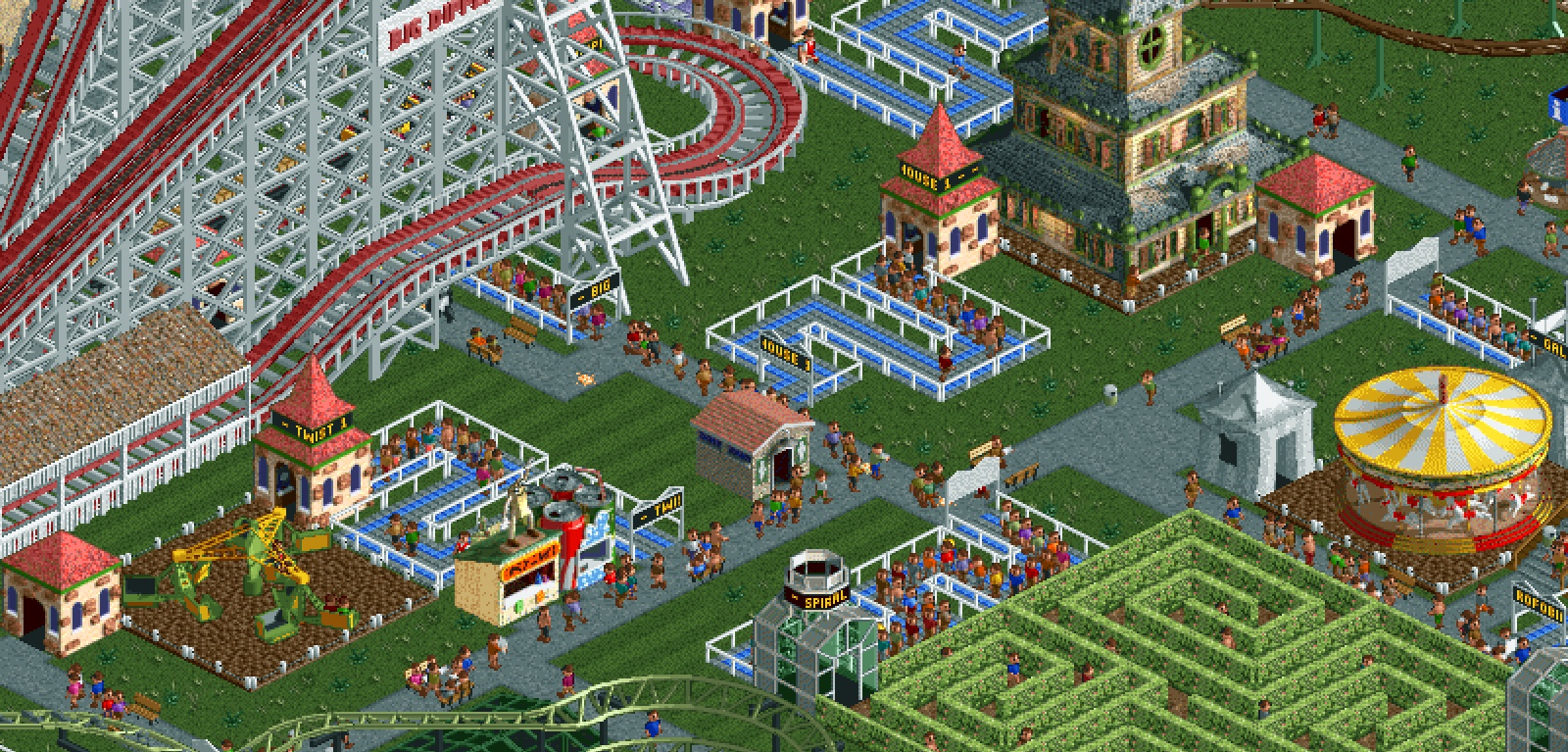
These things are pixel art, but not in the sense that you're meant to perceive the pixels. They were intended for rendering on a display with a DPI and lack-of-crispness such that those pixels would be barely perceptible. Rather, they're pixel art in the sense that every pixel was individually considered, for the informational effect it has in communicating the idea of a more complex underlying visual object than can be compressed into a 16x16 or 32x32 grid.
In the Windows icon example, the smaller 16x16 icons, were almost always created by first designing the 32x32 image, then resizing it to 16x16, and then "cleaning it up", redrawing edges and textures to create something that looks crisp and conveys the same information that the 32x32 image does.
But if you think about it, the "informationally correct" upscaling of the 16x16 image, is the original 32x32 image that was downscaled to create it. In the same sense that the proper upscaled version of an 8pt font in a font-face, is a 16pt or 32pt or 72pt font in that same font-face. If someone asks you to replace the 16x16 images with 32x32 ones, and you have the original 32x32 images used to create the 16x16 ones laying around, then you'd use those.
But if all you have is the 16x16s — well, that information from the 32x32 originals, doesn't exist in the 16x16 images. And, as well, a bunch of information has been "created" in the 16x16 image — a sort of "hinting" has been done (by hand, but it could have just as well been done like font hinting, specifying algorithmically an arbitrary position within each 2x2-pixel UV-coordinate box that should be sampled to produce the resulting pixel for the 16x16 image, in order to get crisp borders et al.) Taking that information into account, would distort the 32x32 image. (Exactly the same way that applying small-font-size font-hints to a large-font-size grapheme would distort it.)
Some pixel-art assets, e.g. the ones in games like Donkey Kong Country, are literally downsamplings of original higher-resolution 3D renders. The "correct" upscaling for these would just be the original high-resolution image. You can't create that upscaling, though, because some of the information to create it was discarded during the downsampling. There is detail that has been lost. The pixel art is a summary, an abridgement, of an underlying image — a literal sampling of some, but not all, of the underlying data.
The only difference between Donkey Kong Country's assets, and Windows 9x, is that in Windows 9x, the "underlying image" that the icons sample, is imaginary. Nobody created a hi-res version of the icon, before creating the low-res version. But they were picturing it. And, if they were asked to, they could put that version to paper just as well. Just because the original icon only existed in someone's mind's eye, doesn't mean it didn't exist. Just because the underlying scene painted in a pontillist style was imagined out of whole cloth, doesn't mean it didn't exist, in the painter's mind's eye, in more detail than the painting captured.
This is in contrast to the modern "pixel art" aesthetic, where the pixels themselves are the intended detail. If you upscale Steve Minecraft, you just get Steve Minecraft. Same blocky look, even at infinite resolution. No additional information needed, because the information is already there — the UV map really does convey "a tessellation of infinitely-sharply-edged squares" (or a mesh of polygons composing into little voxel-cubes), rather than sample-points.