Live data from Hacker News

1% of farms operate 70% of world's farmland

theguardian.com

161–170 of 222 posts

Re: 1% of farms operate 70% of world's farmland

#161
post #5

Some farms are just hella big with ultra low land productivity.

Currently, EU subsidizes farms based on land area. Which is supposed to change, but the lobby is strong.

The current CAP proposal for the 2020-2027 period basically, thanks to intense lobbying by the agribusiness sector, more or less the same as the current scheme.

If adopted, it will more or less put a stake through the EU Green New Deal that they're supposedly also implementing. :(
Re: 1% of farms operate 70% of world's farmland

#162
post #23

Earlier quoted context omitted.

Isn’t the solution to increase these farms’ economies of scale? So the same civilisation-enhancing forces that drove development 10,000 years ago can show their force more broadly?

What economies of scale specifically do farms have? A farm is not a factory where you can create a uniform process...

Just a few: Tractor amortization over additional acres. Administrative overhead rarely scales linearly. Better prices on inputs from ordering in larger quantities. Access to new tech that is too expensive for smaller operations to justify.

A farm is very similar to a factory in many ways. You buy inputs (especially Nitrogen) and convert those into a usable output using biological machinery. This becomes especially true for people planting permanent crops (I.e almonds) where you also need to consider the maintenance on the plant (pruning, etc) as it ages. Uniformity of process is actually another place that large farms benefit. They can afford the quality managers capable of designing such systems. An owner-operator with one guy working part-time for him is less likely to bother.

Re: 1% of farms operate 70% of world's farmland

#164
post #26
post #23

Earlier quoted context omitted.

What economies of scale specifically do farms have? A farm is not a factory where you can create a uniform process...

Well, as a simple example, you can't efficiently plow or mechanically harvest lots of land which are very small or have a weird shape. If you aggregate them, it becomes much more efficient. Same thing goes for purchasing equipment or supplies, you can buy in bulk for a large farm. Modern farms ARE factories.

Modern farm business is made to look like a factory by the big business, but that is not a proof that this maximizes yield per acre, or makes food as cheap as possible.

This is not an anti-corporate slur, I am just pointing out that if you have n acres of land under big ag, you would need to implement a more boutique ag operation on the same piece of land to come up with a sane comparison.

Since this is really not feasible generally I would like to know has someone actually studied this.

For example, soil is not necessarily uniform, and smaller scale operation might utilize the specific area of land for a mixture of landraces that might improve the yield than the monocrop that was designed to be able to produce crop in a generic industrial process, but not might for example be optimal for any soil.

Re: 1% of farms operate 70% of world's farmland

#165
post #152
post #93

Earlier quoted context omitted.

> Maybe true in glorious future where the industrialized farm can support increased biodiversity While it certainly reduces on-farm biodiversity, higher yields also let us leave more land completely un-farmed. For example I think maybe 10% of France has returned to forest in the last 40 years, and more since 1900, but I can't seem to find a great link...

The Jevons Paradox would like a word. E.g., we spend 14 million acres on non-food corn ethanol, and 80+ million acres of corn is fed to livestock at terrible feed conversion ratios. We'd get the same amount of net calories on our plates for 8 million acres if we ate the corn.

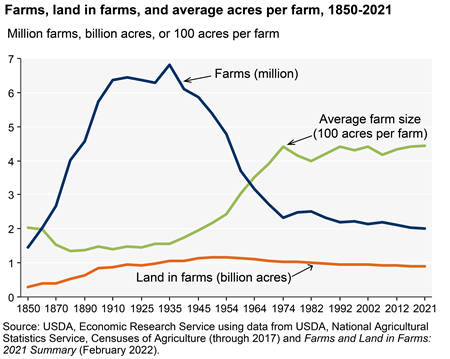
The area farmed in the US has declined slowly since the 1950s, maybe down 20%? Am eyeballing graphs as google is failing me:

https://www.ers.usda.gov/webdocs/charts/58267/farms_fig01_45...

It would decline faster if we didn't subsidize stupid stuff like corn ethanol, for sure.

Edit, a maybe a better graph:

https://ourworldindata.org/grapher/share-of-land-area-used-f...

Re: 1% of farms operate 70% of world's farmland

#166
post #17

Earlier quoted context omitted.

> And even if someone farms for selling to others if they don't have reliable access to machinery the farms will be really small as that just does not scale up (just take a look at pre industrial world where something like 90% of people were farmers) You seem to assume/imply that small farms in the developing world cannot scale up due to economic/business reasons. However in some developing countries, farms cannot be…

I agree with most of your comment but the final paragraph is a bit ???? > if farming in the Western world wasn't heavily subsidized, it wouldn't exist in the Western world It probably would change, but it's weird to suggest it would stop existing without governmental subsidies. Most farming in the West is either intensive mass-production of commodities or sectorial, high-margin goods like wine. For the most part, agr…

New Zeeland ended all agricultural subsidies in, IIRC, 1984. Seems to be working out pretty well for them.

That being said, there certainly are good reasons to have rough food self sufficiency and resiliency for crisis situations, rather than going all the way with free trade and Ricardo's comparative advantage arguments.

I just hope the EU could direct it's farm subsidies to emphasize the environment, and not dump as much excess products on the world market, driving poor 3rd world farmers into bankruptcy.

Re: 1% of farms operate 70% of world's farmland

#167
post #13

Farms have continued to grow, echoing Earl Butz' (Nixon's Secretary of Ag) "get big or get out" philosophy. However, there are several studies out there showing that a greater portion of the world's population is fed by small farms: - https://www.thelancet.com/journals/lanplh/article/PIIS2542-5... - https://iopscience.iop.org/article/10.1088/1748-9326/11/12/1... - http://www.fao.org/family-farming/detail/en/c/284666/…

Isn’t the solution to increase these farms’ economies of scale? So the same civilisation-enhancing forces that drove development 10,000 years ago can show their force more broadly?

The problem is that the economies of scale are invested in and enjoyed by the biggest players first, so by the time they can be enjoyed by the smaller farms the markets have already adjusted to make it a necessity just to stay above water.

Re: 1% of farms operate 70% of world's farmland

#168
post #141

Earlier quoted context omitted.

It’s important to prevent monopolies in any industry but there are degrees of importance. The food supply chain is more important than the automotive supply chain.

But 1% of even 2000 car firms is far from a "monopoly", and 1% of the world's farms is still probably thousands of farms, right?

Much more then thousands, WAY more.

Somebody else in this thread says:

> there are 608 million farms in the world

Re: 1% of farms operate 70% of world's farmland

#169
post #30

Industrialisation of farming is a good thing more than a bad thing. You don't want the cost of food to go up, or the supply to go down. You kind of want large scale industrial farming. It's like complaining that large factories are taking over small artisans.

This is a gross over-simplification of an incredibly complex problem. For those interested in an analysis that goes beyond 140-character insights, please read A Small Farm Future by Chris Smaje. And for those uninterested, be cautious of these "common sense" hot takes.

Re: 1% of farms operate 70% of world's farmland

#170
post #11

Earlier quoted context omitted.

EU also sets limits on how much farms can produce. No one cares about yield from unit of land, they care about keeping prices high, so that farmers get adequate profits. EU will even pay farmers a pension if they retire and stop production.

Funny story, an aging local farmer used raise free-range a small amount of turkeys for the Christmas market. But she stopped because she thought the EU satellites would catch her doing it without permission. Those turkeys were far better than anything you would buy in a supermarket.

Regulations and centralised governments kill small businesses. Don't worry though, it's for your health (oh and for those cheeky shareholders of big corporations).

Similar story here: https://www.fwi.co.uk/livestock/poultry/other-poultry/turkey...

Post reply on HN