Earlier quoted context omitted.
What was the illness? Did you ask the doctor why he was using a Commodore 64?
I deliberately didn't specify the illness for privacy reasons, though it was an airborne contagious disease. I did not ask him why he was using such an old machine, but it seemed to work and he was rather old also. The detail only sticks out because it was so odd.
Nearly 1 in 3 drugs have a significant safety issue after FDA approval
161–167 of 167 posts
Re: Nearly 1 in 3 drugs have a significant safety issue after FDA approval
#162Earlier quoted context omitted.
That's a very industry-friendly number with a very industry-friendly calculation; > CSDD’s finding, a bellwether figure in the drug industry, is based on an average out-of-pocket cost of $1.4 billion and an estimate of $1.2 billion in returns that investors forego on that money during the 10-plus years a drug candidate spends in development. Backing some figures out then, the actual cash cost is $1.4 billion to devel…
> Backing some figures out then, the actual cash cost is $1.4 billion to develop a drug. They rely on a 11.8% clinical success rate for that figure, so if you back out the drugs that were abandoned along the way (since they won't need late-stage human safety studies), it's more like $165M to develop a self-originated drug if you believe the self-supplied pharma figures. The actual cost to develop a single successful…
I'd love to see a source for that.. Not even Pharma claims figures that high. Take Sofosbuvir for example; It was discovered in 2007, was developed through 2011 and then the company was acquired by Gilead while they had multiple Phase III trials running. In that time period, they spent a total of $230 million on R&D -- for all of their candidates. They also had two other compounds that were undergoing Phase II trials.
> The Phase III clinical trial by itself is well over $100M, much more if you're doing a large, long-term clinical study for a difficult problem (say, Alzheimer's or cancer).
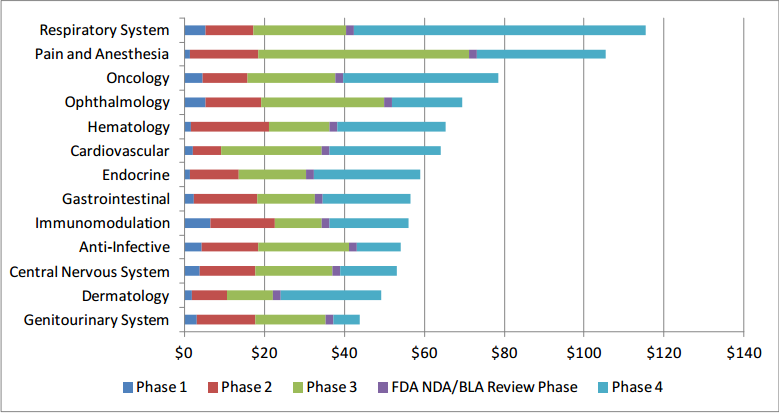
Nah. Not even close. HHS's most recent look placed Phase III at $19.9M, with very few classes of drugs costing more than $50M total for all phases (Ignoring IV since those are often more marketing than R&D)[1]:
https://aspe.hhs.gov/system/files/images-reports/examination...
> Something like 50% of all drugs fail in phase III.
The average is closer to 60% success rate, with some areas up to 75% success.[2] And it's not like if you fail the Phase III, the compound is scrapped and all of that work is wasted. There's an entire industry behind drug "repurposing, repositioning and rescue" to purchase and retarget promising compounds.
[1] Full study: https://aspe.hhs.gov/report/examination-clinical-trial-costs...
[2] https://www.bio.org/sites/default/files/Clinical%20Developme...
Re: Nearly 1 in 3 drugs have a significant safety issue after FDA approval
#163Earlier quoted context omitted.
Irrationalism? Err no. Taleb expounds on his definition of the natural - anything that man has done for 100s of years without observing downside. There is reasonable cause to believe that people are very interventionist in a lot of cases where all that is needed is letting the system sort itself out. Diabetes medication for instance (again - not in all cases): https://www.youtube.com/watch?v=da1vvigy5tQ A lot of open…
Note that thalidomide is still used as a medicine; it is a very effective drug when other drugs don't work. The issue was that it was given to pregnant women, when it was known that it shouldn't have been.
Re: Nearly 1 in 3 drugs have a significant safety issue after FDA approval
#164Earlier quoted context omitted.
Note that thalidomide is still used as a medicine; it is a very effective drug when other drugs don't work. The issue was that it was given to pregnant women, when it was known that it shouldn't have been.
I think it was only a stereoisomer that caused trouble.
Re: Nearly 1 in 3 drugs have a significant safety issue after FDA approval
#165Earlier quoted context omitted.
I will admit that some of us may be inappropriately dismissive of the usefulness of regulators. However pointing to how long it takes and how much money is spent could just as well imply inefficiency as rigor. You say that we don't need competing regulation agencies because this one is rigorously scientific. By what mechanism, would you say, does this singular institution maintain quality?
>By what mechanism, would you say, does this singular institution maintain quality? Interesting question, quality is such a foundationally important and vital subject for the FDA. Hard to answer, it's like asking what does Microsoft do to maintain software quality? The answer has to be long and in depth... And in this case, the FDA is over 100 years old, born out of atrociously horrendous food and chemical accidents…
My question is about incentives. An unchallenged organization, I would think, would have the tendency to perpetuate itself, and sing its own praises, and deem itself very important.
Let me put it this way: The analogous question isn't what Microsoft does to maintain quality. The question is, how does the world at large maintain Microsoft's quality (and efficiency?). A decade or so of security embarrassments and OSX's and Linux's better reputation got them to step up their security game. Recently, Apple's design got them to step up their design game. If you asked a manager for a canceled project inside the company they might have a great process plan, a great argument for why they need more time and resources, and a great explanation for why they and their team are important. But they may have no sense of the needs of the outside world. This exchange between Steve Jobs and an (apparent) Apple employee highlights this mentality, vs the mentality of an entrepreneur who does respond to the outside world: https://www.youtube.com/watch?v=FF-tKLISfPE
It very well may be that the FDA does a fantastic job of filtering out bad stuff. And, as (I may as well come out and say it) a libertarian, perhaps I am guilty of not appreciating all the work that has gone into setting it up. But it doesn't mean that they have a sense of the correct amount of rigor to apply, money to spend on various aspects of their operation, etc. That's why we like to see competition in the field of certification.
"That a business should go bankrupt before 1 bad drug is approved." and "some of the largest fines against businesses in history" are great examples of perhaps being a bit too rigorous or punitive. You can always apply more and get at least marginally safer drugs. But you may also get fewer drugs through the process, or more expensive drugs, or companies that decide not to even bother starting the process (which you'll never hear about), and (maybe) more people die on net as a result.
I will grant to you, taking your claims at face value, that you make a convincing case that the FDA at least hasn't gotten lax for the lack of outside corrective influence. I guess the mechanism for improvement there is simply human dedication, and I will buy that argument.
Re: Nearly 1 in 3 drugs have a significant safety issue after FDA approval
#166Negative press like this probably contributes to the FDA being so conservative. They get none of the benefits when a great new drug is approved, but get scapegoated when they approve something dangerous even to small numbers of people. So they just approve as few drugs and medical devices as they can get away with - it's a massive misalignment of incentives. One might think drugs would be more dangerous if the FDA we…
"The far bigger problem than drugs with side effects is a lack of drugs." I'm not so sure about that. Arguably the market is actually oversaturated with drugs, and too many people rely on them to an absurd extent rather than changing behaviors and habits to improve overall health.
Re: Nearly 1 in 3 drugs have a significant safety issue after FDA approval
#167Earlier quoted context omitted.
> 'I can’t read the full study you linked, so I don’t have their examples' Then you go on to cite tumblr ?! Just read the actual paper: http://sci-hub.cc/10.1001/jama.2017.5150
That is, at least, the tumblr of a psychiatrist resident who writes a lot on the subject of FDA regulations. I really recommend his blog posts on the subject, like this one about how different countries (Russia and US particularly) use different drugs and for the most part don't even seem to be so interested in trying the drugs available elsewhere: http://slatestarcodex.com/2014/08/16/an-iron-curtain-has-des...