Live data from Hacker News

USDA Projects Smallest US Wheat Harvest Since 1972 Due to Plains Drought

agweb.com

151–160 of 187 posts

Re: USDA Projects Smallest US Wheat Harvest Since 1972 Due to Plains Drought

#151

Title claims "due to plains drought" but the article text largely attributes this to increased planting of soy for its lower fertilizer requirements (related to Strait of Hormuz).

Maybe a positive. Soy Beans are more healthy. So lower fertilizer demand, and healthier produce, could be a net positive. Kind of like an oil shortage is driving an increase in EVs and renewable energy. Finally waking up the US that oil dependence is a National Security issue that renewables are possible solution for. That renewables aren't the 'woke' enemy, but a valid technical option. So, maybe a net positive.

> Finally waking up the US that oil dependence is a National Security issue that renewables are possible solution for. That renewables aren't the 'woke' enemy, but a valid technical option.

Amazingly invisible fact to the US political right. Glaringly obvious, yet they can't see it. It's almost like they don't even have their country's best interests at heart...
Re: USDA Projects Smallest US Wheat Harvest Since 1972 Due to Plains Drought

#152
post #57

Earlier quoted context omitted.

Do you think laws go away just because they're old? The Colorado River compact came into effect in 1922 and I'm almost surprised literal fist fights haven't erupted over it during the modern negotiations.

I think laws become less relevant over time for many reasons. There are entire books written about silly and obsolete laws, e.g.: https://en.wikipedia.org/wiki/The_Trenton_Pickle_Ordinance_a... The age of a law or regulation is likely a strong indicator for its relevance in modern times, especially if it’s regarding something quite niche.

These laws are neither silly nor obsolete. That's a distraction.

So is the age of the law, for that matter; courts don't waste one second on the topic. Settled law is settled.

Re: USDA Projects Smallest US Wheat Harvest Since 1972 Due to Plains Drought

#153

Earlier quoted context omitted.

It is...? H-mart + Wegmans has tofu at ~$2.5 for a 400g block. The cheapest bulk pork is at $2.6, but most portions / cuts sell at $4.

Costco has tofu for $1.50/block in my area.

Must just be my relatively rural area, then.

Re: USDA Projects Smallest US Wheat Harvest Since 1972 Due to Plains Drought

#154

Title claims "due to plains drought" but the article text largely attributes this to increased planting of soy for its lower fertilizer requirements (related to Strait of Hormuz).

Has the USA's potash supply been reduced due to strained relations with Canada? They are our top supplier, by far.

i dont think canada has had any drop in potash sales to the south. the main potash producers are even planning new US ports for exporting potash to global markets through.

which itself is a major factor - the US imports tons of potash from canada, only to re-export it elsewhere. a clampdown from canada would be more likely to hit a south korea or china more than the midwest

Re: USDA Projects Smallest US Wheat Harvest Since 1972 Due to Plains Drought

#155

Earlier quoted context omitted.

Having the two major inputs turned off turns fungible to non-fungible

No, but it makes it pricier. In case you don't know: "Fungible describes goods, assets, or commodities that are mutually interchangeable, meaning one unit is equivalent to another of the same type and value.

mind you, the hormuz fertilizer and the canadian fertilizer arent interchangeable.

they are two parts of a three part whole.

they arent perfectly fungible either - the core nitrogen, potassium, and phosphorus can come in many forms, and need some chemical processing to get into the right shape for use

Re: USDA Projects Smallest US Wheat Harvest Since 1972 Due to Plains Drought

#156
post #30

Earlier quoted context omitted.

The US provides a lot of its own supply there.

Nitrogen is pulled out of the air which is free but the process requires hydrogen which is acquired from disassembled methane, the price of which is a significant contributor.

US shale oil notably has a lot of natural gas - methane.

the methane isnt the issue, building and operating the processing plants is

Re: USDA Projects Smallest US Wheat Harvest Since 1972 Due to Plains Drought

#157

Earlier quoted context omitted.

Has the USA's potash supply been reduced due to strained relations with Canada? They are our top supplier, by far.

US and Canadian production is largely irrelevant to the price. These are world comodities. If worldwide production drops, prices rise. As with oil/gas producers, domestic potash producers are under no obligation to sell locally. If prices are higher in europe/asia/africa, that domestic potash will be loaded onto ships until domestic prices rise to match.

much of canadian oil should be pretty insulated and thus also the US consumption of it.

its not particularly available to the rest of the globe because you need different refining.

i find it to be kinda funny that albertan oil prices jump with global markets when albertas major complaint is about a lack of access to global markets.

Canada also doesnt have the export capacity for selling potash directly. if its being redirected away from the US, its US importers deciding they can get a better price by re-exporting it

like a "in theory in ten years from now, these other customers could swap what oil theyre using, so were gonna charge you more now just in case"

Re: USDA Projects Smallest US Wheat Harvest Since 1972 Due to Plains Drought

#158
post #45

Earlier quoted context omitted.

> Plenty of countries completely rely on desalination already Let's take Kansas... the largest producer of wheat in the US. https://www.statista.com/statistics/190376/top-us-states-in-... Kansas wheat crop down 38% from last year https://youtu.be/QjrhAXzEGDc Kansas cannot run on desalination plants ... there's no salt water. The gulf coast of Texas is 1000 miles away. While aquifers do regenerate (Groundwater levels…

We didn't get much snow in ND over the winter. Hasn't rained much this year either

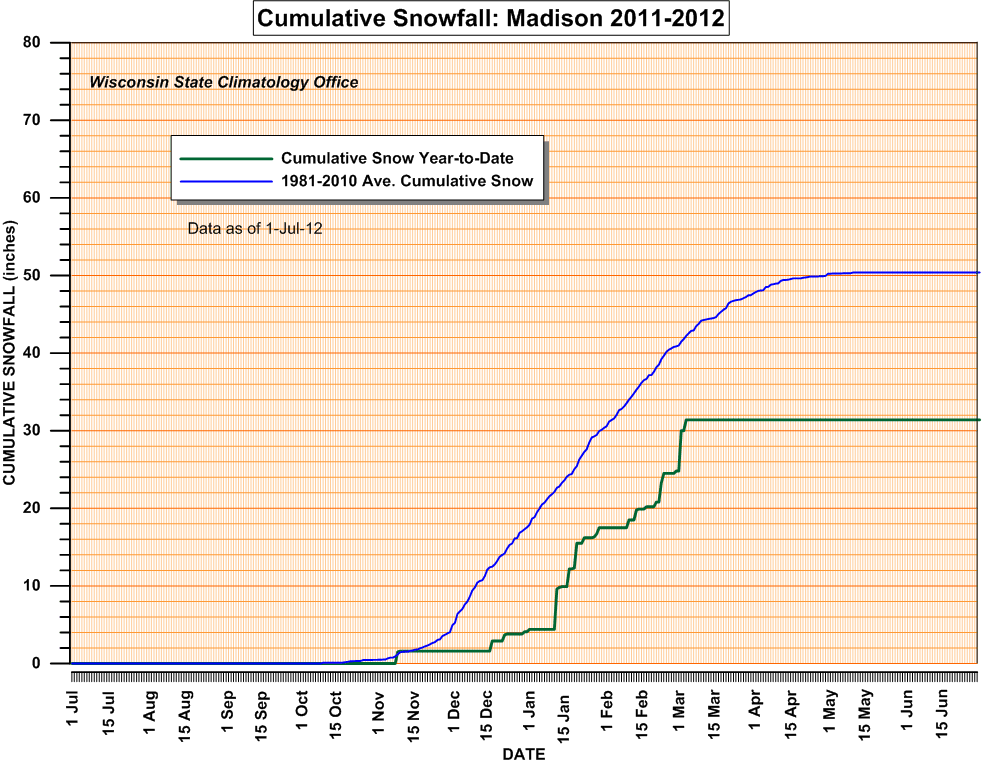
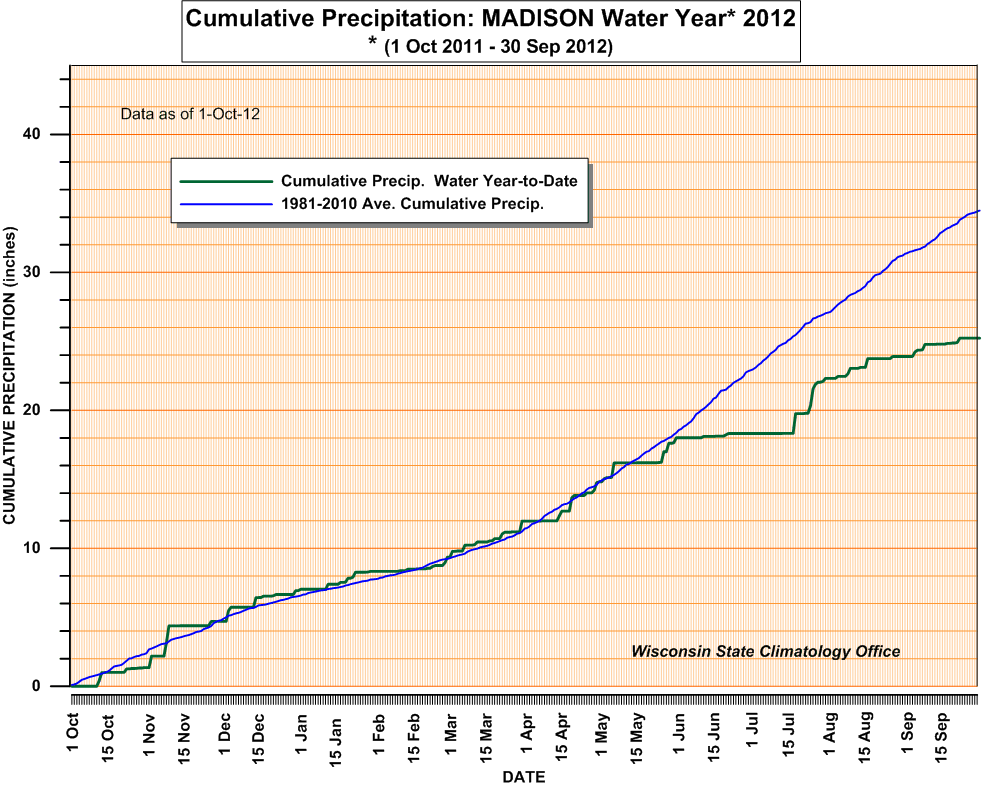
If you can find climate data... for example, in Wisconsin 2012 our snowfall looked like https://www.aos.wisc.edu/oldsco/clim-history/stations/msn/ms... and the overall water year precipitation chart was https://www.aos.wisc.edu/oldsco/clim-history/stations/msn/ms...

PBS program on the 2012 drought - https://www.pbs.org/video/wpt-presents-wisconsin-drought-201...

And what the fields looked like ... http://www.wcwcw.com/feature96.html (also has a national map, and all of Nebraska, Kansas, Iowa, Missouri, and Illinois were in bad shape - Wisconsin looked pretty good by comparison in that map).

If you've got similar data for ND... (digging) https://www.ndsu.edu/agriculture/sites/default/files/2026-05... page 2 has the precipitation chart. North west ND looks bad.

Re: USDA Projects Smallest US Wheat Harvest Since 1972 Due to Plains Drought

#159
post #156

Earlier quoted context omitted.

Nitrogen is pulled out of the air which is free but the process requires hydrogen which is acquired from disassembled methane, the price of which is a significant contributor.

US shale oil notably has a lot of natural gas - methane. the methane isnt the issue, building and operating the processing plants is

Hard to find exact data but 60-80% of the cost to manufacture ammonia comes from the cost of natural gas. Feel free to look a price charts for both to see the correlation.

Re: USDA Projects Smallest US Wheat Harvest Since 1972 Due to Plains Drought

#160

Earlier quoted context omitted.

Fertilizer is pretty fungible and is a global market, so even if the US is primarily supplied by Canada, and overall global demand remained constant, prices would go up since there will be supply reduction due to the Hormuz strait being closed.

Having the two major inputs turned off turns fungible to non-fungible

"Fungible" here means "traded globally", as others have noted elsewhere in this thread.
Post reply on HN