Live data from Hacker News

A conversation about AI for science with Jason Pruet

lanl.gov

151–160 of 163 posts

Re: A conversation about AI for science with Jason Pruet

#151

Earlier quoted context omitted.

You sound more prejudiced against AI than they seem to be hyping AI in that sentence. Yes, they’re very good coders; no, they aren’t perfect. Sometimes they make trivial mistakes or hallucinate, and other times they have unique insights about difficult problems or one-shot a lot of complex tasks. If you don’t see the value of AI even at this point, you’re either lacking imagination and/or just too stuck in your own w…

I don't think they're good coders at all, I think they're good at generating small snippets of codes. If you tried to replace a programmer with whatever LLM it would completely flop. Just write a script to fetch Jira tickets and let it rip - it won't work well. Because it doesn't know that maybe the Jira ticket is stupid, or that if they implement this change it requires insight from Team X, or that this bug is reall…

So whats actually important are PMs. Got it.
Re: A conversation about AI for science with Jason Pruet

#152

Earlier quoted context omitted.

"LLM" is not mentioned anywhere in the article.

There's a serious issue around naming here, I'll agree. I assume "AI" in contemporary articles, especially as it pertains to investments, means "Generative AI, especially or exclusively LLMs."

This is about "AI for science" and I don't think LLMs are the biggest deal there. Alphafold is maybe the best AI science so far and it isn't a language model.

Re: A conversation about AI for science with Jason Pruet

#153

> If you’ve played with the most recent AI tools, you know: They’re very good coders, very good legal analysts, very good first drafters of writing, very good image generators. They’re only going to get better. Most of the bullshitters will tip their hand pretty early that they're just hype men for AI. Right off the bat, the fact that AI is disruptive and transforming society is apparently self-evident because they n…

> very good legal analysts

This one in particular is a hearty kek.

Re: A conversation about AI for science with Jason Pruet

#154

> If you’ve played with the most recent AI tools, you know: They’re very good coders, very good legal analysts, very good first drafters of writing, very good image generators. They’re only going to get better. Most of the bullshitters will tip their hand pretty early that they're just hype men for AI. Right off the bat, the fact that AI is disruptive and transforming society is apparently self-evident because they n…

You sound more prejudiced against AI than they seem to be hyping AI in that sentence. Yes, they’re very good coders; no, they aren’t perfect. Sometimes they make trivial mistakes or hallucinate, and other times they have unique insights about difficult problems or one-shot a lot of complex tasks. If you don’t see the value of AI even at this point, you’re either lacking imagination and/or just too stuck in your own w…

They aren't good coders. They know nothing about the problem domain requirements. (The meat of programming.)

> bu-but you can waste your day writing prompts to get around the fact that LLMs are brainless!

Yes, and?

Re: A conversation about AI for science with Jason Pruet

#155
post #134

Earlier quoted context omitted.

The gap between demo impressive and reliably useful in real-world scenarios is still huge in a lot of cases. That said, I think the concern isn't that AI is flawless now, but that it's improving at a pace we haven't really seen with other technologies

It's really funny to see someone say this technology, which seems to be plateauing with marginal improvements after a few years, is improving at a pace we have never seen before, in an industry that is built on the microprocessor. Astoundingly ignorant.

Correct. We've reached negative returns on increasing parameter counts. This is a dead end unless they figure out how to microtune models on ultra-specific niches.

Re: A conversation about AI for science with Jason Pruet

#156

> If you’ve played with the most recent AI tools, you know: They’re very good coders, very good legal analysts, very good first drafters of writing, very good image generators. They’re only going to get better. Most of the bullshitters will tip their hand pretty early that they're just hype men for AI. Right off the bat, the fact that AI is disruptive and transforming society is apparently self-evident because they n…

I don’t understand this viewpoint at all. Even if AI tools are nothing more than complex autocomplete systems - and not some kind of new consciousness - that alone is enough to dramatically shift entire industries. And it already is doing so…this isn’t theoretical anymore.

Just check any mature project's commit history. It's rarely that huge, even for things that brought in features. Here's a PR[0] that's less than the usual rambling ChatGPT produces, and add a valuable feature to the software. More often than not, you spend more time designing the feature than actually coding it. And a huge part of the design process is dealing with impact to other parts of the project.

[0]: https://github.com/OpenRC/openrc/pull/723/files

Re: A conversation about AI for science with Jason Pruet

#157

Earlier quoted context omitted.

You really see only downsides? I’m no AI optimist, but it is a useful tool, and it’s here to stay.

Yes, I only see downsides. It's mostly because the actual stated and actualized goal of real AI is clearly bad. It's like if you approached me and said "I'm going to erase meaning from your life. You will want for nothing. The entire paradigm of reality will be changed: your entire evolutionary struggle, made meaningless. You will want for nothing: "be" nothing. Also this might potentially kill you or some rich perso…

Why would you want for nothing? Even in a completely post scarcity world there are plenty of things I would want for

Re: A conversation about AI for science with Jason Pruet

#158

Earlier quoted context omitted.

I don't think they're good coders at all, I think they're good at generating small snippets of codes. If you tried to replace a programmer with whatever LLM it would completely flop. Just write a script to fetch Jira tickets and let it rip - it won't work well. Because it doesn't know that maybe the Jira ticket is stupid, or that if they implement this change it requires insight from Team X, or that this bug is reall…

So whats actually important are PMs. Got it.

No, what I mean is you’re going to encounter hundreds of technical and business challenges while you’re writing code (that you don’t know before you write the code).

Making those decisions and communicating is a big chunk of being a programmer.

Re: A conversation about AI for science with Jason Pruet

#159
post #6

> We certainly need to partner with industry. Because they are so far ahead and are making such giant investments, that is the only possible path. And therein lies the risk: research labs may become wholly dependent on companies whose agendas are fundamentally commercial. In exchange for access to compute and frontier models, labs may cede control over data, methods, and IP—letting private firms quietly extract value…

> research labs may become wholly dependent on companies They already are. Who provides their computers and operating systems? Who provides their HR software? Who provides their expensive lab equipment? Companies are not in some separate realm. They are how our society produces goods and services, including the most essential ones.

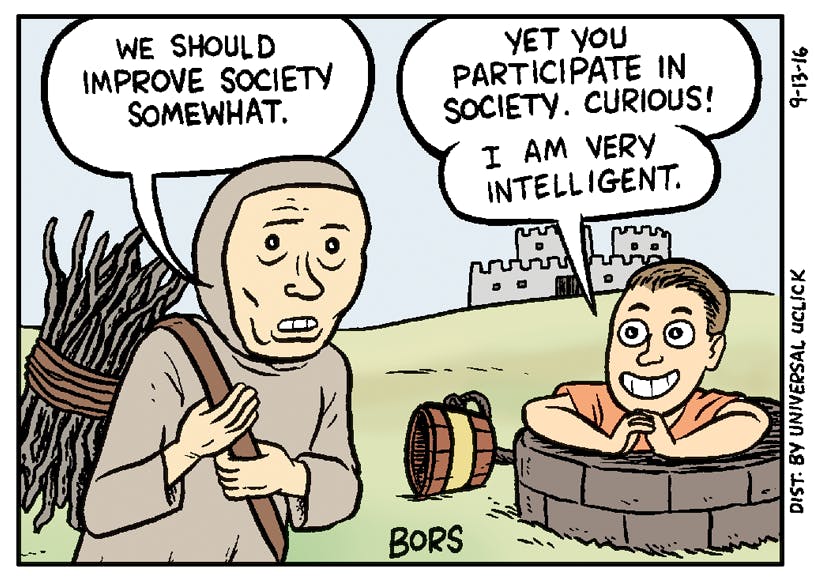
For purchases sure but their funding and therefor what they're buying with that funding is not tied to companies at all which is an incredibly important distinction. This rhymes with the old "yet you participate in society/capitalism" "gotcha" [0] and it's worth about as much.

[0] https://iea.org.uk/wp-content/uploads/2021/12/mister-gotcha-...

Re: A conversation about AI for science with Jason Pruet

#160

Earlier quoted context omitted.

We can't just switch to clean energy, we would need to drastically reduce our energy use per capita.

Absolutely not. We would be moving backwards as a society. Increased energy usage is a bellwether of societal advancement. See the Kardashev scale and Dyson sphere for example. [0]: https://en.wikipedia.org/wiki/Kardashev_scale [1]: https://en.wikipedia.org/wiki/Dyson_sphere

.. both of which are solidly science fiction. You might as well say "giant mechs are the bellwether of societal advancement, just look at Warhammer/Evangelion/Gurren Lagann".

It can equally be argued that efficiency of use of power is a bellwether of societal advancement, since wasting it will always be easier than making efficient use of it.

Case in point, few people realize that humanity reached 1.9 on the Kardashev/Sagan scale (EG, we output more power than the entire Trappist star that exoplanet enthusiasts have been so excited to colonize) for 39 brief nanoseconds on October 30, 1961. But that certainly didn't make us an entire Kardashev rung more civilized for the same brief moment as we erased another huge portion of our natural environment.

Post reply on HN