Live data from Hacker News

The Streets Were Never Free. Congestion Pricing Finally Makes That Plain

nytimes.com

151–160 of 375 posts

Re: The Streets Were Never Free. Congestion Pricing Finally Makes That Plain

#151

Earlier quoted context omitted.

OK, how about "it's a way to make sure people who need the road most are the ones who get to use it" Kind of how parking meters are FANTASTIC because they mean I can finally get a damn space for the rare occasion when I rent a van or car and need to park in front of my flat. I just wish they'd raise prices on my street because it's still tough sometimes.

"it's a way to make sure people who need the road most are the ones who get to use it" It is too regressive to achieve that end. If you have a lot of money, it is a trivial cost for convenience. If you are poor, but would really benefit from road access, you still may not be able to afford it. You could easily frame this as "keep the poor off the road so the rich don't have to deal with traffic".

But we already do that with homes, so why not be consistent and do it with cars?

Anyway, making walking and cycling as crappy as possible by giving people congested, polluted, dangerous streets is pretty inconsiderate to poor people as is.

And the article specifically mentions waivers for low income people.

Re: The Streets Were Never Free. Congestion Pricing Finally Makes That Plain

#152

Earlier quoted context omitted.

Some people use the roads a lot more than others. Those people should pay their fair share. Someone who commutes in an SUV from Fairfield to Manhattan every day should have to pay much, much higher fees than someone who rides their bike from Greenpoint to Brooklyn heights. Once (particularly wealthy) people are made to incur the true cost of their lifestyle choices, the hope is that better choices are made.

That's the cost of having a functioning society. I don't have kids, yet I still pay school taxes because even though I'm not participating in that particular aspect of society, I still benefit from it. Public biking infrastructure wouldn't be possible without the roads and right-aways we already have for cars and pedestrians; someone only using a mile of roadway on their daily commute is benefiting from the entirety…

I don't think your op was arguing against roads, I think they were more arguing that the cost algorithm is wonky for those roads - for some reason, people that chose the significantly more road- and space- and environmentally- damaging option of the SUV while on that road are paying the same to use it as the bicyclist.

Re: The Streets Were Never Free. Congestion Pricing Finally Makes That Plain

#153

Earlier quoted context omitted.

while we're at it, let's make the congestion pricing proportional to some power of vehicle weight so that it also reflects the cost of road maintenance.

Drivers pay fuel taxes already. Fuel taxes are proportional to vehicle weight and power. IMHO, it better to tax normalized_area normalized_weight normalized_congestion . For example, if vehicle is 30% spacer than average, has 50% more weight per space than average, and uses road at peak hour when road usage is 50% more than average, then it should pay 1.3 x 1.5 x 1.5 = ~3x tax. If owner want to reduce tax, then it sh…

I mean, are they really proportional to weight and power? My Cayman weighs less than 3000 lbs, uses very little of it's power, in traffic, and gets 12-16 mpg (around 30 in no traffic). My rx300 weighed nearly 4000 lbs and would get 21-23 mpg in no traffic. My rx300 saw almost no traffic whereas my Cayman sees a lot simply because my last job didn't care whether or not I came into work (unless there was a meeting I needed to go to).

Re: The Streets Were Never Free. Congestion Pricing Finally Makes That Plain

#154

Earlier quoted context omitted.

OK, how about "it's a way to make sure people who need the road most are the ones who get to use it" Kind of how parking meters are FANTASTIC because they mean I can finally get a damn space for the rare occasion when I rent a van or car and need to park in front of my flat. I just wish they'd raise prices on my street because it's still tough sometimes.

If I’m wealthy and want my SUV motorcade to drive through NYC all day I can trivially afford it, even if my need asymptotically approaches zero. If I’m a desperate person working three jobs to support my family, I have a great need, and yet the tax is a hardship.

Indeed - but as noted in the article, you'd likely be exempted in that situation, and having less congested streets on which to walk, cycle, take the bus, or drive would be a great benefit.

Re: The Streets Were Never Free. Congestion Pricing Finally Makes That Plain

#155
post #112
post #3

It's sad to see congestion pricing in America. I had hoped that the long-lived cultural freedom of driving would keep it at bay for longer, but I guess not anymore. I live in Sydney. It takes a 45 minute drive to visit a family member, who is sick and homebound. To do so in the shortest and least congested route, I must pay 3 tolls: $14.85 total, one way; $30 dollars a trip. Public transport is not a suitable option.…

What jumped to my attention from your comment is that tolls seem to bother you more than public transportation not being a suitable option. I live in Madrid, which has a metropolitan population of 6.5 million (compared to Sydney's 5.2m). I can get pretty much everywhere from anywhere in about 1 hour, combining metro and buses. So when I want to visit a friend, I just go out the door, and walk to the metro station. If…

Exactly. I'm still waiting for a day I see a full-throated defense of a car-centric system that frankly doest rely on myopia about the second-order effects of the system. Sure, given that you're in a city designed around owning cars, owning a car has advantages: that's almost tautological. But policy needs to think at the societal level, which includes all the effects that you take for granted as part of the background. Without the criminal waste of valuable urban space that cars entail, the odds that GP would be taking a 45 minute trip would be far lower.

The ubiquity of this kind of myopia makes me worry about transit policy, and I've seen little evidence that voters are capable of or willing to engage in second-order thinking, especially when their incentives are involved. Though I suppose it's not like our transit policy could get much worse....

Re: The Streets Were Never Free. Congestion Pricing Finally Makes That Plain

#156

Earlier quoted context omitted.

> don’t masquerade this as some kind of “economic reckoning” In New York, low-income New Yorkers who own a car (or live in the zone) will be eligible for a waiver [1]. People with disabilities, too, will probably be eligible for a waiver. (Some carve-outs are still being pinned down.) Taxis, Ubers, trucks and cars owned by people who opt to pay hundreds of dollars a month in parking are who will be taxed. Given the u…

How do people feel on a congestion fee for sidewalks. Too many people on sidewalks in NYC making them almost unusable. If you want to walk on a sidewalk during the busiest times you should pay a congestion fee. Why would we stop at just roads?

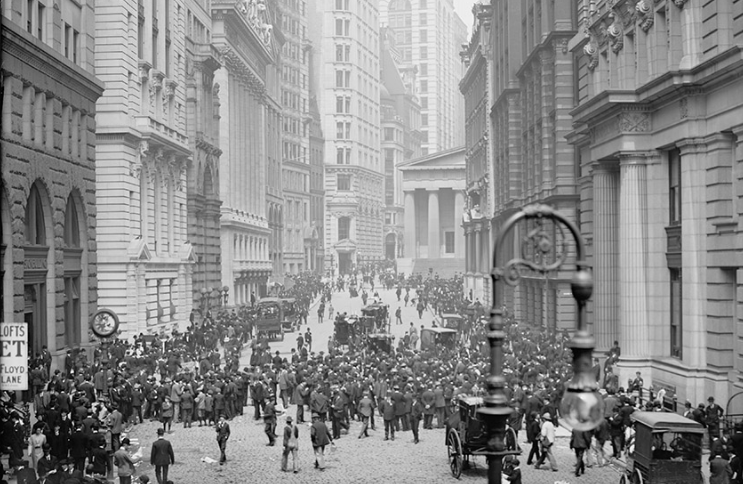
Well, considering that the streets were for walking and drivers stole them, that seems a tad unfair.

Here's what they looked like before: http://static.libsyn.com/p/assets/c/c/3/a/cc3a56fafeaa6119/S...

Re: The Streets Were Never Free. Congestion Pricing Finally Makes That Plain

#157
post #98

Earlier quoted context omitted.

I don't think your examples really count as freedoms. I agree with your point, but I don't think you need to stretch the definition of a word to make it.

But how is the right to drive anywhere more of a freedom than those other things?

Because it is told from the perspective of the activity that is allowed. Now they could have technically been stated as the freedom from {Annoying/Harmful thing}* but thats still weak. The only reason to it is to take away power from the original argument by watering down the language it used. I'm sure the op didn't mean anything by it, I just happened to be listening to a conference call with a lot of corporate speak and was particular sensitive to how words are (mis)used

The actual point is that freedoms should be curtailed when they cause harm to others.

In this case unchecked freedom of movement can cause harm to society in different ways, so some forms of movement are restricted. Which is already true, we have signs, lights walls, fences, licenses, etc to restrict our movement. So the argument is really about how much more should they be restricted.

* EDIT, Zarath already called me out on that, but I still think it's a stretch

Re: The Streets Were Never Free. Congestion Pricing Finally Makes That Plain

#158
post #3

It's sad to see congestion pricing in America. I had hoped that the long-lived cultural freedom of driving would keep it at bay for longer, but I guess not anymore. I live in Sydney. It takes a 45 minute drive to visit a family member, who is sick and homebound. To do so in the shortest and least congested route, I must pay 3 tolls: $14.85 total, one way; $30 dollars a trip. Public transport is not a suitable option.…

I think you're mixing up two meanings of "free" here. Sure, your drive is not free as in beer, but it's still free as in speech. The whole point of the OP is that your drive was never free as in beer. Somebody has always been paying for it. It might not make sense for every road to be a toll road, but it makes even less sense for none to be. It's funny how many people think the relationship between prices, supply, an…

My favorite example was the blind rage with which almost everyone I know reacted to airlines starting to charge for bags. Even the most libertarian, "taxes are theft" people I talked to would sputter to come up with some insane rationalization when bagless flyers like myself should be subsidizing their baggage.

Re: The Streets Were Never Free. Congestion Pricing Finally Makes That Plain

#159
post #71

Earlier quoted context omitted.

> Taxis, Ubers, trucks and cars owned by people who opt to pay hundreds of dollars a month in parking are who will be taxed. Given the unusability of our streets, this seems closer to an economic reckoning than a political money grab. Taxis and Ubers are forms of public transportation, and likely reduce the overall number of cars on the road. Simultaneously, they reduce the incidences of drunk driving, providing posi…

> Taxis and Ubers are forms of public transportation, and likely reduce the overall number of cars on the road The charge is levied on private transport and Ubers et cetera . It's unlikely to shift demand from Ubers to private vehicles. On the risk of regressive taxation, I agree. But it's a risk, not a certain outcome. Properly varying the charge throughout the day will incentivize deliveries when the roads are less…

> On the risk of regressive taxation, I agree. But it's a risk, not a certain outcome. Properly varying the charge throughout the day will incentivize deliveries when the roads are less crowded. Better utilizing our freight rail infrastructure may also dampen the effect.

The congestion already does that. The issue is that it's a hard problem. You can't make deliveries to shops at 3AM because there is no one there to receive them. To the extent you can make deliveries at 6AM, they already do. But a delivery driver loads up the truck and then makes deliveries for eight hours. Telling them to work a de facto 14 hour shift because you're going to put two separate three hour blocks of "don't drive during peak hours" into the middle of their day is going to drive up costs.

And freight rail serves an entirely different market. That's used to transport bulk products in industrial quantities, not to deliver bread to the corner deli. Trucks sometimes are used in contexts where freight rail could be used but those aren't the ones driving through Manhattan during rush hour.

> The congestion charge makes little sense as a way to fund the MTA. It does make sense as a counterbalance to the negative externalities traffic congestion creates.

The problem is that the externalities are really just failures in the markets for alternatives that have dumped their natural demand onto the roads, because all of the externalities come from congestion, which could be absorbed by better alternatives if they existed.

If you make the subways better then fewer people drive. If you make them less expensive then fewer people drive. That means paying for them from taxes rather than fares -- just getting rid of the fares and using taxes instead would get a huge number of cars off the road and eliminate the overhead cost of all the fare collection infrastructure.

When you have things like minimum parking requirements or anti-density zoning rules, that makes it more expensive to build high density housing and subsidizes car ownership for people in urban areas. Then the people who live there drive more, because they have somewhere to park a car and therefore own one, meanwhile there is less housing there which means people need to live further away and then many of them will drive back in to their jobs.

Congestion pricing doesn't actually fix any of that, it just squeezes even harder on the people who the lack of alternatives had already squeezed into congested roads. It makes driving worse when what we need is for alternatives to driving to be better.
Re: The Streets Were Never Free. Congestion Pricing Finally Makes That Plain

#160

Earlier quoted context omitted.

OK, how about "it's a way to make sure people who need the road most are the ones who get to use it" Kind of how parking meters are FANTASTIC because they mean I can finally get a damn space for the rare occasion when I rent a van or car and need to park in front of my flat. I just wish they'd raise prices on my street because it's still tough sometimes.

"it's a way to make sure people who need the road most are the ones who get to use it" It is too regressive to achieve that end. If you have a lot of money, it is a trivial cost for convenience. If you are poor, but would really benefit from road access, you still may not be able to afford it. You could easily frame this as "keep the poor off the road so the rich don't have to deal with traffic".

There are rebates for specific use cases like that. It’s a lot cheaper than just fire hosing subsidies for everyone.
Post reply on HN