Live data from Hacker News

Americans Want to Believe Jobs Are the Solution to Poverty. They’re Not

nytimes.com

151–160 of 632 posts

Re: Americans Want to Believe Jobs Are the Solution to Poverty. They’re Not

#151

Earlier quoted context omitted.

Has anyone ever calculated the maximum possible wage for a job? Take strawberry picking for an example. If run by a non-profit, what is the highest possible wage? Would be interesting to see this relative to the actual wage.

The entire farming industry is distorted. It's much more subsidized and controlled than most industries. For instance we literally pay some farmers not to grow food. And at times when harvests are high the government will prevent farmers from marketing some portion of their harvest which, in extreme cases, can mean that food simply ends up getting destroyed. It's all about extreme manipulation of supply to try to con…

> For instance we literally pay some farmers not to grow food. And at times when harvests are high the government will prevent farmers from marketing some portion of their harvest which, in extreme cases, can mean that food simply ends up getting destroyed

Wait, so they are intentionally keeping food prices higher by paying people to not grow food? I mean, I understand that we need farmers and dipping food price markets isn't ideal, but... wow... what a world.
Re: Americans Want to Believe Jobs Are the Solution to Poverty. They’re Not

#152

I broke out of poverty. Why can't they do it too? It was a simple thing for me, a combination of studying hard, focusing on my future and the death of my father. You see, my parents were both fishermen. It's a grueling, painful job that can destroy your body as you age leaving you with back problems and forcing you to retire early. It also paid poorly and had a lot of risks. Which unfortunately for us, resulted in th…

Your story seems to indicate that studying hard and focusing on the future are necessary but not sufficient conditions to enter the middle class.

I think the formula is that you need all three:

-Relatively consistent work ethic

-Decent decision-making

-Some minimal opportunity

Often the argument seems to swing between these absurd positions that it's all about just one of these and the others don't matter. Of course they're all necessary, and different people lack different components. There's no shortage people poor hard-working people. There's also no shortage of people who blew a lot of money or opportunity due to laziness and terrible choices. There's terrible luck events and great luck events. It all matters.

Some smart person said: People are usually correct in what they assert, and incorrect in what they deny. (I think maybe it was Hume).

Re: Americans Want to Believe Jobs Are the Solution to Poverty. They’re Not

#153
post #8

Poverty in America is a result of American capitalism, at a very high level. At a very very high level, it is caused by human greed, and a lack of love for our neighbors. We can talk about wages and employment rates, and race all day long, but those are just details. It's human greed in the end, and our inability to love others like we love ourselves.

Is that why hunter gatherer societies didn't have poverty? Is that why communist countries weren't poor? How is that working out for Venezuela? Capitalism is literally the only thing in human history that has ever lifted large numbers of people out of poverty.

Well, there was America's gilden age, which was also present in wide areas of Europe; Factory Owners would get all of the money and the workers got almost nothing. In Germany this was so bad that children over the age of about 12 generally worked in the factory along with the entire family to be able to affort a 10sqm single room housing in the city with 2 meals a day.

The factory owners largely didn't care and caused quite a few large scale accidents facing little to no consequence for it.

That only changed in Europe after strikes, unions and socialist programs got punched through (also stuff like the 48 hour work week, 2 days of rest a week, sickdays, social welfare and healthcare and a lot of other stuff that was largely not capitalistic in nature), in the US only after anti-monopoly rulings where deployed en masse (while still paying out the factory owners shitloads of money).

Re: Americans Want to Believe Jobs Are the Solution to Poverty. They’re Not

#154

If there are only 19 bones for every 20 dogs, then it doesn't matter how good a bone hunter they all are there will always be one dog disappointed and the other 19 will be grateful for the bone no matter how thin and weedy it is. Systemically the 'interest rate targeting' approach starts to tighten up policy when unemployment gets below 5% - which they consider 'full employment' even though 1 in 20 haven't got jobs.…

And, of course you need a way to prevent employers from using various alternatives available to them.

* You need very high import taxes, so goods have to be produced with local labour

* If truly automation were to become pervasive, that needs taxing

* You probably need restrictions to prevent money from crossing borders too easily

* You can't have open borders

(or)

* You have to strongly respond to illegals working (or legalize them, while still killing those illegal jobs), because they'll destroy the bargaining power of others

(this is, incidentally, why for 90% of history leftists and communists were strongly against immigration, and the right was pro-immigration. Even today, the right is still in favor of (limited) immigration, that doesn't seem to have changed much. But I sometimes wonder if it isn't the case that Trump won because a significant portion of the left electorate voted for him because of the labour competition due to immigration and tolerating of illegal immigrants and illegal immigrants' labour)

Re: Americans Want to Believe Jobs Are the Solution to Poverty. They’re Not

#155

Wage growth would help, but for some reason, these articles never even mention immigration. The scale of immigration both legal and illegal I believe has the greatest impact on the lowest sectors of society. The lack of discussion on the impact so many potential new workers is having on wage growth leads one to think they believe labor cost is the one thing immune to the law of supply and demand.

The FT had a couple of great podcasts last year ([0], [1]) that discussed the economic and fiscal impacts of immigration. I don't remember all of the details, but the key points were, to the best of my recollection:

* Highly skilled/educated immigrants provide a significant boost to economic growth and pay more in taxes than they receive in benefits. I don't recall whether the podcast addressed the impact of these immigrants on the wages of highly skilled native-born workers.

* Low-skill immigrants are a net positive in the long term (i.e., once their children grow up) to the economy as a whole, but their net impacts in the short term are somewhat ambiguous, and there is some evidence that they bring about wage decreases for low-skill native-born workers. While that evidence is not completely clear-cut, it seems likely that there's at least some level of impact. There's also evidence suggesting that some of the displaced native-born workers "climb the ladder" into higher-skill, higher-wage positions when this happens, which may mitigate that impact.

From what I've read more generally, my impression is that outsourcing has a much larger impact on unskilled workers' wages than immigration does, though I don't have a specific source to support that claim.

[0] https://ftalphaville.ft.com/2017/09/15/2193785/podcast-the-e...

[1] https://ftalphaville.ft.com/2017/11/10/2195727/podcast-kim-r...

Re: Americans Want to Believe Jobs Are the Solution to Poverty. They’re Not

#156
post #47
post #40

Earlier quoted context omitted.

You're ignoring the demand side. Immigrants also increase demand. For everything.

Do they? By how much? Immigrants have usually low wages. Anyways, in Western Europe, the increased demand (which is probably smaller than in the US), those things are easily canceled by the added costs to public healthcare + social benefits.

If immigrants are young working adults, then you are, in fact, getting an educated (At least high school, often post-secondary) adults, for whose education, food, shelter, and childcare you didn't have to pay a penny for.

Turning them away is like turning away a gift of hundreds of thousands of dollars.

Re: Americans Want to Believe Jobs Are the Solution to Poverty. They’re Not

#157
post #137

Earlier quoted context omitted.

It’s more complicated than that though. In Denmark where I live, we have trouble staffing certain industry jobs. Jobs like gutting, freezing and packing fish or general slaughter houses. It used to be that these were low paying jobs, packed with immigrants. Since you need a social security number to work, and we’re rather good at finding people who cheat the system, illegal immigration workers isn’t really a thing in…

> Anyway eventually regulation caught up and ended the low pay loopholes. So now a job at those factories pays half a million kroner a year, or more than I earn as a senior IT-architect. I think this is an important point that many people seem to gloss over when discussing what humans _deserve_ to be paid. Many believe the uniqueness of a skill set or how much physical stress is inherent to a position should be the o…

This also shows why high import taxes are a necessity. Not an option for Denmark (because they've signed away that authority to Brussels), but a necessity nonetheless.

Re: Americans Want to Believe Jobs Are the Solution to Poverty. They’re Not

#158

If there are only 19 bones for every 20 dogs, then it doesn't matter how good a bone hunter they all are there will always be one dog disappointed and the other 19 will be grateful for the bone no matter how thin and weedy it is. Systemically the 'interest rate targeting' approach starts to tighten up policy when unemployment gets below 5% - which they consider 'full employment' even though 1 in 20 haven't got jobs.…

And, of course you need a way to prevent employers from using various alternatives available to them. * You need very high import taxes, so goods have to be produced with local labour * If truly automation were to become pervasive, that needs taxing * You probably need restrictions to prevent money from crossing borders too easily * You can't have open borders (or) * You have to strongly respond to illegals working (…

Alternatively, we could ditch the neo-feudalism, embrace automation, and give people a more meaningful live than having to slave 60 hour weeks to be allowed to survive, at meaningless jobs that could easily be done by machines.

Re: Americans Want to Believe Jobs Are the Solution to Poverty. They’re Not

#159

Earlier quoted context omitted.

The illegals are all picking strawberries for below minimum wage so we don't have the bear the true costs of our food. Remove them and there would be serious repercussions for those at the lower strata of society.

An anecdotal observation. In the majority black city where I live 50% of black men are unemployed but if you look at the numerous construction sites workers are largely Hispanic. I worked at a hotel for several years in the early 2000's the housekeeping staff was overwhelmingly black women and men but shifted dramatically to Hispanic women and men after new penny pinching ownership took over and started using some du…

> I worked at a hotel for several years in the early 2000's the housekeeping staff was overwhelmingly black women and men but shifted dramatically to Hispanic women and men

The Hispanic staff that doesn't seem to have anything close to living wage is a pervasive feature in the Bay Area too. I'm not sure if, and to what extent, they displaced black workers in the Bay Area though.

Re: Americans Want to Believe Jobs Are the Solution to Poverty. They’re Not

#160
post #80
post #70

Earlier quoted context omitted.

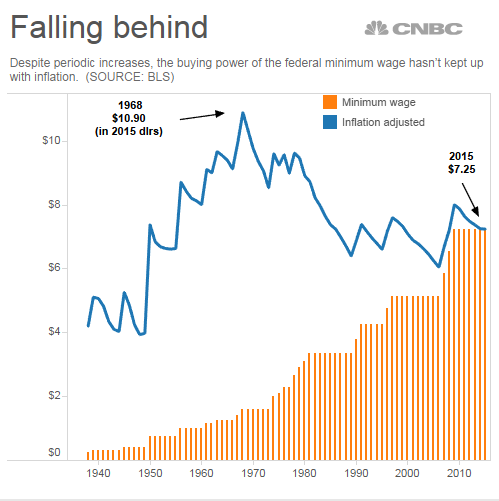
Have you checked minimum wage vs inflation chart? Seems that not having a minimum wage that goes up yearly to catch up to inflation has the biggest impact in wage growth. There are bigger fish to fry rather than speculate on the impact of immigration (but not as easy to sell to angry constituents), the current population is at ~320 million and you receive ~1 million immigrants a year, I'll give you the benefit of the…

I think that this is a sleight-of-hand trick that comes up a lot in immigration discussion: he was talking about the small subset of the population that is most directly affected by the change, you switched the focus of the impact to the entire economic system. If you only look at the bottom 10% of society where the job competition is occurring, your 1.5% becomes 15% - annually! It's staggering. Immigration applies d…

The main point was inflation and wages. He mentions that "The scale of immigration both legal and illegal I believe has the greatest impact on the lowest sectors of society.", I doubt the impact is greater than the stagnation of wages against inflation where $2 min wage in 1968 is equivalent to almost $11 of today's dollars [0]. Current min wage is at $7.25. Do the immigrants vote for maintaining the minimum wage at the current level or where am I getting lost? I'm quite sure econ 101 says that if the salary goes up there will be more people willing to accept the job. Until that happens, of course a low-skilled immigrant will take that $7.25 hour job that no one wants. He will barely survive (while making sacrifices in the quality of life) and yes the corporation will happily accept it since nobody wants to do that work for that wage and people want low prices.

[0] https://sc.cnbcfm.com/applications/cnbc.com/resources/files/...

Post reply on HN