Live data from Hacker News

London-Paris electric flight 'in decade'

bbc.co.uk

151–160 of 165 posts

Re: London-Paris electric flight 'in decade'

#151
post #115

Earlier quoted context omitted.

I wonder why there is no fast London - Amsterdam train. It's not that much farther than Paris.

UK border security. On Eurostar journeys all border checks are done at the departure station, and only Paris, Brussels and Lille have the facilities for that. That said, it should be coming this year.

Ok, good. It seems it will make a 30 min stop in Brussels for the border check though. Unfortunate.
Re: London-Paris electric flight 'in decade'

#152

Earlier quoted context omitted.

Sure. How about LNG (liquid methane)? We have enough natural gas to last quite a while. In the far future, hopefully we will have mastered producing kerosene using algae.

LNG tanks are far from lightweight; to keep LNG at room temperature is about 320 atmospheres of pressure. Liquid propane on the other hand is about 8 atmospheres. Mind you at altitude it's around -50 ~ -60 C, but that will only reduce the pressure requirements to approx 100 atm. Also, LNG has about 60% of the energy density of kerosene. SO to use LNG you'd be taking a double whammy, lower density and heavier tanks.

[deleted]

Re: London-Paris electric flight 'in decade'

#153
post #50

Earlier quoted context omitted.

Based on another article they are not doing 100% electric. They are basically using battery's to replace the alternator/APU attached to the jet engine. That still adds up to a lot of jet fuel, but is only something like 5% total fuel savings.

That's a little more achievable than the "zero emissions airliner" their website promises and would explain why they're talking about going after the A320 market rather than the ATR one (And a 5% emissions reduction over a 10 year horizon is only half what engine suppliers aim for by improved jet technology, though if it's on top of that improvement it would still be very welcome) But if what they're building is an A…

To pull this off efficenctly they are going to want a ~20,000 kg battery pack that's easily swapable on landing. That's going to take a fairly significant change to an airframe and weight distribution is going to an issue. On the other hand they would also want smaller gas tanks if it's really only doing 300 mile trips + buffer.

Longer term, they would want to start using electricity for propulsion and ramp that up as batteries improve.

Re: London-Paris electric flight 'in decade'

#154

Earlier quoted context omitted.

Sure. How about LNG (liquid methane)? We have enough natural gas to last quite a while. In the far future, hopefully we will have mastered producing kerosene using algae.

LNG tanks are far from lightweight; to keep LNG at room temperature is about 320 atmospheres of pressure. Liquid propane on the other hand is about 8 atmospheres. Mind you at altitude it's around -50 ~ -60 C, but that will only reduce the pressure requirements to approx 100 atm. Also, LNG has about 60% of the energy density of kerosene. SO to use LNG you'd be taking a double whammy, lower density and heavier tanks.

Sounds like propane is a winner. Would it help to use a composite tank a la SpaceX?

Re: London-Paris electric flight 'in decade'

#155
post #102

Earlier quoted context omitted.

You've contradicted yourself by saying that batteries are both less and more dense than jet fuel...

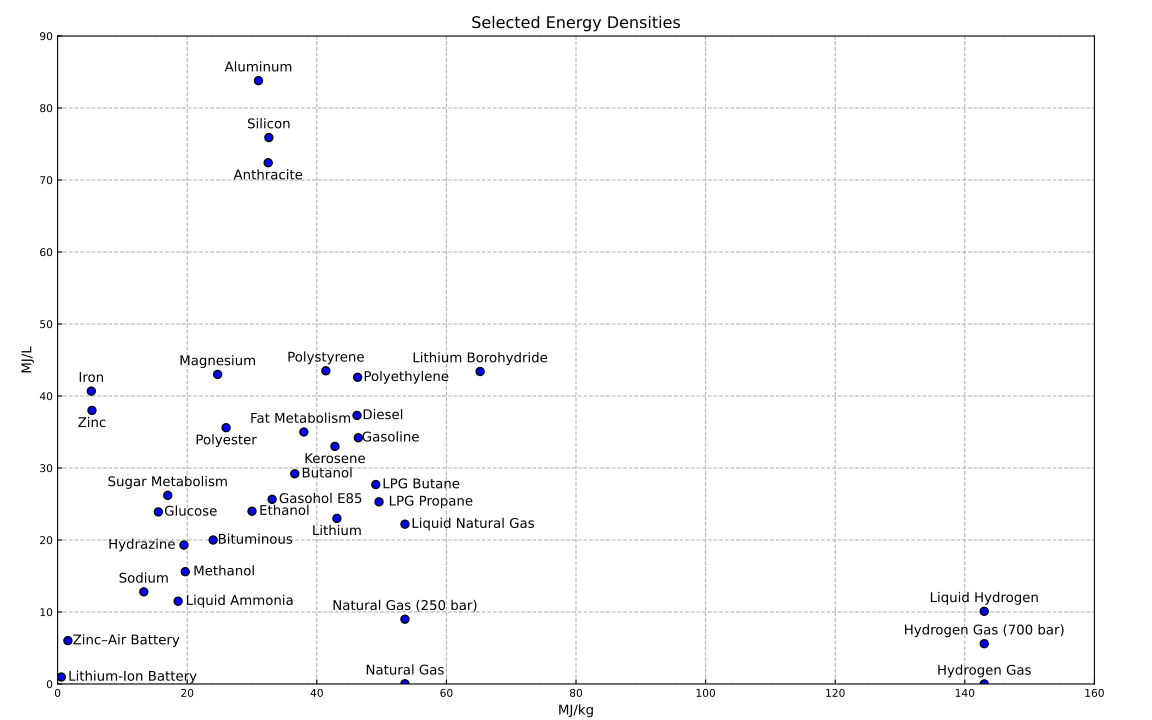
LOL energy density is much much lower, but volumetric density is several times higher. Meaning, they take less space for same weight -> airframe can have smaller profile and have less air resistance.

I don't think that's true, both volumetric and mass densities for lithium ion batteries are very low (https://upload.wikimedia.org/wikipedia/commons/c/c6/Energy_d...).

Re: London-Paris electric flight 'in decade'

#156

Earlier quoted context omitted.

On the other hand, the majority of the cost of almost any flight is the fuel. Electricity won't be free, but should be considerably less than tonnes of kerosene(I'd love to hear how much less exactly) - which means that obviously airlines can pocket the difference as profit, and they do love that. There's already loads of short connections in EU, so an aircraft like that should be hugely attractive.

> airlines can pocket the difference as profit Air travel is intensely competitive in most areas, and customers generally have very little "brand loyalty" and buy almost entirely based on price. The difference in expenses should result in lower fares. And it is yet unknown whether the extra cost of flying tons of batteries around (they weigh the same when depleted, as opposed to jet fueled aircraft which become light…

I could be wrong, but I am guessing that batteries + electric motors will be both cheaper and need a lot less maintenance than jet engines plus fuel tanks and pumps.

Re: London-Paris electric flight 'in decade'

#157
post #101
post #42

Earlier quoted context omitted.

Speaking as someone with no aviation knowledge at all this seems like an awesome idea. The plane could take off with battery packs slung under the wings which are jettisoned and become drones, gliding down to a depot. I'm now waiting for someone who actually knows what they're talking about to point out the flaws. One that springs to mind is the logistics of collecting the drone-batteries and transporting them to be…

I would also add safety and the fact that 70% of our planet is covered in water/not easy to retrieve batteries from.

The aircraft in question is being offered for a relatively short-range flight (London-Paris), 345 km (215 mi). Odds are good this flight configuration wouldn't be used on long-distance trans-oceanic flights.

Though it might be best-suited to short hops between islands, islands and mainlands, or across deep peninsulas. That's a somewhat limited set of markets.

For travel between heavily-populated continental points, ground-based rail would almost certainly be more efficient and practicable, and even in the case of the suggested London-Paris route, there is a ground-based alternative.

Re: London-Paris electric flight 'in decade'

#158
post #135

Airlines that switch to electrics will have to resolve a logistical issue -- do you switch batteries between flights, or do you need to buy twice as many aircraft, so half are flying and half are charging? I suspect that battery-switching will be the answer, even though the batteries will be a significant percentage of the aircraft's volume.

It's already possible to swap the battery pack on a Tesla Model S faster than a gasoline car can be refilled.[1] That is special equipment, but presumably modular batteries that are quickly bolted into a large cavity on the underside of a plane would be possible. It might only make sense in hubs, or highly traveled routes to put the equipment in place, though. Slower charging when the plane is on the ground overnight at a regional airport for example probably wouldn't be a problem.

Re: London-Paris electric flight 'in decade'

#159
post #72

Currently the shortest LGW-CDG flight is 1h. There is LCY-CDG lasting 1h 20m. For both cities it takes 30 - 60m to get to the airport from central location and you should be there at least 1h before the departure (for a total of 2-3h non-flight time). This makes total travel 3h - 4h30m. For comparison, the fastest train is 2h 25m. I guess you need to travel to and from the train station too, but it's definitely more…

>short distances will always be a tough sell for airplanes

Glancing at Skyscanner for this Sunday there are about 35 flights a day from London to Paris starting from £39 vs 14 trains starting from £151 single. The flights look like they are doing ok.

Re: London-Paris electric flight 'in decade'

#160
post #88
post #72

Currently the shortest LGW-CDG flight is 1h. There is LCY-CDG lasting 1h 20m. For both cities it takes 30 - 60m to get to the airport from central location and you should be there at least 1h before the departure (for a total of 2-3h non-flight time). This makes total travel 3h - 4h30m. For comparison, the fastest train is 2h 25m. I guess you need to travel to and from the train station too, but it's definitely more…

What you're saying. The only reason to take a plane vs taking a train for this distance is the price. Usually planes are way cheaper. But the hassle of taking a plane is really making it a tough sell as you say.

Depends where you are going to and from. Not everyone lives near St Pancras and is going to Gare du Nord.
Post reply on HN