Live data from Hacker News

Electricity prices in France turn negative as renewable energy floods the grid

fortune.com

141–150 of 182 posts

Re: Electricity prices in France turn negative as renewable energy floods the grid

#141

Earlier quoted context omitted.

I wonder how many people need to do that in order for it to become not negative.

That's pretty much the whole dilemma now with decarbonization. We know how to generate electricity very cheaply with solar and wind. We just don't know how to do it at the right time. It will take a lot of investment in storage tech (beyond lots of people using their EV car batteries as time-shifting storage, though that's certainly a good use!) in order to get prices smoothed out so that electricity generated at 1PM…

> We know how to generate electricity very cheaply with solar and wind. We just don't know how to do it at the right time

I’m not sure this needs to be a goal to be honest.

It’s more practical for us to become accustomed to agile tariffs and have our own batteries + charging the car when prices drop than to hope for large scale storage solutions. In the UK the average solar install now includes batteries as prices come down on them.

We can already do this today fairly easily, and with open tariff APIs plus more integrated devices it will become easier.
Re: Electricity prices in France turn negative as renewable energy floods the grid

#142
post #92
post #65

Earlier quoted context omitted.

It is complex, wholesale prices generally do not reflect in retail directly. even when suppliers have flexible pricing and support V2G /buying from users solar etc, there is only only some correlation not 100% pass through of rates. There are also technical and economic reasons this may not work beyond just inelastic vendor pricing, there is cost to transmission(loss) and all the step down that has to happen before e…

> Projects like the one at Dinorwig (pumped hydro-storage) are more viable solution for excess capacity. I think this is a little simplistic. Pumped hydro is very reliant on finding suitable geography which ultimately limits the potential capacity. I think it's more likely that grids of the future will rely on a variety of storage solutions (pumped hydro, consumer EVs, grid scale batteries etc.) and smarter load-shed…

I meant to imply grid scale solutions not just pumped hydro only. The point was end customers based storage is not cost effective option for negative pricing, which will be be almost always marginally negative just shy of the cost of plants to scale down their generation.

Pumped hydro has been the cheapest by far and proven at scale far beyond any other solution including grid scale batteries, but only works in specific geographies and up to a fixed scale.

Grid scale batteries, pumped hydro, molten salts or other grid scale storage are all viable options provided TCO is cheaper than arbitrage that comes from price fluctuations.

This is no different than arbitrage in say commodity markets by taking delivery of the goods like say how U.S. government is using its strategic oil reserves these days.

Re: Electricity prices in France turn negative as renewable energy floods the grid

#143
post #123
post #101

Earlier quoted context omitted.

> It's been true for 50 years, assuming it will be true for another decade or two is not wishful thinking. Well it's one thing though to use the storage for a cell phones and some cars, another to keep all the industries and homes going on. Do you have any data about what you claim? For example in italy of hydro, nothing has been built for decades, everything that could be used has been used. If we want to go further…

> Well it's one thing though to use the storage for a cell phones and some cars, another to keep all the industries and homes going on. Not really. If all vehicles on the road where 100% PEV’s your looking at ~250 TWh in batteries. 1/5 of that would be ~50TWh. Global electricity demand is about 70 TWh per day. You don’t need 70 TWh worth of storage if daily production is > daily demand. It all comes down to which is…

I quite believe in it with the fact that it is feasible in the coming decades a way to redistirbute peak energy through daily storage. The problems in my opinion is assuming too much that everything will go as planned according to current trends (cheaper renewable, cheaper battery, enough production, 100+% penetration, etc). Because we're talking about several independent variables, and there's a chance (in my opinion quite large) that not everything will go as predicted.

If we find out in a few decades that the price of solar, batteries or renewables is no longer going down (and the reasons could be many, like a war, or a plateau in penetration), it could be enough to ruin those expectations. And discover that putting all our hopes in a single event could be our downfall.

Besides, even if daily storage is feasible, with current trends, we're still a long way from seasonal storage...

That's my opinion, which is why I think it's necessary to invest and believe in all technologies, without looking for the one we like the most or looks the most promising, since it leads to big bias and overestimation.

Re: Electricity prices in France turn negative as renewable energy floods the grid

#144

Isolated this is a zero sum game in favor of buyers (someone has ti take the electricity), but longer term, this shows there needs to be better greater electricity storage solutions available, i.e batteries or similar.

The prices being negative is literally the incentive to build storage.

And even better, the incentive to expand the grid. The market is easy to control, because the money flows via the internet. But how to transport the energy?

Without a proper grid not possible. The various countries block the expansion for political reasons. They would loose their power.

Re: Electricity prices in France turn negative as renewable energy floods the grid

#145
post #143
post #123

Earlier quoted context omitted.

> Well it's one thing though to use the storage for a cell phones and some cars, another to keep all the industries and homes going on. Not really. If all vehicles on the road where 100% PEV’s your looking at ~250 TWh in batteries. 1/5 of that would be ~50TWh. Global electricity demand is about 70 TWh per day. You don’t need 70 TWh worth of storage if daily production is > daily demand. It all comes down to which is…

I quite believe in it with the fact that it is feasible in the coming decades a way to redistirbute peak energy through daily storage. The problems in my opinion is assuming too much that everything will go as planned according to current trends (cheaper renewable, cheaper battery, enough production, 100+% penetration, etc). Because we're talking about several independent variables, and there's a chance (in my opinio…

There are enough innovations in the pipeline that it's very safe to predict continuing battery price drops for the next decade, another 80% reduction or so. It's possible it stops after a decade. At that point nuclear would need a 100x price reduction to compete.

Re: Electricity prices in France turn negative as renewable energy floods the grid

#146
post #129

Earlier quoted context omitted.

My aging mind can't remember the actual facts but it was determined that when someone has significantly more power than they had a need for (say, full batteries and a whole lot of solar) that it opened up interesting behaviors. We try hard to be as efficient as possible, but when you don't have to, it leads to interesting stuff. (like leave the lights on, leave the windows open with a space heater next to you, etc.)

I was told that in Russia nat gas is so cheap that they keep the heating on 24/7 and will often just open windows to regulate temperature. No idea how true this is and whether it just applies to offices / apartment complexes but this is what I was told.

District heating maybe

Re: Electricity prices in France turn negative as renewable energy floods the grid

#147
post #129

Earlier quoted context omitted.

My aging mind can't remember the actual facts but it was determined that when someone has significantly more power than they had a need for (say, full batteries and a whole lot of solar) that it opened up interesting behaviors. We try hard to be as efficient as possible, but when you don't have to, it leads to interesting stuff. (like leave the lights on, leave the windows open with a space heater next to you, etc.)

I was told that in Russia nat gas is so cheap that they keep the heating on 24/7 and will often just open windows to regulate temperature. No idea how true this is and whether it just applies to offices / apartment complexes but this is what I was told.

My uncle in Moscow used to have his gas cooker on all the time in the kitchen.

Re: Electricity prices in France turn negative as renewable energy floods the grid

#148
post #129

Earlier quoted context omitted.

My aging mind can't remember the actual facts but it was determined that when someone has significantly more power than they had a need for (say, full batteries and a whole lot of solar) that it opened up interesting behaviors. We try hard to be as efficient as possible, but when you don't have to, it leads to interesting stuff. (like leave the lights on, leave the windows open with a space heater next to you, etc.)

I was told that in Russia nat gas is so cheap that they keep the heating on 24/7 and will often just open windows to regulate temperature. No idea how true this is and whether it just applies to offices / apartment complexes but this is what I was told.

That's true. Proper ventilation with heat exchangers and all that is a very recent thing and not very widespread. Almost the entire housing stock, offices and other buildings were built without modern ventilation. Instead, buildings got windows with small separately openable sections (1/6 of the opening) known as fortochkas [1] for ventilation. They were a standard element of mass-built commieblocks [2] and it was common to overheat buildings so much that ventilation windows were left open all the time even in the winter. In modern times, when energy has a cost, they are often replaced with the latest well-insulated windows and kept shut to save money, which leads to molding issues due to insufficient ventilation.

[1] https://en.wikipedia.org/wiki/Fortochka

[2] https://en.wikipedia.org/wiki/Khrushchevka

Re: Electricity prices in France turn negative as renewable energy floods the grid

#149
post #143

Earlier quoted context omitted.

I quite believe in it with the fact that it is feasible in the coming decades a way to redistirbute peak energy through daily storage. The problems in my opinion is assuming too much that everything will go as planned according to current trends (cheaper renewable, cheaper battery, enough production, 100+% penetration, etc). Because we're talking about several independent variables, and there's a chance (in my opinio…

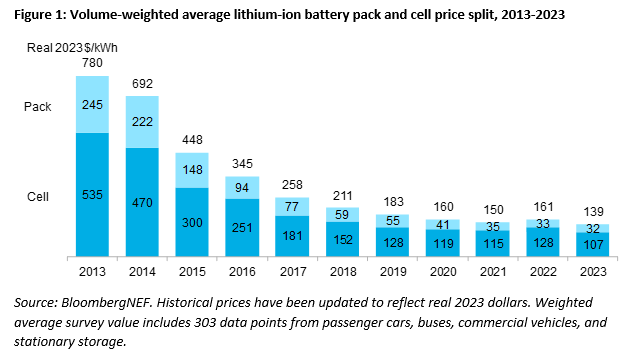
There are enough innovations in the pipeline that it's very safe to predict continuing battery price drops for the next decade, another 80% reduction or so. It's possible it stops after a decade. At that point nuclear would need a 100x price reduction to compete.

https://assets.bbhub.io/professional/sites/24/fig1battery.pn...

Sorry but where do you see this 80% drop? When the price of storage seems close to reaching a plateau (which by the way is also what I assumed in previous comments).

I understand being optimistic, but you claim to know the future while also denying the present... It's ironic.

Re: Electricity prices in France turn negative as renewable energy floods the grid

#150

Earlier quoted context omitted.

I'm confused. The way you've phrased this certainly doesn't sound like it couldn't be the future.

I've heard for years that if we just had "tons" of Nuclear plants, our energy costs would essentially be too cheap to meter. Yet France is not experiencing this even at 75% Nuclear.

The words of a human shouldn't necessarily represent reality, especially when the human in question is a politician and not a scientist. Your argument doesn't make much sense.

Furthermore, no one could have predicted the mass protests, scandals, and fears that nuclear energy has sparked over the decades. These factors have significantly reduced the hype and investment in the sector.

Post reply on HN