Hey, we also got a weird signal from this area not too long ago!
Earth-like planet spotted orbiting Sun’s closest star
141–150 of 351 posts
Re: Earth-like planet spotted orbiting Sun’s closest star
#142Another point for anyone considering whether we should send a space-probe there... The current fastest man-man object is the Helios 2 space-probe, reaching something like 25 000 kilometres per hour. Proxima Centauri is 1.3020 parsecs away from Earth. So, just diving one by the other, we'd looking at something like 18 000 years as a rough order of magnitude for sending something from Earth to Proxima Centauri. You'd b…
> 25 000 kilometres per hour
252 792 km/h
Re: Earth-like planet spotted orbiting Sun’s closest star
#143Perhaps it's too soon after reading The Dark Forest, but uh oh.
I just finished the book yesterday. I rank it #1 on my all-time SciFi list. I would say A Fire Upon the Deep is #2 and Dune #3.
Really? A Fire Upon the Deep and Dune are masterpieces, yes, but The Dark Forest although good isn't in the same league IMO.
- - - -
Tangent: Have you read Gene Wolfe's Book of the New Sun? It's less famous than the books above, but (IMO) it's in the same rarefied company as Dune and J.R.R. Tolkien's work.
Re: Earth-like planet spotted orbiting Sun’s closest star
#144There seems to be some confusion about the meaning of "within the habitable zone". From the paper (Introduction and Conclusions, respectively) [1]: The habitability conditions of Proxima b, which orbits within the HZ of the star, have been extensively studied (e.g. Barnes et al. 2017; Ribas et al. 2016; Turbet et al. 2016; Meadows & Barnes 2018). On the other hand, the candidate Proxima d orbits much closer to the st…
Here's a good collection of details about the entire star system of Proxima Centauri, including its planets.
https://www.star-facts.com/proxima-centauri/
Also fascinating, a relative distance vs time graph of close stars. It turns out we'll have closer distances for 6 in the next 10,000 - 50,000 years.
https://www.star-facts.com/wp-content/uploads/2020/08/Neares...
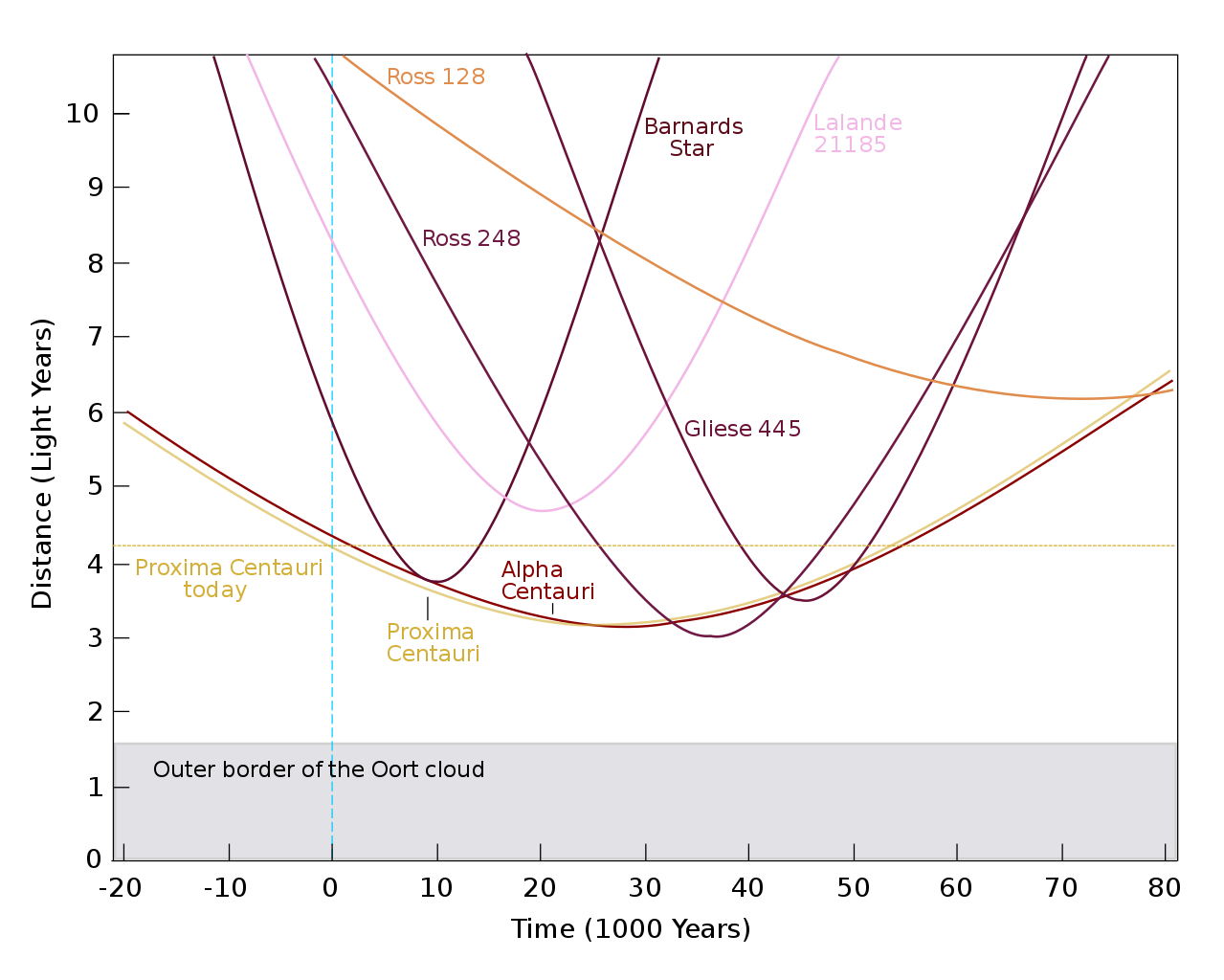
Somehow I feel like Elon Musk has a print out of that graph on his office wall.
Re: Earth-like planet spotted orbiting Sun’s closest star
#145Sadly, as discussed here, the technical problems with propulsion systems for interstellar travel are non-trivial: https://news.ycombinator.com/item?id=29638529 Of course that doesn't necessarily preclude a nearby higher level Kardashev Civilization becoming interested in all the noise we're making and heading over. As we put up systems beyond Webb, it may be possible to observe a hypothetical inbound craft / fleet so…
I thought the nuclear propulsion options were viable and relative simple.
All of the descriptions I've seen were "viable" in the sense of "we could hypothetically accomplish this in a few decades a for around $100 trillion". At least that was the estimate for Project Daedalus, which designed a nuclear pulse propulsion probe to do a 50-year flyby of Barnard's Star. Fun to think about but it's going to be a while before even the largest governments can afford to fund a project that most of its creators will never see completed.
Re: Earth-like planet spotted orbiting Sun’s closest star
#146Earlier quoted context omitted.
Frankly, I believe that any form of mind upload or consciousness transfer is a much harder problem than both rejuvenation and interstellar spaceflight. Looking at current aging research, there's a good possibility we'll see rejuvenation in the next decade or two and it'll profoundly change our society. In 20 years, everyone will be looking 25 years old and pointing at frail people with wrinkly faces and laughing, sam…
That's insane optimism to me. We don't even know how to get a nail to re-attach to a nail bed. We can't put some crystals on a tooth. We can't create a single hair follicle. We have zero non-surgical ways to repair arteries. Etc, etc, etc. We have made zero progress in anti-aging other than controlling blood pressure and identifying harmful chemicals in an environment. We ARE good at extreme, surgical and or heavy me…
At least there is such a thing as growing tissues from stem cells. Nothing at all in the category of "uploading" one's consciousness anywhere exists. Not "uploading a memory", not "uploading a thought process", those are abstract concepts we've made to describe what the extremely strange organs that brains are do, anyway, and we're nowhere near close to understanding its biology much less replicating what it actually does with a machine.
Re: Earth-like planet spotted orbiting Sun’s closest star
#147Another point for anyone considering whether we should send a space-probe there... The current fastest man-man object is the Helios 2 space-probe, reaching something like 25 000 kilometres per hour. Proxima Centauri is 1.3020 parsecs away from Earth. So, just diving one by the other, we'd looking at something like 18 000 years as a rough order of magnitude for sending something from Earth to Proxima Centauri. You'd b…
A probe based on nuclear pulse propulsion could do it in around 50 years, with today's technology. It's not that we can't do it fast (within one average human lifespan), it's that the project would be very expensive and something like Nasa has a relatively tight budget. I mean we, as humanity, have to have an eccentric billionaire start a Martian fire (SpaceX Starship) under our lazy asses to even start to think abou…
Why is it weird that a private corporation is doing space exploration & technology? Most of the biggest sailing expeditions were undertaken by private individuals and companies (although often under the funding of a royal family). Locomotives and airplanes were also created and perfected by private individuals / companies.
The 1950s-2000s NASA model for space exploration was unusual in its centralized approach.
Re: Earth-like planet spotted orbiting Sun’s closest star
#148Another point for anyone considering whether we should send a space-probe there... The current fastest man-man object is the Helios 2 space-probe, reaching something like 25 000 kilometres per hour. Proxima Centauri is 1.3020 parsecs away from Earth. So, just diving one by the other, we'd looking at something like 18 000 years as a rough order of magnitude for sending something from Earth to Proxima Centauri. You'd b…
Isn't Parker Solar Probe much faster than that? It's supposed to be going hundreds of thousands of km/h. [1] [1] https://en.wikipedia.org/wiki/Parker_Solar_Probe
Yes, Parker breaks the 40+ year old record set by Helios. OP is using stale data.
The fastest crewed spaceship was Apollo 10 at 39,705km/h before reentry. After orbiting the moon they had lots of fuel left over so they just floored the engine on the way home. Not just falling back towards the planet but actively flying towards the ground for longer than any other Apollo mission.
This record can be broken with current technology, we just have to go back to the moon.
Re: Earth-like planet spotted orbiting Sun’s closest star
#149Earlier quoted context omitted.
A probe based on nuclear pulse propulsion could do it in around 50 years, with today's technology. It's not that we can't do it fast (within one average human lifespan), it's that the project would be very expensive and something like Nasa has a relatively tight budget. I mean we, as humanity, have to have an eccentric billionaire start a Martian fire (SpaceX Starship) under our lazy asses to even start to think abou…
Going to Mars seems pretty useless to me at this time. It’s a super hostile environment and we don’t have the technology yet to have a self sustaining base there. Give it a few decades and progress in robotics will make a Mars base much easier. There is plenty of work to be done on Earth. We have to solve clean energy production and in general reduce pollution. These are massive technological challenges that deserve…
Going to {the Middle East, Europe / Asia, Australia, the New World, interior South America, the North American West) seems pretty useless to me at this time. It’s a super hostile environment and we don’t have the technology yet to have a self sustaining base there. Give it a few decades and progress in {insert technology} will make a base much easier. There is plenty of work to be done on {current place}. We have to solve {current problems}. These are massive technological challenges that deserve massive funding.
... has been said for the entirety of human history. And in all that time, they've only ever been right about Australia. (J/k Aussies!)
Only one technology matters: that which enables transportation.
Animal husbandry. Sailing. Railroads.
In the end, humans are plentiful. As long as it's done in full disclosure and as an uncoerced individual choice, who the hell are we to stand in the way of adventurers taking a chance on a better life?
Re: Earth-like planet spotted orbiting Sun’s closest star
#150Earlier quoted context omitted.
There is a major logical flaw in your argument. Space travel is only considered to be impractical for humans , or similarly large organic entities within their limited lifespan. The time constraint and the mass constraint may not be particularly relevant to intelligence that no longer has organic form. An artificial lifeform may not have a defined life span and thus taking 100,000 years to travel the stars may be acc…
Time is still a problem because how do you keep such a spacecraft in good repair?. If anything breaks it needs a fair amount of intelligence to fix. same for parts that wear out. Rocks though space, but that doesn't help learn much. Rocks bring up the other issue is we don't know how many high velocity things might be between starts, numbers below the noise limits of our current sensors is enough to destroy anything…
Your body breaks constantly in minor ways, yet it's automagically repaired to a degree. This evolved naturally, but after sufficient breakthroughs in material sciences we could evolve/design materials that are indestructible.
If you haven't already, give Rendezvous with Rama a read.