Live data from Hacker News

Why can't you reverse a string with a flag emoji?

davidamos.dev

141–150 of 247 posts

Re: Why can't you reverse a string with a flag emoji?

#141
post #130

Maybe I'm missing some prerequisite knowledge here, but why would I assume `flag="us"` is an emoji? Looking at that first block of code, there is no reason for me to think "us" is a single character. Edit: Turns out my browser wasn't rendering the flags.

If it's Windows, it doesn't actually use flags for those emojis, it renders a country code instead. If it wasn't supported you would just see the glyph for an unknown character. The reason was because they didn't want to be caught up in any arguments about what flag to render for a country during any dispute, as with, e.g. the flag for Afghanistan after the Taliban took control.

Do you have a citation for that? I suspected it was because of the political issues, so I tried hunting down the reason one day and came up blank.

[Microsoft had this same issue with the timezone map in Windows. The early versions were cool and had country borders, but then I think it was India/Pakistan threw a fit and it was simplified to take the borders out]
Re: Why can't you reverse a string with a flag emoji?

#142

If flag emojis are really a combination of 2 special characters, the reversal of the U.S. flag should result in having the Soviet Union flag.

Just tried reversing a Spanish flag with Python and indeed I got Sweden back

No-one expects the Swedish flag!

Re: Why can't you reverse a string with a flag emoji?

#144
post #44

Interestingly, on my phone the so-called flag is not a flag at all, but "US" in outline. So python behaves as expected: the 2 character string, when reversed, becomes "SU". Similar stuff happens with the other "flag" strings. I'm sure emojis in my phone are outdated. I'm not sure how that affects whether I see a flag or letters.

Out of interest, what phone and browser? The only platform I've seen that doesn't render the flags is Windows.

Re: Why can't you reverse a string with a flag emoji?

#145
post #74

This misses the real problem with flag emoji in that they are composed of codepoints that can be in any order. With other emoji you get a base codepoint with potential combining characters. Using a table of combining character ranges you can skip over them and isolate the logical glyph sequences. You don't need surrounding context to parse them out like flags need.

I think that somewhere in this answer lies a reason why Windows still doesn't support flag emoji. I don't count Microsoft Edge as "Windows" in this case, but as Chromium. Windows doesn't support flag emoji in its native text boxes, but it does support even colorized emoji. But then again, flags seem to be not only Unicode-hard but post-Unicode-hard.

Flags are political. Microsoft has removed country borders from its products for political reasons, a post above says the flags rendering was excluded for the same reason.

Re: Why can't you reverse a string with a flag emoji?

#146
Something I haven't seen mentioned yet is one of the most annoying things about regional indicator symbols, which is that interpreting them correctly requires arbitrary backtracking, and handling this correctly is very annoying for things like text fields.

Basically: A single, unpaired RIS counts as a single grapheme. Similarly, a pair of RIS count as a single grapheme. Now imagine if your cursor position is after an RTS, and you arrow backwards (assuming LTR text, imagine your cursor is to the right of an RIS, and you press the left arrow.) Your textbox should now move the cursor to the left by one grapheme. How do you figure out where this is, in code units? You basically have to scan backwards until you find the first non-RIS codepoint, and then you have to match them up into pairs to figure out if your left-arrow movement should correspond to a movement of one or two codepoints.

This is a longstanding source of bugs, and if you're bored you can play around with pasting a huge sequence of flags into a textfield and then trying to navigate around it with the arrow keys/mouse. There are some broken implementations out there.

edit: while I'm thinking about this I will point out that an alternative design, which would have solved this problem (and which was first pointed out to me by @raphlinus) would have been to have two separate sets of RI symbols, one for 'first position' and one for 'second position'; then you could always determine the appropriate cursor position without needing context. Isn't hindsight a wonderful thing?

Re: Why can't you reverse a string with a flag emoji?

#147

Earlier quoted context omitted.

From Wikipedia: > A separate mechanism (emoji tag sequences) is used for regional flags, such as England 󠁧󠁢󠁥󠁮󠁧󠁿, Scotland 󠁧󠁢󠁳󠁣󠁴󠁿, Wales 󠁧󠁢󠁷󠁬󠁳󠁿, Texas 󠁵󠁳󠁴󠁸󠁿 or California 󠁵󠁳󠁣󠁡󠁿. It uses U+1F3F4 WAVING BLACK FLAG and formatting tag characters instead of regional indicator symbols. It is based on ISO 3166-2 regions with hyphen removed and lowercase, e.g. GB-ENG → gbeng, terminating with U+E00…

This was the only part that was surprising to me, and as it turns out my surprise mostly stems from still not really understanding how the United Kingdom works.

I was born and raised in the UK and I still can't explain to people how it works. Are England, Scotland, Wales and Northern Ireland separate countries? Is the UK a country? It's countries all the way down.

Re: Why can't you reverse a string with a flag emoji?

#149

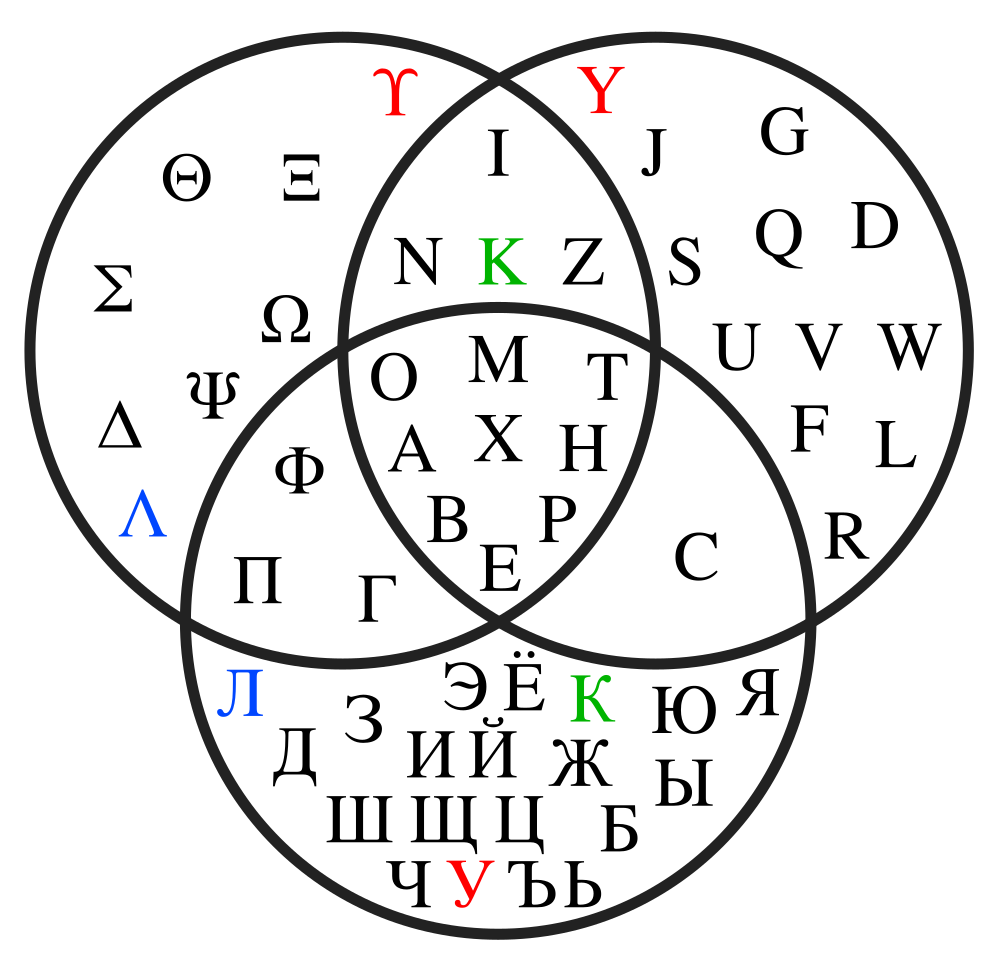
What I'd like to know is, given the explosion of the character set for emoji, does the rationale for Han unification still make sense? The case for not allowing national variants seems less and less compelling with every emoji they add. This is a bit of a hobby horse, but imagine if every time you read an article in English on your phone some of the letters were replaced with "equivalent" Greek or Cyrillic one and yo…

> were replaced with "equivalent" Greek or Cyrillic one

The subset of equivalent letters, or different ones? If they looked the same, it wouldn't bother me if the letters in the center were a single codepoint between European languages:

https://upload.wikimedia.org/wikipedia/commons/8/84/Venn_dia...

Re: Why can't you reverse a string with a flag emoji?

#150

Earlier quoted context omitted.

> It always feels like the most amount of work goes to the least used emoji. I always feel like those emoji were added on purpose in order to force implementations to fix their unicode support. Before emoji were added, most software had completely broken support for anything beyond the BMP (case study: MySQL's so-called "UTF8" encoding). The introduction of emoji, and their immediate popularity, forced many systems t…

WTF business do emojis have in Unicode? The BMP is all there ever should have been. Standardize the actual writing systems of the world, so everyone can write in their language. And once that is done, the standard doesn't need to change for a hundred years. What we need now is a standardized, sane subset of Unicode that implementations can support while rejecting the insane scope creep that got added on top of that.…

This argument was lost the moment Unicode was created. Japanese carriers had created their own standard for emoji encoding for sms. And they would not switch to Unicode unless the emoji were ported over.

It’s a tricky situation. Maybe allowing an arbitrary bitmap char to represent any emoji would have been better but then we could have ended up in a situation where normal text or meaningful punctuation or perhaps even fonts would get encoded as bitmaps.

For something like a face or hand gesture, a bitmap likely would have been better since it would at least look the same on all platforms.

Post reply on HN