Live data from Hacker News

Non-English-based programming languages

en.wikipedia.org

141–150 of 228 posts

Re: Non-English-based programming languages

#141
post #13

I'd rather see a language with more math-like operator symbols (e.g. for-all, element-of, union, is-proper-subset, etc) and an accompanying keyboard.

Dyalog will sell you a keyboard to go with their APL: https://www.dyalog.com/uploads/images/Business/products/dk_r...
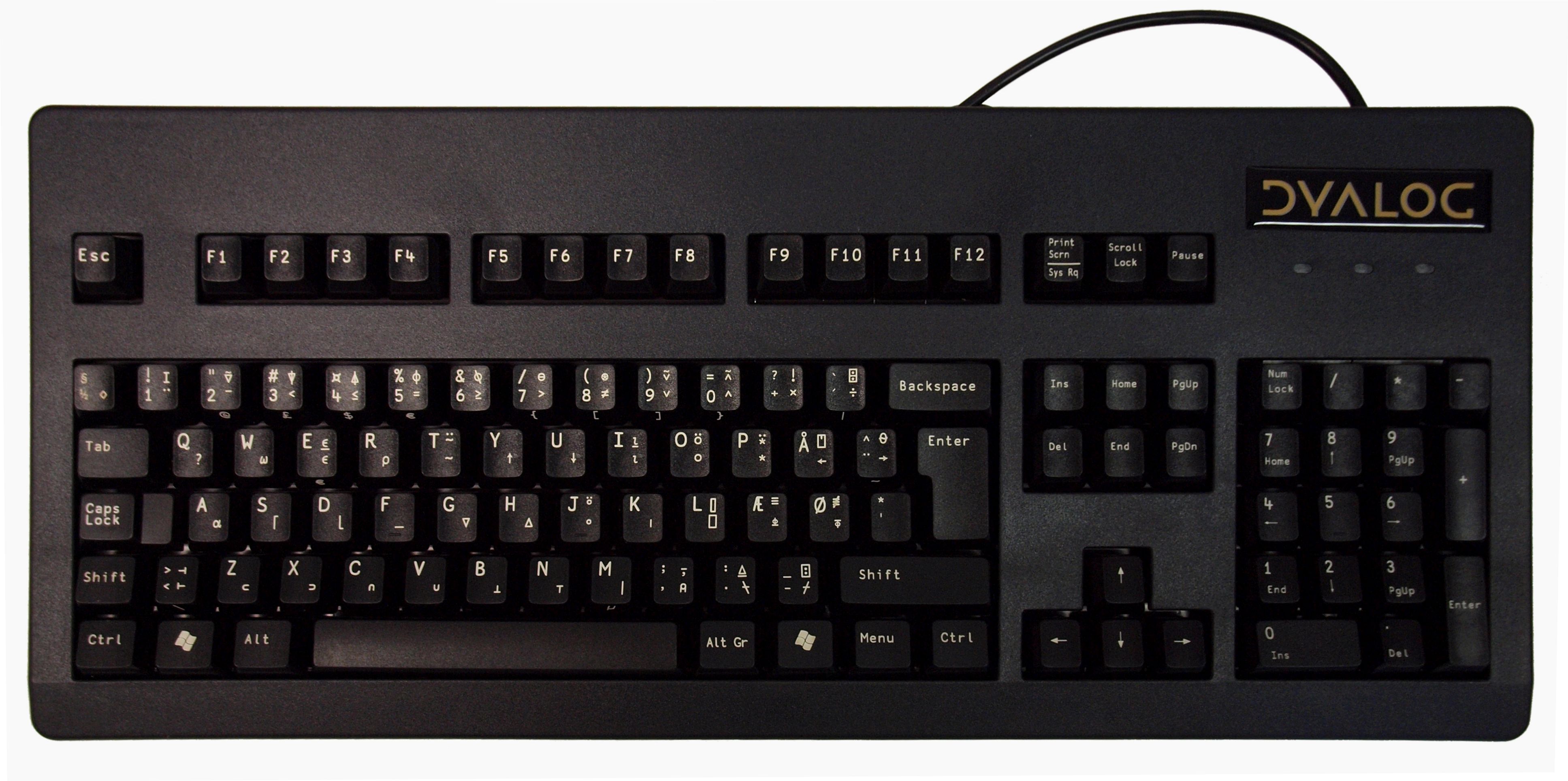
∪ - dyadic downshoe is union ( https://tryapl.org/?a=%27ab%27%20%27cde%27%20%27fg%27%20%u22... )

proper-subset isn't builtin; this might do it, but there are probably neater ways

    'ab' 'cde' 'fg' {((≢⊆⍺)>≢⊆⍵)∧(≢⊆⍵)=+/⍺∊⊆⍵} 'cde' 'ab'
"If the count of items of the left vector is greater than the count of the right vector (right side is smaller, it is proper), and the count of the right vector is equal to the number of elements in the right vector which are in the left vector (i.e. all of them are found, it is a subset)". https://tryapl.org/?a=%27ab%27%20%27cde%27%20%27fg%27%20%7B%...

Not sure it needs "for-all" because functions work on all elements by default. It can have for: loops, but they aren't math-like.

Re: Non-English-based programming languages

#143
post #24

Seeing a programming language in your native language after working with English ones, you discover that it looks and sounds pretty ridiculous. My belief is that the native language is ingrained on a low level in the brain, so it's decoded ‘in the hardware’ and directly invokes meanings and associations, whereas a second language goes through at least some level of conscious processing. The very same way, I'm physica…

French here, that's my experience as well. I want to emphasize that the huge majority of the non-english native programmers I know are pretty opposed to translating programming languages.

However, my experience teaching Japaneses has been that what is crucial if you want to make a programming language accessible to different nationalities is to translate error messages correctly. Learning IF, FOR, RETURN is not hard. There are 20 words max to learn. You could learn that many kanjis in one day if you needed. However, when you are not good at English, understanding "Access error: Array index is out of bounds" requires another level of understanding and vocabulary.

Re: Non-English-based programming languages

#144
post #143
post #24

Seeing a programming language in your native language after working with English ones, you discover that it looks and sounds pretty ridiculous. My belief is that the native language is ingrained on a low level in the brain, so it's decoded ‘in the hardware’ and directly invokes meanings and associations, whereas a second language goes through at least some level of conscious processing. The very same way, I'm physica…

French here, that's my experience as well. I want to emphasize that the huge majority of the non-english native programmers I know are pretty opposed to translating programming languages. However, my experience teaching Japaneses has been that what is crucial if you want to make a programming language accessible to different nationalities is to translate error messages correctly. Learning IF, FOR, RETURN is not hard.…

That's a great point. And that combined with the cryptic nature of many error messages could easily make debugging a nightmare for people who don't speak English...

Re: Non-English-based programming languages

#145

Earlier quoted context omitted.

Yep. Virtually no word has a concrete meaning without a context. For example the word “guys” which may mean a group of males or just a generic collection of people irrespective of gender depending on the context in which it is used.

It can also mean ropes that are anchoring an object. "When camping, I enjoy pegging the guys" for example.

"When camping, I enjoy pegging the guys" can also have a wildly different (sexual) meaning.

Re: Non-English-based programming languages

#146
post #78

Earlier quoted context omitted.

having learned Excel functions in English and having to use them at work in German makes me always nervous

I'm never able to get a function to work as I don't even know their equivalents in German.

Now with Sharepoint and Excel Online, we've discovered that function names follow the base language of the Workspace that the sheet is stored in. It's essentially rendered Excel Online useless.

Re: Non-English-based programming languages

#147
post #24

Seeing a programming language in your native language after working with English ones, you discover that it looks and sounds pretty ridiculous. My belief is that the native language is ingrained on a low level in the brain, so it's decoded ‘in the hardware’ and directly invokes meanings and associations, whereas a second language goes through at least some level of conscious processing. The very same way, I'm physica…

Not saying you're wrong about the hardware analogy. But I think it's no different than learning to drive or play a sport. Eventually it just becomes automatic.

Re: Non-English-based programming languages

#148
post #74
post #24

Seeing a programming language in your native language after working with English ones, you discover that it looks and sounds pretty ridiculous. My belief is that the native language is ingrained on a low level in the brain, so it's decoded ‘in the hardware’ and directly invokes meanings and associations, whereas a second language goes through at least some level of conscious processing. The very same way, I'm physica…

I can't imagine programming with ESL and having to deal with code where some english speaker thought they were super clever and named various classes and variables after things that are super referential or punny. I see a lot of classes at my current job named after 80s TV shows or inside jokes. Maybe having ESL would make that type of thing easier to deal with actually since it drives me up the wall.

I remember having to look up what foobar meant back when I started learning programming. "What do you mean it doesn't mean anything? It has to mean something, otherwise what does this code do!?"

Re: Non-English-based programming languages

#149
post #49

Earlier quoted context omitted.

> All nouns start with an uppercase letter, so your loop index must be "I" or "J". We could have user-defined qualifiers (like const) which are distinct from variables because they start lowercase. So where you have to use @ in Python, we just use lowercase. Yeah, but i and j come from math. I've never seen a math paper where people summed a variable using a capital subscript. I think it might be more interesting to…

Also, a loop index is a placeholder for a numeral, like "eins", "zwei", "drei", hence Für i = 1 bis 2 ... However, using articles, Für das I = 1 bis 2 ... And we may want to use a "Doppelpunkt" and an exclamation mark, since this is still a command: Für i: 1 bis 2!

Extending on the importance of commands in the German language (and culture) – these are a serious matter and not to be fuzzed with –, a computer featuring an explicit fast-mode, like the Sinclair ZX81, may lend itself particlarly well to a German language implementation:

  Für i: 1 bis 10, aber schnell!
;-)

Re: Non-English-based programming languages

#150
https://metacpan.org/pod/Lingua::tlhInganHol::yIghun

    use Lingua::tlhInganHol::yIghun;
 
    > tIghItlh!
  
    {
        wa' yIQong!
        Dotlh 'oH yIHoH yInob 
                qoj  'oH yIHegh jay'!
         yIghItlh!
    } jaghmey tIqel!
Perl makes me smile more than any other language I've poked at. There's an absurd amount of flexibility available.
Post reply on HN