Here's an article about the referenced "slow play" by Sidewalk Labs: https://thelogic.co/news/exclusive/waterfront-toronto-chair-...
Unfortunately most of it is behind a paywall. Can anyone else provide additional context?
141–150 of 194 posts
Unfortunately most of it is behind a paywall. Can anyone else provide additional context?
One of the 'mysteries' of corporations is that they will either do nothing, or take an action that furthers their corporate interests. People don't seem to expect that of companies with a public face and seem surprised when they turn out to be just like any other corporate group. It's a coordination thing - coordinating a large group of people is so challenging only simple messages like 'make a profit' get through on…
Corporations or any other business exist solely on one purpose: to make profit. If you're not making any profit you're not doing business, you're running a charity. That's why you can't trust corporations when it comes to anything "open" and "free".
Earlier quoted context omitted.
> And you can view the US Government in a similar fashion, except exchange corporate profits for power. The difference is that however flawed or imperfect it might be our government does have a democratic and representative system intended to give us a degree of control over it, and was designed with a series of checks and balances intended to mitigate the potential for abuse of power. There are no such equivalent me…
> There are no such equivalent mechanisms in private corporations. To the contrary, you can view the free market as a parallel system of checks and balances where the people have voice and opinion: your wallet. Yes you can actually "vote" with your wallet in a free market. And unfortunately unlike the free market, where greed of money actually acts as a balancing factor, greed of power is terrible in a democracy, and…
As we can see from the way Microsoft and Oracle failed after milking their customers too aggressively, not to mention the way AT&T, Verizon, Comcast, etc. are begging everyone to come back. Yes, you can no-true-Scotsman a claim about those not being free markets but then you're going to have to bring in the essential role of the government in keeping markets from being dominated by large players.
> At the end of the day, if we all stopped using Google Search, Youtube and everyone used adblock to block Google's Ad networks, Google would be toast. Consumers can simply elect to take a different action.
Don't forget giving up Gmail, Google Docs, etc. “if we all” is technically true but really leaves out the degree of effort that it would take to get any significant fraction of people to switch — consider how effective Microsoft and Yahoo! were at competing with Google in those areas and ask yourself what it would take that they lacked.
Earlier quoted context omitted.
If you own Google docs, ensuring it doesn’t break or show an incompatible banner on competing browsers is not an abstract or metric-less concept, it is very tangible and measurable. In fact that’s the sort of thing I would expect any of their engineer to do as part of the development, unless they have been told that releasing a website that only renders on Chrome is OK.
The engineer doesn't decide the schedule though. Usually their activity is controlled by having to do X tasks in time(X)-time(Y)=available_time, with Y being any set of reasons, political, financial, organisational that the engineers will accept as true. Then as engineer what can you do? Either assume toxic Management (and switch Jobs) or do a subset of what you would usually do, and that means optimize for your own…
With that said, there is some indication from the outside that the culture is changing. It can be difficult to sustain culture over time, especially in the face of massive success.
Earlier quoted context omitted.
But likely few people, if anyone, in the organization have any serious incentives (i.e. bonus/promotion) to proactively prioritize that. On the other hand, they almost certainly have at least bonuses on the line to add X users to service/product Y or roll out feature Z (server or client side.) So people work toward what the company rewards[1] and everything else becomes a break/fix situation as it occurs and time per…
I get your point but actually it should go the other way round. If the owner of Google Doc is really focused on own user base only, the incentive would be to make it the most browser compatible. By making it run on chrome only, google docs is potentially sacrificing its user base for a greater purpose.
If it i make google docs great/dominate, then firefox, and safari are critical. You would ask hard questions and have deep discussions around dropping support for internet explorer. If someone suggested khtml (picking something old and poorly maintained) would work with just a little effort you would have a serious discussion around just how much effort that takes.
If the incentive is to make google great then things are different. Losing a few Firefox users might well be worth it if you can convert a few others from firefox to chrome. You might even go so far as to needlessly break firefox once in a while to drive your incentive.
I don't know how google is setup. I've seen companies setup both ways. There are downsides to both.
Earlier quoted context omitted.
I've used a few retina Macs to do various kinds of web dev. Firefox tends to do some things fastest (eg: re-layout when resizing the window), some things the slowest (eg: certain large, complex CSS animations). For most things, it's perceptually equivalent to Chrome or Safari. Some things that are fast/good in Chrome will be slow/bad in FF, and vice versa. The biggest shortcomings I currently face are (1) a lot of ba…
A big problem of early Quantum Firefox on HiDPI Macs was its high battery usage. I think it got slightly better with later releases, but I don't have data to support that.
All I got out of that link of tweets was a series of "Look at all the ways big evil Google steered us off the internet". I'm not doubting any if those claims are true. At the same time, I don't think any of those malicious motives were strong enough. That post came off as more of a whistle blowing speech from an oppressed developer. Nothing written was solid enough to make me think "Ohhh that's how Google killed Mozi…
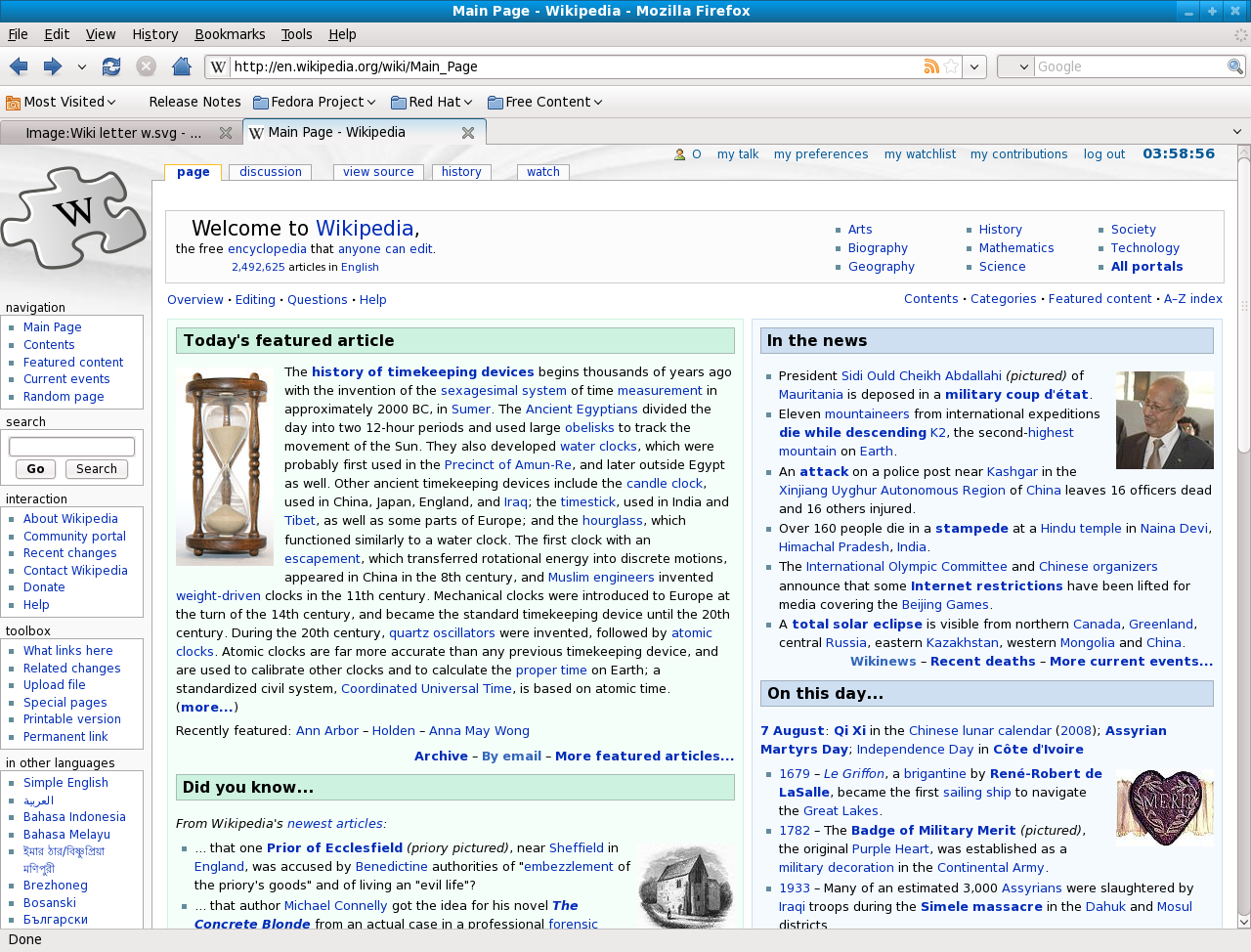
> The GUI features Google introduced were very important. I don't trust my memory, so I'm checking with Firefox 3.0.1[0], released in July 16, 2008[1], definitely before the first release of Chrome. I can't be bothered to also test early Chrome and multiple old versions of Firefox, so the fact that a feature isn't in Firefox 3.0.1 doesn't mean that it came first in Chrome. > Draggable, swappable tabs Firefox 3.0.1 ha…
Here's a screenshot of Firefox 3.0.1, for example: https://upload.wikimedia.org/wikipedia/commons/3/30/Mozilla_...
By contrast, here's Chrome 1.0: http://img.brothersoft.com/top/screenshots/g/Google-Chrome-1...
Aside from the sheer cleanness of the UI (Wow, tabs on top?) Chrome's implementation of draggable tabs was better (the tab itself moved when dragged, not just an icon representing the tab), as was the Omnibox (it was way better at guessing when you wanted a search vs a URL; even to this day Chrome's site search features are better than Firefox).
Just looking at that old Firefox screenshot vs modern day FF it's obvious how many UI features were borrowed from Chrome.
I think the original comic that Google used to announce Chrome explains pretty well what made it different from other browsers of the day: https://www.google.com/googlebooks/chrome/small_00.html Just think about how many of those features eventually became standard in modern-day browsers and it becomes pretty clear how far Chrome was ahead of its time. (Skip to the section on "Search and User Experience" for the bit most relevant to this discussion thread.)
All I got out of that link of tweets was a series of "Look at all the ways big evil Google steered us off the internet". I'm not doubting any if those claims are true. At the same time, I don't think any of those malicious motives were strong enough. That post came off as more of a whistle blowing speech from an oppressed developer. Nothing written was solid enough to make me think "Ohhh that's how Google killed Mozi…
We had built in PDF viewers in IE long before Chrome. In fact, it was even better because it was an OLE component, so IE could embed Adobe PDF, not the cut-rate alternative Chrome has. (Edge is even worse, it’s PDF viewer can’t even search large documents properly.) We have massively regressed on that front over the last 20 years.
Earlier quoted context omitted.
I get your point but actually it should go the other way round. If the owner of Google Doc is really focused on own user base only, the incentive would be to make it the most browser compatible. By making it run on chrome only, google docs is potentially sacrificing its user base for a greater purpose.
What is the incentives for the owner of google docs? If it i make google docs great/dominate, then firefox, and safari are critical. You would ask hard questions and have deep discussions around dropping support for internet explorer. If someone suggested khtml (picking something old and poorly maintained) would work with just a little effort you would have a serious discussion around just how much effort that takes.…
Google is an advertising company. The goal of every Google product is to provide the company with more data, to make users give the company more of their data so that data can be mined for more data.
Controlling the browser or OS means having the ultimate access to the users the ads will be shown to. So if a Google app doesn't help harvesting data, it must be used to push the OS or browser. Google allows for a lot of indirection but ultimately if a product neither harvests interesting data nor helps push users to using Google products that do, there's no reason to keep it around.
Earlier quoted context omitted.
Back when IE was king and there were separate search/address bars, everyone I knew either went to search engine websites or used the search bar. Only those in my tech-literate circle occasionally typed in full domain names when they knew exactly what website they want to go to. The web was marketed as a place to "find anything", and the address bar didn't do that for the regular user.
True, and a big reason why Google effectively removed the address bar. People are now too dumb to type addresses? Let's them fall back to our search engine even more often than they originally did. Now when I'm typing an URL, I must make sure it has a valid syntax, because otherwise I'm redirected to the search engine right away. Kind of annoying, since one reason I don't go through the search engine is to avoid bein…
This is unwarranted condescension. Many URLs are long and non-obvious — do remember that people usually want specific pages rather than a top-level homepage — and there's a thriving industry registering domains which are one typo away from something legitimate and loading them up with ads & malware. For the average person, it's safer and faster just to let Google figure it out.
> Now when I'm typing an URL, I must make sure it has a valid syntax, because otherwise I'm redirected to the search engine right away.
I don't know about Chrome but Firefox shows the status while you're typing so you can tell when you've entered something such as a space which will cause it to be treated as a search query instead.