Live data from Hacker News

Keeping a plaintext “did” file

theptrk.com

141–150 of 202 posts

Re: Keeping a plaintext “did” file

#141
post #25

Earlier quoted context omitted.

The history of the .plan file goes back to way before ID or Carmack. It's been part of unix for a long time. Back when things were simpler, you could finger a user and read their .plan to see what they were up to.

... and other useful info such as office location, phone number, etc. Those were the days before corporate directories.

For a brief bit I had a simple python script dump tweets into a .plan file mostly just to amuse myself by connecting new social media to old.

Hmm, I wonder if I ask my Mastodon host nicely if they'd open up finger protocol support, lol. (ETA: Reminds one of the old adage about blind men touching the elephant.)
Re: Keeping a plaintext “did” file

#143
What I do for all of my side projects now is keep a TODOs.md file in the project root. I no longer keep track of to-dos for programming projects external to the project. I find it makes it much easier to pick up a project I've left for a while.

What I do is every time I think of a new work item or discover a bug, I add an item to the list. Once I finish an item, I check it off. Since it's checked in with everything else, it's a good history of what work was "discovered" along the way and what work has been done.

For the last few years, I've worked on a bunch of little side projects projects here and there and this system has kept me sane.

For an example, see https://raw.githubusercontent.com/allenu/YokosukaJS/master/T...

Re: Keeping a plaintext “did” file

#144
I just store all of my shell command-lines in a big file, including the date and current working directory. That way, I can always grep and see what I did. For stuff that doesn't happen on the commandline, I just type "echo" followed by a description of what I did, and it ends up in the history file just the same.

Re: Keeping a plaintext “did” file

#147
Back (some time ago) when work, etc., had me spending a lot of time on Windows, I found and used this generous free and open-source project.

https://www.codeproject.com/articles/5371/todolist

Looking now at the revision history, it looks as if something may have happened to Dan after last summer.

It wasn't plaintext, but it and its format are open. And I found it a pretty good combination of features in a compact presentation.

There've been a couple of recent "to do" threads, that made me think of this. This thread finally got me to look it up.

I never tried this:

http://abstractspoon.com/wiki/doku.php?id=linux

Re: Keeping a plaintext “did” file

#148
post #78

Earlier quoted context omitted.

I would do the same if I weren't afraid of coming off as passive-aggressive given that I voiced my opinions in the past but received a reply in the vein of: "We're aware that this old code is really bad, but with our constrained resources we need to prioritize keeping this boat afloat.".

At some point you do need to stop baling water and actually plug the hole though.

[deleted]

Re: Keeping a plaintext “did” file

#150

For those who use Emacs, org-capture is probably the way to go: https://orgmode.org/manual/Capture.html#Capture

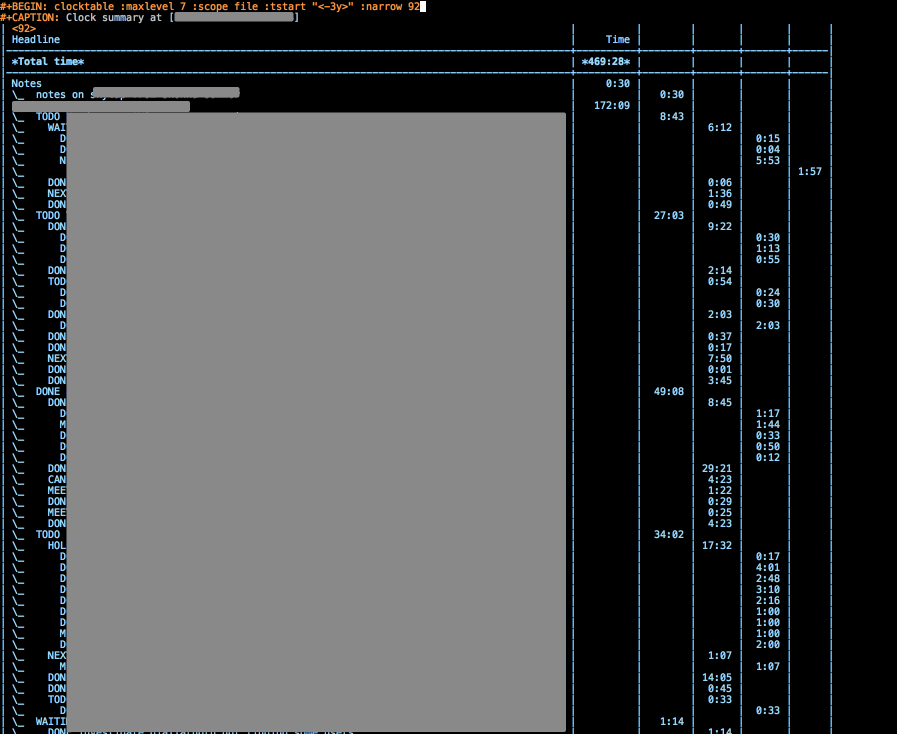
Plus org-clocking, easy time keeping and also offers easy aggregation for reviews. It is really interesting to see after a while how much time was spend at various activities... https://orgmode.org/manual/Clocking-commands.html

here's an example of the kind of summary information you can generate over time:

https://snap.philsnow.io/2018-07-16T11-15-11.9p5nrv1j2ohavi6...

I once was really good about keeping notes like this, but I stopped when I couldn't integrate it very well with the flavor-of-the-day bug tracker my team used.

Post reply on HN