Live data from Hacker News

When employees feel slighted, they work less

penntoday.upenn.edu

131–140 of 279 posts

Re: When employees feel slighted, they work less

#131
"The lost productivity was a form of revenge, with slighted employees taking more paid sick time, arriving late, leaving early, and taking longer breaks."

Someone will feel slighted no matter how well you treat them. I blame all of the 'micro-aggression' nonsense we've seen in the last couple of years and subreddits like /r/antiwork. This sounds like just the kind of thing that's encouraged there.

"The study found that when managers at a national retail chain failed to deliver birthday greetings on time, it resulted in a 50% increase in absenteeism and a reduction of more than two working hours per month. "

Most people I know don't care about their birthday (or being recognized) to this extent. Years ago, I worked at a place that decided to celebrate everyone's birthday that week with a cake and a 10/15 minute meeting (usually multiple birthdays were celebrated at the same time). As the company grew, we were having these meetings 3-times per week.

My 6 year old would care if their birthday didn't get recognized and similarly pout all day and seek this type of 'revenge'.

I wouldn't want to work with anyone that did this.
Re: When employees feel slighted, they work less

#132
post #35

Earlier quoted context omitted.

> When you train a dog, you have to give a reward very soon after the desired behavior, otherwise the dog won't associate the reward with the behavior Regarding dog training, one can use a placeholder for the reward. This is useful, for example, if you want to reward a dolphin jumping through a hula, because you will not be able to give the reward at that moment, but for example, you can say "yes!" or use a clicker a…

Have we got to the point where we need an article telling us that slighting people doesn't help their motivation? Perhaps the answer is yes when we also compare a worker's motivation to a dog's motivation seemingly without irony.

Indeed, they're not animals--we don't want them demanding hay https://dilbert-viewer.herokuapp.com/2002-08-05

Re: When employees feel slighted, they work less

#133
post #67

Lots of “no shit” in these comments makes me wonder how many VP level managers you guys have interacted with. Maybe it’s just my location, but this is one of those things that legitimately NEVER makes it through to upper managers. When they tell their base managers to crack the whip and force them to give the whole “you are not working hard enough, tighten up. Shorter lunches, clock in 5 minutes early, etc” speech to…

> When they tell their base managers to crack the whip and force them to give the whole “you are not working hard enough, tighten up. Shorter lunches, clock in 5 minutes early, etc” speech to the base employees, they will absolutely feel resentment and do LESS work, not more. The most influential question from team lead trainings over the years has been: Do you trust your employee to want to complete the task and pur…

This is a great post on this topic: https://blog.cleancoder.com/uncle-bob/2014/02/23/OhForemanWh.... I'm not sure I'd agree with the full argument as such about commit rights (vs. e.g. pull request review), but it does illustrate parent's point

Re: When employees feel slighted, they work less

#134
post #25

As a Brit, the birthday card example feels oddly American. The effect seems plausible, but the UK equivalent slight would be something much more informal

I wonder if this is generationally specific. I'm an American and have zero expectation that anybody at work should acknowledge my birthday. On the other hand, I can understand feeling slighted if the manager consistently recognizes their employees' birthdays but overlooks mine.

My only experience with acknowledging birthdays at work is that you do it yourself if you want to. Most jobs I've had, birthdays are just not recognized at all, but at one employer the tradition was that you brought in donuts to share on your birthday (if you wanted to--it wasn't required of course).

Re: When employees feel slighted, they work less

#135

As a small business owner who often has to deal with that worst possible ratio 1:1 for management/employee, I can promise you that emoloyees are premptivly looking for reasons to get there digs in, and often show up enacting vengence? in the form of vandalism from day 1. As I have never taken shit from an employer, I walk out and get another job imediatly, I have no sympathy for passive agressives whatsoever and desp…

https://miro.medium.com/v2/resize:fit:1100/format:webp/1*ikF...

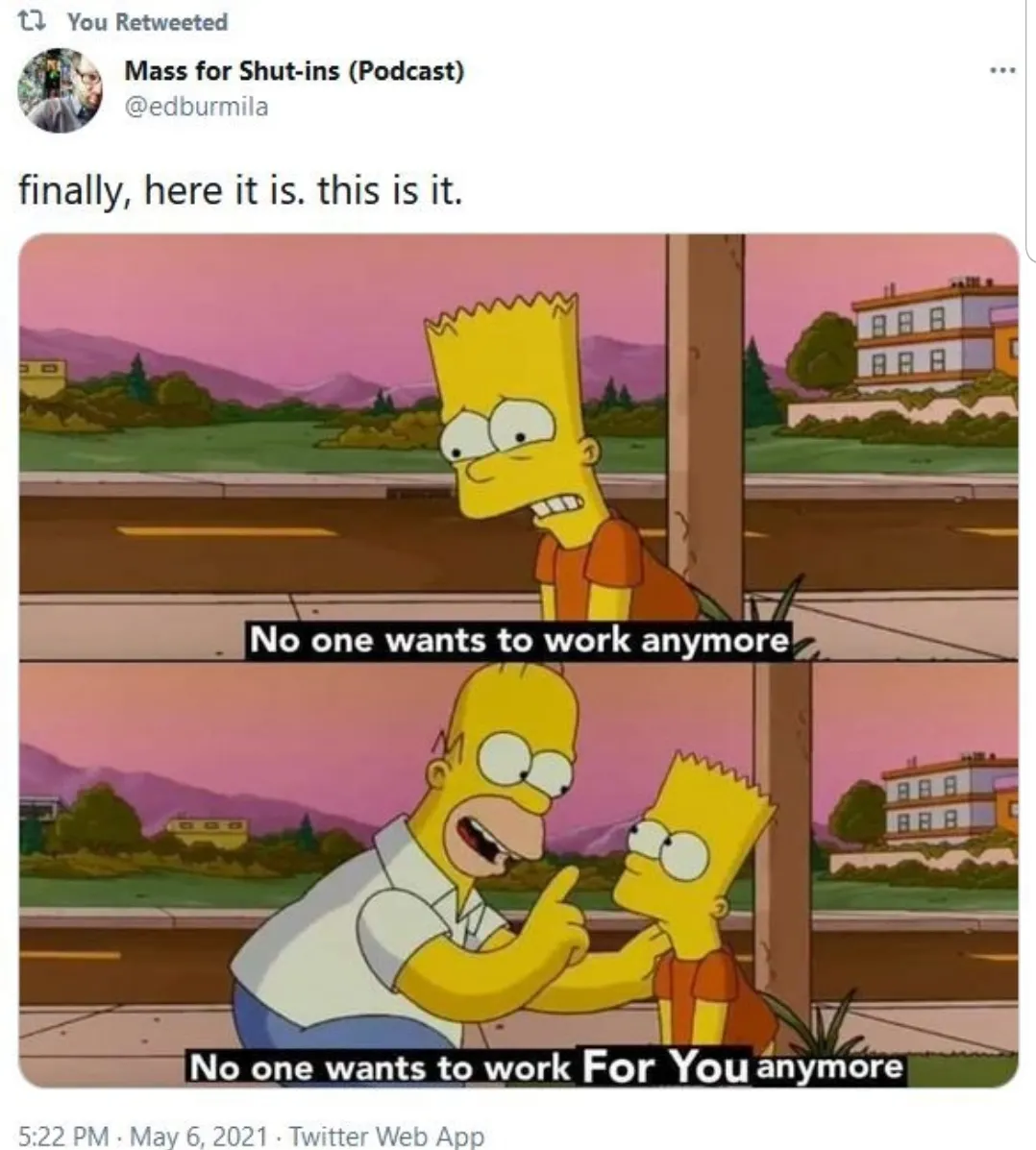
When nobody wants to work for you, that should be a strong indication that you are the problem.

And thinking that employees are "enacting vengence? in the form of vandalism from day 1."... You must be terrible indeed.

Re: When employees feel slighted, they work less

#137
post #4

This seems obvious but I guess needs 'official research' to register. A quote I remember from a coleage - 'They wouldn't give me a pay rate rise, so I gave myself one, by working less hours in a day'

Yeah, I think nobody is gonna tell their boss "I did not like the way you treated me, so I will take a day off for feeling slightly sick". So, while it all sounds obvious, the extent of "idgaf then" is not easy to quantify.

I think zfg is a measurable quantity.

Re: When employees feel slighted, they work less

#138
post #13

On some level the headline is like "yeah, no shit," but the surprising thing is the claimed strength of the effect. 50% absenteeism increase for missing a birthday congratulations? Really?

I'm now somewhat interested in the study to see how they accounted for possible hidden factors. If a team lead or manager spent the time to track birthdays and took time out of their day to have a 10 minute chat with someone on their birthday, they probably exhibit a number of other behaviors that could be summarized as "treating their employees as humans". That's the boss people tend to like to work with and possibl…

However, if at some point somehow it shines through, that this is just another checklist being ticked off, without actual sincerity behind it, this all goes down the drain, and the time would be better spent on actual work environment improvements, rather than wet handshakes and pseudo "we are a family".

Re: When employees feel slighted, they work less

#139
post #34

Earlier quoted context omitted.

Yup. We just lost our "slightly below average" developers, but he was a nice guy and tries to deliver. But they have been slow to replace him, and now we are likely looking at 3 months before a new hire will just be in place, plus the new hire will not have the three years worth of experience the other guy had, so their project will likely be slower than at it already was for the rest of the year.

I’d take “slightly below average but is generally good to work with and tries hard” over “genius asshole” almost any day. Few projects require the latter. There’s also the problem with how useless so many are at their jobs with no way to be sure until its too late.

I've found those genius assholes are mostly just assholes and not much on the genius side

Re: When employees feel slighted, they work less

#140

Earlier quoted context omitted.

> see the employee-manager relationship as adversarial by default. I don't see how anyone can be happy in their job if that were the default. Maybe I am naive or lucky, but I have a very goed relation with my boss, as well as with the boss above. When that condition is not fulfilled, i definitely tend to slack off and I will eventually leave. I believe such should be the default.

The relationship between owners and workers has always been extractive. The adversarial relationship is built in. That doesn’t mean that you can’t have a good relationship with your employer, but there is always a conflict of interest, so to speak. I’ve had great relationships with my bosses, but they’re always under pressure to extract more work from the workers. In turn, their bosses are also pressured to do the sa…

This is an oversimplificstion. The relationship between the person holding the scarce resource, and the person holding the common resource, has always been adversarial.

As labor becomes more skilled and less common this dynamic changes.

Post reply on HN