1. While I agree we're beginning to reach absurd proportions, lets really analyze the situation and think about it. 2. Are there any GPUs that actually have performed physical damage on a motherboard slot? 3. GPUs are already 2-wide by default, and some are 3-wide. 4-wide GPUs will have more support from the chassis. This seems like the simpler solution, especially since most people rarely have a 2nd add in card at a…
My proposal isn’t too different. Move the one ultra-fast PCIe slot to the top of the motherboard. It would be mounted so the GPU plugs in parallel to the motherboard, on the same plane, above the motherboard on a tower case. The few other PCIe slots that exist can stay at the bottom. Only downside is the case has to be taller. Not sure if that would be considered a problem or not. This doesn’t really help dual GPU se…
We Need New Motherboards Before GPUs Collapse Under Their Own Gravity
131–140 of 362 posts
Re: We Need New Motherboards Before GPUs Collapse Under Their Own Gravity
#132Earlier quoted context omitted.
Yeah, I do that for a long time. Had a few accidents where I panicked until it turned out the card was just sagging and the PCIe connection was being stopped. After it happened the 3rd time I just cleaned up a little space and put the PC lying on its side. Zero problems since then.
Quoted post unavailable.
Re: We Need New Motherboards Before GPUs Collapse Under Their Own Gravity
#133New design: Switch things around and stick the CPU into a slot on the GPU.
Re: We Need New Motherboards Before GPUs Collapse Under Their Own Gravity
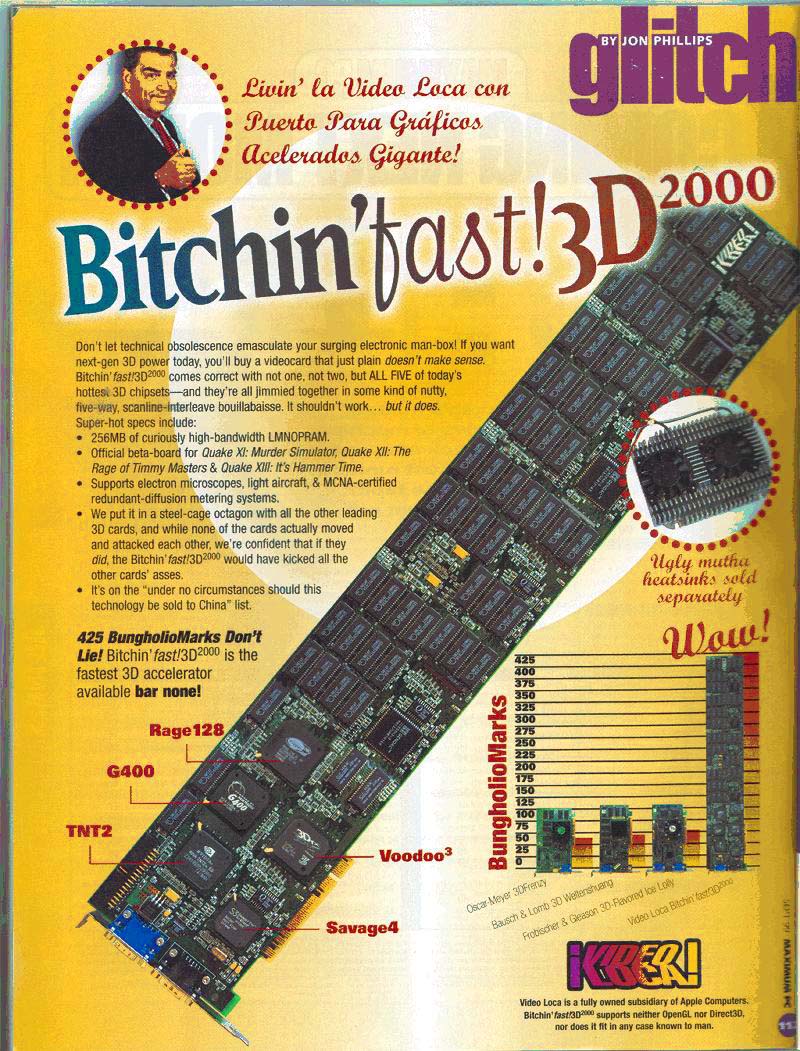
#134https://vgamuseum.ru/wp-content/gallery/bitching-fast/bitchi...
Re: We Need New Motherboards Before GPUs Collapse Under Their Own Gravity
#1351. While I agree we're beginning to reach absurd proportions, lets really analyze the situation and think about it. 2. Are there any GPUs that actually have performed physical damage on a motherboard slot? 3. GPUs are already 2-wide by default, and some are 3-wide. 4-wide GPUs will have more support from the chassis. This seems like the simpler solution, especially since most people rarely have a 2nd add in card at a…
In reality, there is no reason GPUs should be add-ons. Just star designing motherboards with integrated GPUs of sufficient size. Case closed.
Re: We Need New Motherboards Before GPUs Collapse Under Their Own Gravity
#136Every time I see the sizes of GPUs increase, I'm reminded of this from over 2 decades ago: https://vgamuseum.ru/wp-content/gallery/bitching-fast/bitchi...
Re: We Need New Motherboards Before GPUs Collapse Under Their Own Gravity
#137Re: We Need New Motherboards Before GPUs Collapse Under Their Own Gravity
#1381. While I agree we're beginning to reach absurd proportions, lets really analyze the situation and think about it. 2. Are there any GPUs that actually have performed physical damage on a motherboard slot? 3. GPUs are already 2-wide by default, and some are 3-wide. 4-wide GPUs will have more support from the chassis. This seems like the simpler solution, especially since most people rarely have a 2nd add in card at a…
In reality, there is no reason GPUs should be add-ons. Just star designing motherboards with integrated GPUs of sufficient size. Case closed.
Re: We Need New Motherboards Before GPUs Collapse Under Their Own Gravity
#139Earlier quoted context omitted.
The GPU should be the motherboard, and everything sticks onto it.
So how would multi-GPU setups work?
Or maybe they could devise some sort of stacking system, with each GPU board separate and stacked.
Re: We Need New Motherboards Before GPUs Collapse Under Their Own Gravity
#140Earlier quoted context omitted.
My proposal isn’t too different. Move the one ultra-fast PCIe slot to the top of the motherboard. It would be mounted so the GPU plugs in parallel to the motherboard, on the same plane, above the motherboard on a tower case. The few other PCIe slots that exist can stay at the bottom. Only downside is the case has to be taller. Not sure if that would be considered a problem or not. This doesn’t really help dual GPU se…
Not a bad idea however you have hard limits on how physically long the PCIe lanes can be. We had problems making sure we hit signal budget for a PCIe gen 4 slot on an ATX motherboard. The problem (PCIe lane length) gets worse as the speeds increase.
Thinking about it though isn’t that where a lot of motherboards put a lot of their power regulation circuitry? I’m sure something would have to move.
But excellent point. That could easily bet a much bigger sticking point that I didn’t really consider too much.