Live data from Hacker News

The medieval habit of ‘two sleeps’

bbc.com

131–140 of 254 posts

Re: The medieval habit of ‘two sleeps’

#131

Earlier quoted context omitted.

Same for me, I tried that for almost a year and the night hours were super productive and enjoyable no matter which activity I do.

Honestly curious here and not picking on you. If it was super productive and enjoyable, why only do it for a year?

I think the biggest problem/excuse/justification is that life makes it difficult to go to bed before XX o’clock (8:00 PM for me). I’ve never done this bifurcated sleep method, but I am happiest and most productive if I go to bed around 8 PM and rise around 3:30/4:00 AM to workout and get on with my day. But then I have work problems that require a later evening, or a family member that wants to chat, or a house repair I just have to tend to, of a close friend with kids that I only talk to every few weeks who finally has a free moment… and the whole schedule gets screwed up, all the time. The going to bed early, regularly, is the difficult part I think.
Re: The medieval habit of ‘two sleeps’

#132
post #117

Earlier quoted context omitted.

The mother would either sleep with the baby or have it easily retrievable without significantly stirring. Dozing while nursing would provide some compromise between rest for her and the household, and enjoying/enduring some thinking time.

This argument amounts to "cosleeping babies are not noisy" which is only partially true. They are less noisy, but they still do cry enough. > Dozing while nursing .... and enjoying/enduring some thinking time. Nah, it is just brain fog from slee deprivation. It is not free thinking time, it is "Jeeez I want to sleep" time.

I have had some great insights when I can't fall a sleep, in that brain fog you mention, sometimes where the feeling of my own self somehow disappears, seeing everything less through the lens of the self-protective consciousness, then I could suddenly understand and solve some nagging issues.

But the toll is high, not sleeping properly ruins your life. And most of the time it's definitely not insights, but the opposite. For me, it's not something to seek out.

Re: The medieval habit of ‘two sleeps’

#133

Earlier quoted context omitted.

Same for me, I tried that for almost a year and the night hours were super productive and enjoyable no matter which activity I do.

Honestly curious here and not picking on you. If it was super productive and enjoyable, why only do it for a year?

Like others have pointed out, It's really difficult to operate on a different schedule than the rest of society. Eventually family, friends, and other activities pushed me to give up my evening "first sleep"

Re: The medieval habit of ‘two sleeps’

#135

"Despite near-constant headlines about the prevalence of sleep problems, Ekirch has previously argued that, in some ways, the 21st Century is a golden age for sleep – a time when most of us no longer have to worry about being murdered in our beds, freezing to death, or flicking off lice, when we can slumber without pain, the threat of fire, or having strangers snuggled up next to us." What a wonderful time we live in…

Not sure if your comment was partially made as a joke or not but I can certainly attest that having to wake up at 4 or 5 in the morning because of lice is not ideal.

My parents live in the (Eastern-European) countryside and because of the environment (basically all sorts of animals living around the house) they started having lice since 2-3 years, I think. You eventually get used to them, one of the keys is to tuck (I think that's the word) your sleeping pants well into your socks, so that the damn beasts won't make their way up on your skin from bellow. Sleeping with the bedside lamp turned on seems to also have helped, but not sure if that was my placebo or not.

Re: The medieval habit of ‘two sleeps’

#136
post #13

The article does not mention it, but mothers with small children have to nurse babies every couple of hours, even at night. So given that in middle ages, families had "copious numbers of children" (quote from the article), it is for sure that mothers would need to get up to feed a baby. And then possibly the whole family would woke up too. And if multiple generations were living in the same house, then even more prob…

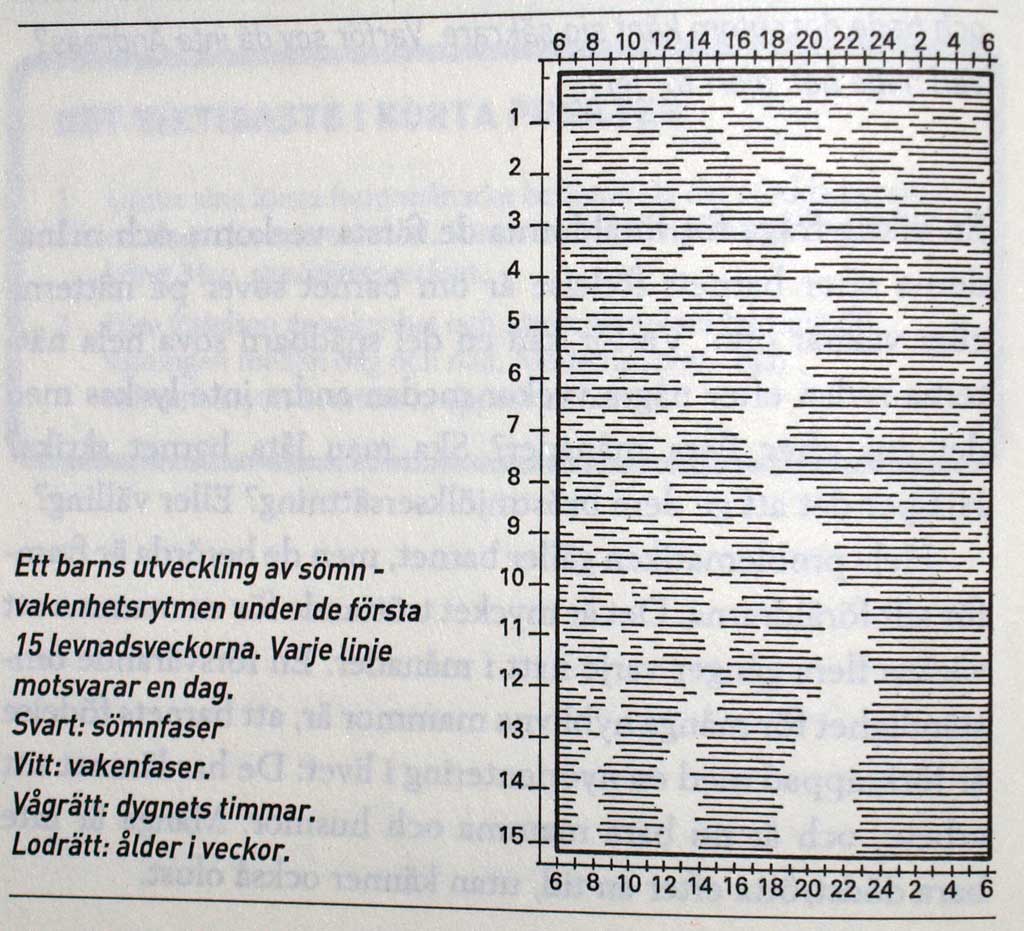
Here's a nice graphic showing a baby's sleep pattern during the first 15 weeks:

http://www.eiman.tv/misc/somnrytm.jpg

Since the text is in Swedish, here's roughly what it says: Every row is a day, black is sleep, white is awake.

Re: The medieval habit of ‘two sleeps’

#138
post #13

The article does not mention it, but mothers with small children have to nurse babies every couple of hours, even at night. So given that in middle ages, families had "copious numbers of children" (quote from the article), it is for sure that mothers would need to get up to feed a baby. And then possibly the whole family would woke up too. And if multiple generations were living in the same house, then even more prob…

Here's a nice graphic showing a baby's sleep pattern during the first 15 weeks: http://www.eiman.tv/misc/somnrytm.jpg Since the text is in Swedish, here's roughly what it says: Every row is a day, black is sleep, white is awake.

Oh wow. Babies sleep a lot.

Re: The medieval habit of ‘two sleeps’

#139
I am wondering how they dealt with that pattern during summer when the night is short.

the article mentioned that a contemporary reproduction of the pattern used blinders to cut off the natural light - something I guess most people did not have in the Middle-Ages. It also mentions that they were waking up at dawn (which is early in the summer).

Re: The medieval habit of ‘two sleeps’

#140

"Despite near-constant headlines about the prevalence of sleep problems, Ekirch has previously argued that, in some ways, the 21st Century is a golden age for sleep – a time when most of us no longer have to worry about being murdered in our beds, freezing to death, or flicking off lice, when we can slumber without pain, the threat of fire, or having strangers snuggled up next to us." What a wonderful time we live in…

Conditions may apply. If you're homeless or living in a country with ongoing war, disease or hunger the likelihood that you have to worry about any of these things goes up dramatically.
Post reply on HN