Live data from Hacker News

Common Jobs in a Medieval City

medievalists.net

131–140 of 193 posts

Re: Common Jobs in a Medieval City

#131
post #127
post #79

Earlier quoted context omitted.

See also The Lindy Effect: https://en.wikipedia.org/wiki/Lindy_effect

Thanks for the link! Hadn't heard of that, although I've seen similar reasoning in other contexts. (Basically, the most reasonable estimate, absent other data, is that you are at the mean -- so, for example, one could reasonably guess that half the people to ever be born have been born at present.)

So some people have 4 testicles?

(assuming I'm average...)
Re: Common Jobs in a Medieval City

#132

It surprises me that all 10 jobs still exist, while there are several more recent occupations that no longer exist (albeit they were not that common): Milkmen, Elevator operator, Switchboard Operator, Ice Cutter, Bowling Pin Setter, Film projectionist, Lamplighter, Leech collector, Alchemist, Bematist, Redsmith, Daguerreotypist, Town crier

Milkmen 100% exist in the UK. Even though I don't drink actual milk they have a massive range of products they will deliver, so I get fruit juice, various foods and oat milk delivered by my milkman.

Re: Common Jobs in a Medieval City

#133

It surprises me that all 10 jobs still exist, while there are several more recent occupations that no longer exist (albeit they were not that common): Milkmen, Elevator operator, Switchboard Operator, Ice Cutter, Bowling Pin Setter, Film projectionist, Lamplighter, Leech collector, Alchemist, Bematist, Redsmith, Daguerreotypist, Town crier

Milkmen definitely still exist in the UK, and likely other places.

https://www.milkandmore.co.uk/

These guys do doorstop milk deliveries to much of the UK. In our area they comes on Tuesday, Thursday and Saturday mornings at around 5:30am.

Milk in old fashioned glass bottles, Welsh cakes, yoghurt... Yummy!

Re: Common Jobs in a Medieval City

#134
post #54

Earlier quoted context omitted.

Blacksmith wasn't a major job until the 1800s when industrial revolution made the job possible. In the 1800s a blacksmith should made nothing: everything was made in a factory and the blacksmith just did the final fitting or repair work. Sure they could and did do some custom decorative stuff, but only the rich could afford that. Before then a city might have a couple in employee of the noble to make armor or swords,…

Farming tools? Wood working rools? Tools for builders? All made a blacksmith of sorts. Those making arms and armor where a highly specialized bunch. That being said, arms manufacturing was a very well developed industry during tue middle ages. Including general contractors, cuttlers, in case of weapons that coordinated the work of the people making the blades, the handles, the scarbords and dis the heat treatment. If…

Weren't bladesmiths a separate profession? I was under the impression that blacksmiths were your run of the mill iron workers, especially considering that a good blade could take far longer to produce than a blacksmith might be able to devote time to.

Slapping a wedge of metal on a pole and calling it a pike could be done by anyone though, I suppose.

Re: Common Jobs in a Medieval City

#135

It surprises me that all 10 jobs still exist, while there are several more recent occupations that no longer exist (albeit they were not that common): Milkmen, Elevator operator, Switchboard Operator, Ice Cutter, Bowling Pin Setter, Film projectionist, Lamplighter, Leech collector, Alchemist, Bematist, Redsmith, Daguerreotypist, Town crier

Alchemist became Chemist. Dageuerreotypist became photographer, which has only recently gone away. Town crier is now the guy flipping a sign for the new burger joint.

Photographers have absolutely not gone away, at least not in the wedding industry.

Re: Common Jobs in a Medieval City

#136
post #94

Earlier quoted context omitted.

Ive heard the possibly apocryphal reason for this is that invading armies would kill or appropriate workers in other professions but keep around the trained blacksmiths working the forge and producing weapons and tools for war. Smiths survived the waves of conquerors.

Wouldn't be true for England which has gone the last millenia (almost) without invasion.

There were technically invasion attempts up until the 18th century, but even discarding most of those as insignificant, we can hardly neglect the War of the Roses and Henry Tudor's (successful) invasion in 1485...

Re: Common Jobs in a Medieval City

#138

It surprises me that all 10 jobs still exist, while there are several more recent occupations that no longer exist (albeit they were not that common): Milkmen, Elevator operator, Switchboard Operator, Ice Cutter, Bowling Pin Setter, Film projectionist, Lamplighter, Leech collector, Alchemist, Bematist, Redsmith, Daguerreotypist, Town crier

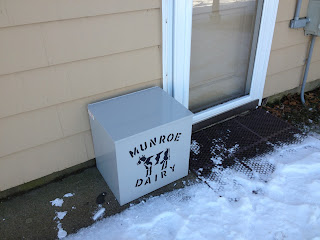
The milkman is alive and well here in Rhode Island. Every other house has one of these on their front porch: https://1.bp.blogspot.com/-55YYt59jQqk/TxnrEKJT4BI/AAAAAAAAA...

Re: Common Jobs in a Medieval City

#139

Earlier quoted context omitted.

Definitely a blacksmith in almost every city, but probably fewer blacksmiths per city than the other jobs. Metal tools are built to last, and are expensive, so it was probably often a low volume high cost kind of business where production could be covered by a minimal number of smiths.

My Dad was born before WW2 in a village in Eastern Europe, which was probably closer to a medieval village than to a 21st century one. He told me that a blacksmith would ask for 3 plum trees to do a certain job, presumably in order to make charcoal. I don't think there was anything special about plum trees, other than the local availability: people were (and still are) growing plum trees in order to make spirits. Giv…

The venerable ACOUP blog says that in order to produce 1 kg of iron, you would need 14,6 kg of charcoal, which translates into 105 kg of raw wood.

https://acoup.blog/2020/09/25/collections-iron-how-did-they-...

Re: Common Jobs in a Medieval City

#140
post #70

Earlier quoted context omitted.

Definitely a blacksmith in almost every city, but probably fewer blacksmiths per city than the other jobs. Metal tools are built to last, and are expensive, so it was probably often a low volume high cost kind of business where production could be covered by a minimal number of smiths.

They must have been quite prolific then. There's a reason Smith is the most common surname in the English speaking world.

According to Mencken's The American Language any metalworking job qualified one for the surname.
Post reply on HN