Live data from Hacker News

The US Army spent millions developing giant, six-legged walking trucks in 1980s

thedrive.com

131–140 of 173 posts

Re: The US Army spent millions developing giant, six-legged walking trucks in 1980s

#131
post #30

Earlier quoted context omitted.

That's the choice of your fellow citizens who'd rather spend money on weapons than feed people, and will come up with elaborate stories about why your uncle deserves to be in that position. :(

," he said, on an ARPA-funded network.

I'd be impressed if you could find a single hop in the modern network we're using that's actually run by ARPA. The ISPs, the hosting, the interconnect - all private. Who owns the transatlantic link?

Calling the internet an ARPA system is like insisting on calling telephones the Bell system.
Re: The US Army spent millions developing giant, six-legged walking trucks in 1980s

#132

485lb payload. Regardless of the design, it makes sense why they scrapped it.

These days delivering that sort of payload with a hexacopter is only a "stupidly expensive hobby grade" project. (Though I'm not aware of any homebuilt multi rotors up in the 485lb plus a ~170lb pilot range. Yet.)

These days? Car sized hexacopters have been vaporware for several decades.

Re: The US Army spent millions developing giant, six-legged walking trucks in 1980s

#133

Earlier quoted context omitted.

," he said, on an ARPA-funded network.

"My uncle is starving while defence projects get lots of money" and "Some defence projects have led to good outcomes for society". Without aiming to insult here¹, is it interesting to anyone that the same things we say when we're 14-15 years old are the same things we say decades later? I remember having had this argument when I was a kid (and very space-obsessed) and it was almost exactly like this. I remember my cl…

> It's like some number of people have to be thrown into the war of the ideas periodically to preserve the battle lines exactly as they are. Stop and you lose ground.

Well, yes. Overton window and all that. Similar discussions on USENET 20 years ago. Although I think in some ways they've moved on, and in some ways regressed - the openness of troll conservativism, for example.

I sometimes think of these ideological fault lines as behaving like the geological ones; pressure maintained for years in equilibrium, then there is a crisis and a huge slip all at once. With a lot of stuff getting demolished along the way.

Re: The US Army spent millions developing giant, six-legged walking trucks in 1980s

#134

Earlier quoted context omitted.

About the timber harvester: I assume better here is meant from a economical perspective, because from a ecological perspective the walkers are superior, as they do not devestate the ground so much. But that is sadly not really a issue for most wood production, but I could imagine, with rising awareness for the forests, market demand for not so intrusive wood harvesting(along with advances in the field in general) cou…

> because from a ecological perspective the walkers are superior You sure about that? Soil compaction is the most serious long-term damage caused by timber harvesting. It's why only tracked harvesters driven by highly-paid fellers are allowed off the gravel. The masses of everyday log-truck drivers (and their wheeled vehicles) are not allowed on the dirt. You want the ground pressure spread out as much as possible, n…

I am not sure about compaction compared to a tracked forester. Physics implies that tracked ones are better, for that, yes. But they rip up even more surface. I believe it is a question, how often the specific path has to be passed by by a forester.

"It's why only tracked harvesters driven by highly-paid fellers are allowed off the gravel."

And this is sadly not true for germany or other parts of europe I know about. I think I never saw a tracked forester in europe. Are they mandatory in the US? That would surprise me, given they have much more lax regulations in general (fracking for example)

Re: The US Army spent millions developing giant, six-legged walking trucks in 1980s

#135

Earlier quoted context omitted.

I feel for you, but military spending is a massive federal jobs program. Each job created has a job multiplier effect, creating additional jobs in the surrounding area. Manufacturing jobs producing military equipment have a much bigger job multiplier effect. So if you were to wave a magic wand and half military spending overnight, the economic impact would be disastrous, and many more people would be in dire economic…

That doesn't seem to be an issue for other Western countries with much smaller militaries (per capita).

We have the US for that military thing.

Re: The US Army spent millions developing giant, six-legged walking trucks in 1980s

#136

Earlier quoted context omitted.

Most timber today isn't harvested in natural forest, they are effectively tree farms, they have a 10 to 20 year growth cycle and since all the trees planted are harvestable, they basically clear cut the land, burn it, off cycle growth as needed, and do it again. In those instances, there is no ecological consideration as the whole area basically gets wiped out.

That's not really accurate. It depends on the tree type, but the growth cycle is somewhere between 50 to 100 years for optimal results. It's true that most forests today are not old growth anymore. They have been cut (usually clear cut) and then either replanted or just naturally reseeded and are now essentially waiting for the next cut. There are some areas where they are monocultural tree farms with not much else g…

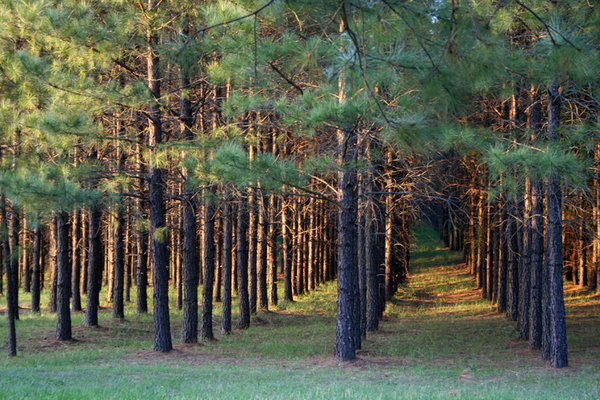
I'm guessing you aren't from the U.S. but in the southern U.S. growing newer species of Pine (variants of Loblolly Pine). A standard lease is 20 years from seedling to harvest, some older variants can go 30 to 50, but you don't see that being planted any longer and that's all leases maturing.

And here, I can assure you they are very much mono culture, evenly spaced, engineered species of trees, almost nothing else happens on the land in that time period. (generally it looks pretty similar to this https://a.rgbimg.com/users/p/pa/paparabbit/600/mwYGk8q.jpg) They do come and selectively thing at 5, 10, or 15 depending)

See the issue is, at least in the southern U.S. they clear cut nearly everything in the 1800s. There is very little old growth left.

Re: The US Army spent millions developing giant, six-legged walking trucks in 1980s

#137
post #70

Earlier quoted context omitted.

Totally. I want that walker for my woodland, because it looks a lot less damaging to the soil (less soil disruption / compaction). The other thing is it would be nice for climbing to spots that don’t have easy road access. This way you can pick a few trees without devastating a whole area just to reach them.

Draft horse logging; we had it done in a sensitive woodland. It's not particularly fast, and it would be expensive.

Oh yeah, there was a bit on a Discovery real-life soap once where one of the characters was a draft horse logger; that was pretty impressive.

Re: The US Army spent millions developing giant, six-legged walking trucks in 1980s

#138

The things you can do when you don't have to tackle child poverty or provide healthcare for all. Its probably because of my Euro socialist identity but all I see is wasteful spending.

The Eurozone (NATO) is protected from Russia and other aggressors by US military spending, and trades along sea routes which are kept open by US military spending, to list only two ways in which the EU benefits massively from our tax dollars here in the US. If the EU decided to allocate a proportional share to their common defense, maybe the US would have less reason to be intervening overseas and could spend some of…

The EU spends about 4 times that amount that Russia (the only direct military threat) spends. Russia has much smaller population and a much smaller economy and pretty much depends on selling oil and gas to the EU to survive.

Re: The US Army spent millions developing giant, six-legged walking trucks in 1980s

#139
post #2

Only millions? Amazing! To actually deliver a physical, one-of-a-kind, working vehicle of that scale & novel function, for low-digit millions, seems pretty impressive to me - especially if the effort documented enough of their choices/discoveries/limitations to help inform later efforts.

It's amazing how much you can achieve with a relatively small team of experts. I also believe people have gone "blind" to how much a million is and what it can afford. I mean a million can employ a decent software developer for a decade, and a solo developer can achieve a lot in a decade. I've probably produced about a million LOC in that period in half a dozen languages.

I was curious; the Manhattan Project cost $2 billion (in 1939) and employed 130,000 people (https://en.wikipedia.org/wiki/Manhattan_Project, first paragraph).

Re: The US Army spent millions developing giant, six-legged walking trucks in 1980s

#140

Earlier quoted context omitted.

That's not really accurate. It depends on the tree type, but the growth cycle is somewhere between 50 to 100 years for optimal results. It's true that most forests today are not old growth anymore. They have been cut (usually clear cut) and then either replanted or just naturally reseeded and are now essentially waiting for the next cut. There are some areas where they are monocultural tree farms with not much else g…

I'm guessing you aren't from the U.S. but in the southern U.S. growing newer species of Pine (variants of Loblolly Pine). A standard lease is 20 years from seedling to harvest, some older variants can go 30 to 50, but you don't see that being planted any longer and that's all leases maturing. And here, I can assure you they are very much mono culture, evenly spaced, engineered species of trees, almost nothing else ha…

Yes they used to do forestry like that in Northern Europe. They realised the methods described by the OP are more sustainable and more reliable (e.g. diseases will wipe out monocultures).
Post reply on HN