Live data from Hacker News

Twelve Days in Xinjiang: How China’s Surveillance State Overwhelms Daily Life

wsj.com

131–139 of 139 posts

Re: Twelve Days in Xinjiang: How China’s Surveillance State Overwhelms Daily Life

#131

Earlier quoted context omitted.

You should talk to the relatives who killed by those terrorist. You wouldn't feel the pain as you still alive

You should talk to the relatives of dissidents killed by the government. See how this game works once we start depending on emotional appeals?

Go find pictures of Iraq before and after Saddam was down and see how the life of the ordinary people was changed.

I am not suggesting dictatorship is good; but in certain level of civilization, it might be better for the majority.

Re: Twelve Days in Xinjiang: How China’s Surveillance State Overwhelms Daily Life

#132

Earlier quoted context omitted.

You should talk to the relatives of dissidents killed by the government. See how this game works once we start depending on emotional appeals?

Go find pictures of Iraq before and after Saddam was down and see how the life of the ordinary people was changed. I am not suggesting dictatorship is good; but in certain level of civilization, it might be better for the majority.

The gross mismanagement of the Iraq war and its aftermath does not demonstrate that security and freedom are incompatible. Yes, it's much more difficult in some places than others, and a despotic leader is all too happy to point out the failures in order to justify their own tyranny. What really sucks is that so many people fall for it.

Re: Twelve Days in Xinjiang: How China’s Surveillance State Overwhelms Daily Life

#133

I'd really like to read more Chinese-from-China views on this kind of article. Although the content of the article scares me personally, it would be interesting to have more of a discourse about more plausible reasons why this kind of surveillance is "good" from a genuine different perspective. One mistake the Chinese govt makes is never explaining themselves in a plausible way so it always comes across as Orwellian.…

Chinese from China here. I live nowhere near these places (Xinjiang and Tibet), I can say I agree with you mostly, but I highly suspect my opinion is popular here. The level of surveillance is scary but as discussed above, it is probably not uncommon. What scared me more is that any of these is not up to discuss and to be acknowledged in China, like even though I am shocked by this article I would not share it on any of my social media for obvious reasons. And for people like most of my family and friends who live far away from there, if you personally don't know anyone from Xinjiang then big chance you don't know what's happening there as it never broadcast in any sort. News like this can only be read by passing the GFW and by people who know English, real journalism in China is dead. So when 99% of this massive population only fed on what the authority gave them, the authority has virtually no control and everyone just live at their mercy. So basically if someone agrees on the safety > liberty, then I say lucky you. For anyone who disagrees with the authority action, can only suck it up and accept the reality.

Re: Twelve Days in Xinjiang: How China’s Surveillance State Overwhelms Daily Life

#134

Earlier quoted context omitted.

How many people killed by extremists in the US last year? Are you suggesting that US should increase their security to the same level as China (and implement a police state) to avoid more extremists death?

Have you ever been to China? You can walk 24/7 in any city in China without worrying your safety. Tell me you dare to walk midnight in downtown New York or LA or Chicago.

You can talk shit about your government, legitimately criticize them, read papers discussing news from different sides even they all biased but they still offer angles, express your opinion freely and perform your citizen duties in NY LA or Chicago. Tell me about all these in China.

Re: Twelve Days in Xinjiang: How China’s Surveillance State Overwhelms Daily Life

#135
post #29
post #23

Earlier quoted context omitted.

Scared people are nearly the worst kinds of people you want making policy decisions. If you can establish statistical significance that no cameras -> cameras (actual causality, not mere correlation) causes a drop in (public) robery-related homicide, and a majority of people believe that drop to be significant enough to warrant the loss of privacy, then sure, you put up cameras. You don't do it because a few people go…

As if you couldn’t rob someone with a knife.

What's your point? I was specifically responding to a claim about gun-related robberies.

Knives are also short-range weapons and are arguably a ton less dangerous than guns. If someone brandishes a knife at me and doesn't have an accomplice to surround me, I've got pretty good odds if I simply turn around and run. The equation changes if they have a gun.

Re: Twelve Days in Xinjiang: How China’s Surveillance State Overwhelms Daily Life

#136
post #23

Earlier quoted context omitted.

Scared people are nearly the worst kinds of people you want making policy decisions. If you can establish statistical significance that no cameras -> cameras (actual causality, not mere correlation) causes a drop in (public) robery-related homicide, and a majority of people believe that drop to be significant enough to warrant the loss of privacy, then sure, you put up cameras. You don't do it because a few people go…

The reason to have citizens own guns is so the population can't be bullied by a totalitarian state, whether foreign or domestic. Guns democratize the use of violence. Sure, militaries can nuke cities, but only if they want to rule over a sheet of glass. Tanks and air superiority can win battles, but they can't stop the occupied population from assembling. To subjugate a populace, to keep them under your boot without…

> The reason to have citizens own guns is so the population can't be bullied by a totalitarian state, whether foreign or domestic.

The US military is far too well-trained and well-equipped for any local civilian militia to have even a remote chance of winning a fight with them. That probably wasn't the case in 1800, but that ship sailed long ago.

> To subjugate a populace, to keep them under your boot without outright killing them, you need infantry or police on the ground, and rifles in everybody's hands is a nightmare for such an occupying force.

So what? The public having guns won't stop that from happening. Having or not having guns makes it equally bad. Actually, civilian gun ownership might make it worse: you end up with a lot more deaths on both sides, but the US military still wins.

> I don't think it's a coincidence that the number of democracies in the world exploded so very close to the same time in our history that guns became widely available and cheap enough for average citizens to own.

That's a pretty extraordinary claim that requires some research and evidence.

> Be careful about tearing down a foundational pillar of what keeps governments in check.

Even if we blithely ignore reality and assume that civilian gun ownership keeps the US government in check, what's keeping all those other democratic governments in check where civilian gun ownership is either not the norm or is mostly or completely outlawed? They seem to be doing just fine, and as a bonus have levels of gun violence that are much, much lower than that in the US.

> It's tangible, and it's already happened repeatedly.

To whom? I don't see regular revolutions happening in the vast majority of present-day democracies. Even if it's the case that legal civilian gun ownership was necessary hundreds of years ago to get us to a point where those democracies were able to be formed (I don't really buy that, but let's just give you that for a second), clearly civilian gun ownership is not necessary to maintain those democracies today. We have clear empirical evidence that it's not necessary if you just look at (nearly?) every other (actual) democracy in the world.

But still, all of this presupposes that an organized, armed, civilian militia could realistically win against the US military and overthrow the US government. That's laughable.
Re: Twelve Days in Xinjiang: How China’s Surveillance State Overwhelms Daily Life

#137

Earlier quoted context omitted.

The reason to have citizens own guns is so the population can't be bullied by a totalitarian state, whether foreign or domestic. Guns democratize the use of violence. Sure, militaries can nuke cities, but only if they want to rule over a sheet of glass. Tanks and air superiority can win battles, but they can't stop the occupied population from assembling. To subjugate a populace, to keep them under your boot without…

I'm honestly a little surprised this comment is so unpopular. My understanding is that this is the rationale behind the USA's second amendment, not personal safety, and not hunting.

Oh, it absolutely is one of the rationales behind the USA's second amendment. The problem is that rationale just isn't relevant today, and believing in it is the height of naivete. Even if you got every civilian gun owner in the US to secretly band together to overthrow the US government[0], the US military would pound them flat[1] before you could say "reload".

[0] Good luck with even that much.

[1] Without even touching the US's nuclear arsenal, though they might opt to level a city in clear, full rebellion as a deterrent. They'd still do fine without nukes, though, as devastating to the US population and infrastructure as it would be.

Re: Twelve Days in Xinjiang: How China’s Surveillance State Overwhelms Daily Life

#138
post #137

Earlier quoted context omitted.

I'm honestly a little surprised this comment is so unpopular. My understanding is that this is the rationale behind the USA's second amendment, not personal safety, and not hunting.

Oh, it absolutely is one of the rationales behind the USA's second amendment. The problem is that rationale just isn't relevant today, and believing in it is the height of naivete. Even if you got every civilian gun owner in the US to secretly band together to overthrow the US government[0], the US military would pound them flat[1] before you could say "reload". [0] Good luck with even that much. [1] Without even tou…

Yea, acknowledged, though I still think it would be harder than you might think for the US military to take over the civilian world. Though I still posit that just because your opposition is extraordinarily well equipped isn't a reason to give up the only advantages you do have.

Re: Twelve Days in Xinjiang: How China’s Surveillance State Overwhelms Daily Life

#139
post #108

Earlier quoted context omitted.

>>"[..] the situation in Russia, and lots of people getting the information from government channels [..]" > It's not only people getting the information from government. Getting the majority of information through government media is widely known as not necessary to having the populace think exactly how the government wants it to. In fact, an independent/private media can be more pro government than a government sta…

>Look no further than the united states and make a very simple exercice: pick a random media of just any political stance, pick a random foreign policy or national security topic and count the number of times you dont see gospel of the state department. That's simply not true. Take any international issue and look at the mainstream media and you will find lots of debate. To take just one example, in the run-up to the…

> in the run-up to the Iraq War, there were many well-known voices both for and against it.

I'm certain you realize a 'media' and a 'well known voice' aren't exactly the same thing. The Iraq war is an excellent example and you are absolutely right that 'medias' were certainly proposing oped columns to those voices here and there. Those voices were sometimes occasions for a little bit of intelligence and sanity, other times unfortunately, in a way, just a way to make the idea of not being 100% pro war kind of dumb and unpatriotic. Sometimes debates were simply being made on alex jones level kind of conspiracy theories, such as the idea that Saddam Hussein has links to Al Qaeda (lol).

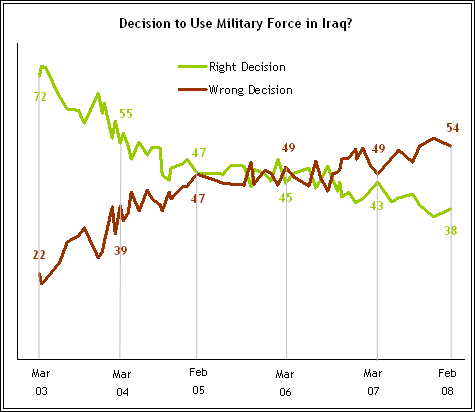
Anyhow, digressing a bit .. I'm talking about the media here, and my claim is that it is overwhelmingly unanimous on those category of issues, at large, and generally speaking aligned on the positions of the state department. US media coverage of Iraq war before the runup is actually a state of the art example of what I am claiming. If not, I would be curious to hear you explain the reason for this trend: http://assets.pewresearch.org/wp-content/uploads/sites/12/ol...

> I may be wrong, but I am guessing you know this perfectly well, and are trying to mislead people for some political or ideological motive.

The second part of your sentence is not right or wrong, it's just inelegant, given you just allowed yourself to speculate on negative intentions of mine, to mislead people for political or ideological motives. I dont know if the idea here is to corner me into disproving a negative such as being a supporter of a particular president of the US? :)

Post reply on HN