can we have falsehoods programmers believe besides video that are more common? this list probably is relevant for 1% of programmers here.
Here's a whole list!
https://github.com/kdeldycke/awesome-falsehood/blob/master/R...
131–139 of 139 posts
can we have falsehoods programmers believe besides video that are more common? this list probably is relevant for 1% of programmers here.
Earlier quoted context omitted.
I think that point should be amended to say "rendering subtitles at the output resolution is always better than rendering them at the video resolution." You don't want to upscale 244p soft subtitles to 1080p but you do want to default to giving video authors creative control over how the subtitles are displayed. The ASS subtitle format allows for some very complex styling that can be used as an artistic element in vi…
> There's also the issue of coordinates for where the subtitles are supposed to be that all go to shit if you render them on a transformed (up/downscaled) frame. Sure, you have to transform the coordinates to the output. But still, better to render fonts at the final resolution; they'll always look better than if scaled after rendering.
The font will look better but you have zero guarantee that the subtitles will be better too. Furthermore, you will lose any artistic value that the creator intended.
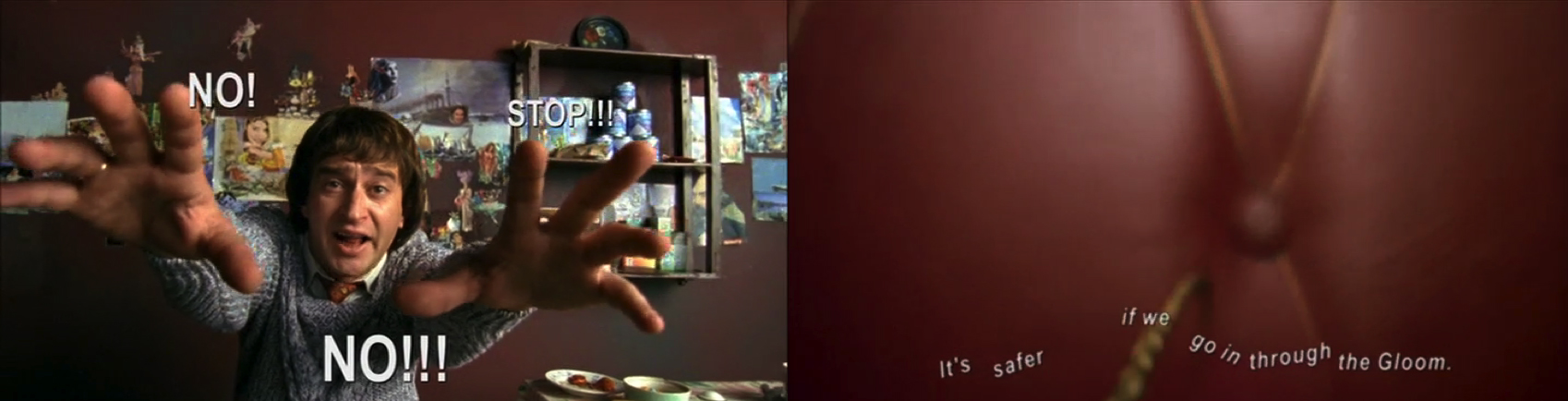
For example, go get the Russian movie Night Watch and watch it with the original subtitles hardcoded and as a separate file. The director insisted on doing the subtitles himself and he used them for great artistic effect throughout the movie [1]. Watch it with scaling and aspect ratio stretching to see how nicely rendered, crisp high resolution fonts can be inferior to a pixelated, stretched version created with intent by an artist.
[1] http://readingsounds.net/wp-content/uploads/2015/12/NightWat...
Earlier quoted context omitted.
Subtitles are simply translations of speech or text into another language, and are generally (though not always) center aligned near the bottom of the frame.
This is wrong. Subtitles and closed captions serve the same purpose and the terms are largely interchangeable. It's an Americanism to associate subtitles specifically with translations or closed captions specifically with EIA-608. The essential function of subtitles and closed captions is to enable a viewer to read dialogue (or contextual audio elements) without needing to either hear or understand the audio. It may…
it is true, video is a nightmare mess littered with weird functionality nobody needs. (limited range only just disappeared in rec 2100, optionally??? really??? i'm not worried about my electron gun in my CRT from 1975 these days...nor do i want to know what a Y or a Cb or a Cr means because everything is RGB and B&W TV is long dead... and 4:2:2 is not exactly compression so much as computational overhead etc.. etc.)…
Please let me know what you do when you have filter overshoots or undershoots in full range. Limited range is there for good reason.
what i think of as undershooting or overshooting is relative to the range... and besides that, what is wrong with clamping? its how computer graphics has always had to deal with these things... limited range simply doesn't exist in that context, and it doesn't harm anything.
when computer games are forced into limited range for consoles you don't get these unless your tv is applying one of those god awful filters that ruins everything anyway... (i'm still not sure why so many tvs have these - reference monitors never do anything this insane) ... but i can tell you what you do get, a subjectively /and/ measurably worse quality of image than from a monitor.
(i don't think i'm alone in this based on the contents of the ITU-R BT.2100 either... which defines a full range as well as a 'narrow' one)
it is true, video is a nightmare mess littered with weird functionality nobody needs. (limited range only just disappeared in rec 2100, optionally??? really??? i'm not worried about my electron gun in my CRT from 1975 these days...nor do i want to know what a Y or a Cb or a Cr means because everything is RGB and B&W TV is long dead... and 4:2:2 is not exactly compression so much as computational overhead etc.. etc.)…
Chroma subsampling isn't going anywhere. You'll usually get subjectively better quality with 4:2:0 chroma compared to 4:4:4 at the same bitrate. And this means you can't have everything in RGB, so all the colorspace conversion complexity can't be ignored. Try experimenting with chroma subsampling in JPGs, but note that not all image viewers have good chroma upscaling. MPV can display still images as well as video and…
but you get the exact same effect from higher resolutions, e.g. going from SD->HD->2K->4K we see the same thing... and we are still doing it, so i would question highly that it is subjectively better in a long-term sense given this continuing trend.
i remember hearing people discuss this sort of thing when HD was new, and they stopped after while - i suspect because they got used to it, and they now realise how low the quality of the SD image was. i noticed this in myself as well...
edit: incidentally there is a discussion about this here (first google thing i found): http://www.neogaf.com/forum/showthread.php?t=1308591
its seems either nobody or very few are taking the perspective that 4:2:0/4:2:2 looks better, and there are even a few descriptions of precisely what they notice as being worse.
Earlier quoted context omitted.
Chroma subsampling isn't going anywhere. You'll usually get subjectively better quality with 4:2:0 chroma compared to 4:4:4 at the same bitrate. And this means you can't have everything in RGB, so all the colorspace conversion complexity can't be ignored. Try experimenting with chroma subsampling in JPGs, but note that not all image viewers have good chroma upscaling. MPV can display still images as well as video and…
> Chroma subsampling isn't going anywhere. You'll usually get subjectively better quality with 4:2:0 chroma compared to 4:4:4 at the same bitrate. And this means you can't have everything in RGB, so all the colorspace conversion complexity can't be ignored. What's more, YCbCr is more efficiently compressed than RGB even if you don't subsample, for the same reason that a DCT saves bits even if you don't quantize: Line…
Earlier quoted context omitted.
Please let me know what you do when you have filter overshoots or undershoots in full range. Limited range is there for good reason.
er... what? can you explain that a bit i think i must misunderstand? what i think of as undershooting or overshooting is relative to the range... and besides that, what is wrong with clamping? its how computer graphics has always had to deal with these things... limited range simply doesn't exist in that context, and it doesn't harm anything. when computer games are forced into limited range for consoles you don't ge…
As far as I understand it, limited range was historically used so you could use efficient fixed-function integer math for your processing filters without needing to worry about overflow or underflow inside the processing chain. You can't just “clamp back” a signal after an overflow happens.
Of course, it's pretty much irrelevant in 2016 when floating point processing is the norm and TVs come with their own operating systems, so these days it just exists for backwards compatibility with the existing stuff - which is a property that video standards have tried to preserve as much as possible since the early beginnings of television.
Earlier quoted context omitted.
> Chroma subsampling isn't going anywhere. You'll usually get subjectively better quality with 4:2:0 chroma compared to 4:4:4 at the same bitrate. And this means you can't have everything in RGB, so all the colorspace conversion complexity can't be ignored. What's more, YCbCr is more efficiently compressed than RGB even if you don't subsample, for the same reason that a DCT saves bits even if you don't quantize: Line…
isn't it the case that amount of data required to store the result of a lossless DCT is bounded below by the size of the data, and this is why lossless JPG compression does not use such a scheme?
In lossless JPEG it seems they omitted the DCT primarily for this reason: It not being a lossless operation to begin with, if you actually want to store the result. What other lossless codecs often do is store a lossy version such as that produced by a DCT, alongside a compressed residual stream coding the difference (error).
In either case, it's important to note the distinction between reordering and compressing; reordering tricks like DCT can reorder entropy without affecting the number of bits required to store them, but the simple fact of having reordered data can make the resultant stream much easier to predict.
For example, compare an input signal like this one:
FF 00 FF 01 FF 02 FF 03 FF 04 ...
By applying a reordering transformation to move all of the low and high bytes together, you turn it into
FF FF FF FF FF .. 00 01 02 03 04 ..
which is much more easily compressed. As for whether that's the case for (some suitable definition of) lossless DCT, I'm not sure.
Earlier quoted context omitted.
Chroma subsampling isn't going anywhere. You'll usually get subjectively better quality with 4:2:0 chroma compared to 4:4:4 at the same bitrate. And this means you can't have everything in RGB, so all the colorspace conversion complexity can't be ignored. Try experimenting with chroma subsampling in JPGs, but note that not all image viewers have good chroma upscaling. MPV can display still images as well as video and…
you are right, there is a weird grainy sharpness kind of 'feeling' when chroma is not subsampled... but you get the exact same effect from higher resolutions, e.g. going from SD->HD->2K->4K we see the same thing... and we are still doing it, so i would question highly that it is subjectively better in a long-term sense given this continuing trend. i remember hearing people discuss this sort of thing when HD was new,…
Nobody is trying to argue that 4:2:0 video looks objectively superior to 4:4:4 video if given a free choice. Obviously, full chroma information will always be better, such as is the case for something like a PC monitor vs a TV with subsampling.
The problem is that 4:4:4 chroma requires more bits to compress, so when you're designing a video/image codec, you have to ask yourself whether the difference in bitrate between 4:2:0 and 4:4:4 is worth the difference in quality, and the answer seems to be “no”.
This means that when you're serving, say, a 5 Mbps youtube video where the bitrate is already fixed, 4:2:0 is going to give you more bits to put into useful stuff (e.g. luma plane) instead of having to waste them on mostly-redundant chroma information.