Live data from Hacker News

Tesla Motors Announces a New Home Battery

offgridquest.com

121–130 of 220 posts

Re: Tesla Motors Announces a New Home Battery

#121

Earlier quoted context omitted.

That's a very expensive battery for the given capacity. If you want to be efficient check out the gel batteries used to power golf carts and forklifts. You'll need 24 2V cells if you want to do this efficiently both from a cost perspective as well as to reduce line losses between batteries and inverters. (24 and 12V are really not adequate for larger power installations).

Such as these? http://www.batterystuff.com/batteries/golf-cart-products/ I don't really see orders of magnitude jumps in power/$. Or am I looking for the wrong thing?

No, more like these:

http://pics.camarades.com/v/jacques/renewables/batteries/IM0...

Sold in bulk. That's a 48KWh bank and it cost about $US 5K
Re: Tesla Motors Announces a New Home Battery

#122

I have home back-up power based on an inverter charging a lead-acid battery (located in a sheltered area outside the home), which costs about $100/kWh. Usage is about 1-2 hours discharge per day. No matter how well serviced, I've found these batteries don't last beyond four years. Hence I'd pay even $400/kWh for a well-engineered deep-cycle battery that is safe, maintenance-free, and will last at least 10 years. Excl…

> No matter how well serviced, I've found these batteries don't last beyond four years. Wow, that's really short, especially with such a shallow discharge pattern.

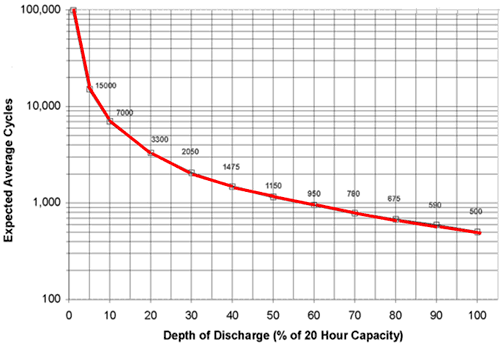
Not necessarily! We don't know how deep the battery is being discharged. But we can make a guess. 4 * 365 = 1400 cycles.

http://www.mpoweruk.com/images/dod.gif

According to that chart (which is an approximation of course) 1400 cycles corresponds to about a 40% depth of discharge. Which isn't terribly shallow.

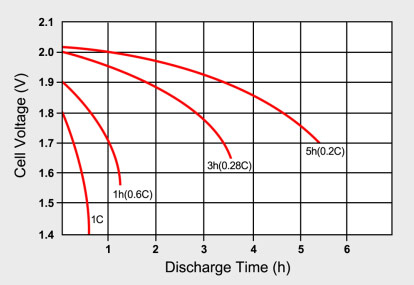
The other variable is the discharge rate, and the higher it is relative to battery capacity the worse the efficiency and also the propensity to fail early. A lot of times doubling the pack size can extend the pack life by more than two because the increased efficiency (the internal resistance is lower) reduces the depth of discharge by more than half.

http://batteryuniversity.com/_img/content/crate1.jpg

Of course it feels totally ridiculous to only use 20% of the nameplate capacity of the system, and much worse than using 40% which you can sort-of rationalize as "half" but if it decreases your dollars per joule, it might be worth it.

EDIT:

I should also mention that if you're constantly charging and discharging and you don't mind a little energy loss you should look at nickel-iron batteries. They're not terribly efficient nor are they cheap in absolute terms but they're basically bulletproof.

http://en.wikipedia.org/wiki/Nickel%E2%80%93iron_battery

http://ironedison.com/

Re: Tesla Motors Announces a New Home Battery

#123
post #110

Earlier quoted context omitted.

And THAT is a primary reason utility companies are fighting grid-connected consumer solar right now. If you are grid attached you are part of the cost of maintaining the grid that is normally offset by your revenue to the utility. If you are just using it as a glorified battery backup by feeding in excess during the day and pulling during the night and you are a net zero to then company then your per-customer revenue…

Or you negotiate with whomever licenses you to be allowed to change your charges so that the maintenance is covered by a connection/subscription fee and usage is billed separately. This is increasingly how utilities are structured in Europe: You have connection charges, and usage charges, and they may be due to different companies (though are often billed together via the provider you pay usage charges to). This has…

My utility here in the US has a per-custom base fee, but I think the issue is the base fee is regulated and not high enough to cover the costs of solar customers.

Re: Tesla Motors Announces a New Home Battery

#124

Earlier quoted context omitted.

Such regulations provide several types of protection to the public commons. Another group of people who are protected are firefighters. In a typical residential installation the power meter also serves as the service disconnect. Response protocols include pulling the meter before many other life saving and property preserving operations. Live equipment and conductors operating from a second source downstream of the m…

And last but not least: when disconnected solar panels are 'open circuit' and the voltages will rise very rapidly. You can arc-weld with two fully illuminated 48V panels in parallel.

that is an interesting fact! wonder if there is a simple solution like a chemical blinder, that could be integrated into something sort of like a "EPO" button, making the panel inert in terms of voltage when hit? Just like the fire rescue folks can pull a breaker or service disconnect for traditional mains?

Re: Tesla Motors Announces a New Home Battery

#125

Earlier quoted context omitted.

The same issue exists with grid connected solar panels. My solar panels are designed to stop working whenever there is a power outage. This is a legally mandated requirement here and is very annoying when it happens on a beautiful sunny day. A solar panel installer told me that if I add a battery backup to my installation, then at least it'll still charge the batteries during a power outage.

There are some ways around that limitation. The reason it exists in the first place is so that the power company can safely power down their lines without installations such as yours feeding power back into the lines that are supposedly safe. This on the off chance that you'll end up electrocuting a line-man, which makes good sense. Of course, since your puny little solar installation is incapable of powering a subst…

Yes it's not such a problem when it's just my 5 KW system. However here in Perth, Western Australia there are a lot of sunny days, so domestic rooftop solar systems are very commonplace now.

In my case there's some significant financial incentives to stay connected to the grid (I actually get a cheque from my power company for most of the year). That'll change in another 6 years time when this higher buyback rate expires, so I'll be looking very closely at whether I want to remain grid connected at that point.

Re: Tesla Motors Announces a New Home Battery

#126
post #17
post #14

Earlier quoted context omitted.

Water and sewage -- Most people in rural america and even in semi-suburban america already use their own wells and septic systems for water and sewage. Likewise with trash, many people drop their trash off at the dump/recycling center themselves. Broadband, yep, no DIY solution there but various forms of wireless internet are available that make it quite feasible to have a completely unwired home if not disconnected.

But still the question is, why would I want that? I'm all for distributed power generation, but it can still be optimized better when it's connected to a grid.

The question isn't "why would I want that" it's more "given that I live in a place where grid hookup is $100k since I'm 10 miles from the nearest power line, what is my next cheapest alternative?"

Once the question is framed properly -- at least for a few million people in the US -- then the motivation for storage becomes much clearer. If you have a battery and an inverter then you hook that up and it feeds the house. And all your other power generation choices feed the battery. Solar, wind, hydro (if you live on/near a stream or river), small generator, etc.

If it costs $100k to get hooked up and then you're paying some fee for power every month it might make sense to buy the battery for $20k, buy a generator for $5k and spend $10k on a wind turbine and $10k on solar. That's $45k versus $100k which is a good chunk of change plus you can expect your prices to go down as solar panels and batteries and whatnot get cheaper, whereas fuel is only going to get more expensive.

Re: Tesla Motors Announces a New Home Battery

#127
The question is: Will it be new battery just for homes or will it be a recycled/repurposed battery from 'old' Teslas?

It think it will be the later one. Elon is just thinking ahead. There is nothing really new in this story. Everything is just made up. It is quite accepted within the industry, that when the car battery has a capacity of less than 70% to 80% it needs to be replaced. But what should the car company, in this case Tesla, should do with battery? Of course, it will be re-packaged and as such repurposed for other use. What other use case is there? The other use case is Solar, especially as his friend runs a Solar company. What in incident.

Re: Tesla Motors Announces a New Home Battery

#128
post #68

Earlier quoted context omitted.

Also many municipalities don't allow battery 'grid-tie' with the option of 'off the grid' living. For example, Connecticut has laws which don't allow houses to have batteries that would allow a house to be self sustaining and have a connection to the grid. This is because if you have batteries which cause a back flow during a power outage to the power station, an electrical worker could get shocked down the road. The…

A properly wired transfer switch fully cures that risk.

True, but bewary of automated transfer switches. I have seen DC's fail due to ATS's not doing their job. This can be pretty dangerous for a lineman/fire rescue if your particular ATS fails to switch...

Re: Tesla Motors Announces a New Home Battery

#129

Earlier quoted context omitted.

The same issue exists with grid connected solar panels. My solar panels are designed to stop working whenever there is a power outage. This is a legally mandated requirement here and is very annoying when it happens on a beautiful sunny day. A solar panel installer told me that if I add a battery backup to my installation, then at least it'll still charge the batteries during a power outage.

There are some ways around that limitation. The reason it exists in the first place is so that the power company can safely power down their lines without installations such as yours feeding power back into the lines that are supposedly safe. This on the off chance that you'll end up electrocuting a line-man, which makes good sense. Of course, since your puny little solar installation is incapable of powering a subst…

That's allowed in Connecticut:

http://cga.ct.gov/2011/rpt/2011-R-0390.htm

$300,000 liability policy requirement right at the end there.

There's also similar rules for installed generators, it's not clear to me how they would treat a big battery.

Re: Tesla Motors Announces a New Home Battery

#130
post #68

Earlier quoted context omitted.

Also many municipalities don't allow battery 'grid-tie' with the option of 'off the grid' living. For example, Connecticut has laws which don't allow houses to have batteries that would allow a house to be self sustaining and have a connection to the grid. This is because if you have batteries which cause a back flow during a power outage to the power station, an electrical worker could get shocked down the road. The…

A properly wired transfer switch fully cures that risk.

And even though the solution is right there, power line worker remains the ninth deadliest job in America.

http://www.businessinsider.com/most-dangerous-jobs-in-americ...

Post reply on HN