Earlier quoted context omitted.
> You seem to be really caught up in this idea of hard-core gang members. I'm not. The vast majority of the gang members driving around shooting each other up are not "committed fully to lives of violent crime." But they are still "bad, antisocial" people. The 19 year old who mugs someone in a gang initiation ritual is still a bad person even if you can explain his behavior in socioeconomic terms. > Is it the only po…
> But they are still "bad, antisocial" people. Yes, but how did they get that way? They got that way because they were drawn into that life by older gang members. They see older gang members living a life of relative privilege and they're willing to accept the violence that goes along with it. If you take away the money, those older gang members become much less attractive role models. > As if that state penitentiary…
The bottom line is that the increase in incarceration rates is the result of a dramatic spike in crime rates starting in 1960, peaking in the early 1990's, and the public response in the form of harsh sentencing laws in the 1990's (three strikes, mandatory minimums). It's a simple explanation: there are more people in prison because there is more crime, and because the spike in crime caused people to vote (by overwhelming margins, I might add) for harsher sentencing laws.
Compare incarceration rates with violent crime rates: http://upload.wikimedia.org/wikipedia/commons/4/48/U.S._inca..., http://www.volokh.com/wp-content/uploads/2013/01/vcrime500.j.... You can see that incarceration rates are clearly a lagging indicator, not a leading indicator. Violent crime peaked in 1993, at 4.3x the 1960 baseline. Incarceration peaked in 2005, at 4.8x the 1960 baseline. It's not until the late 1990's that incarceration rates catch up with violent crime rates.
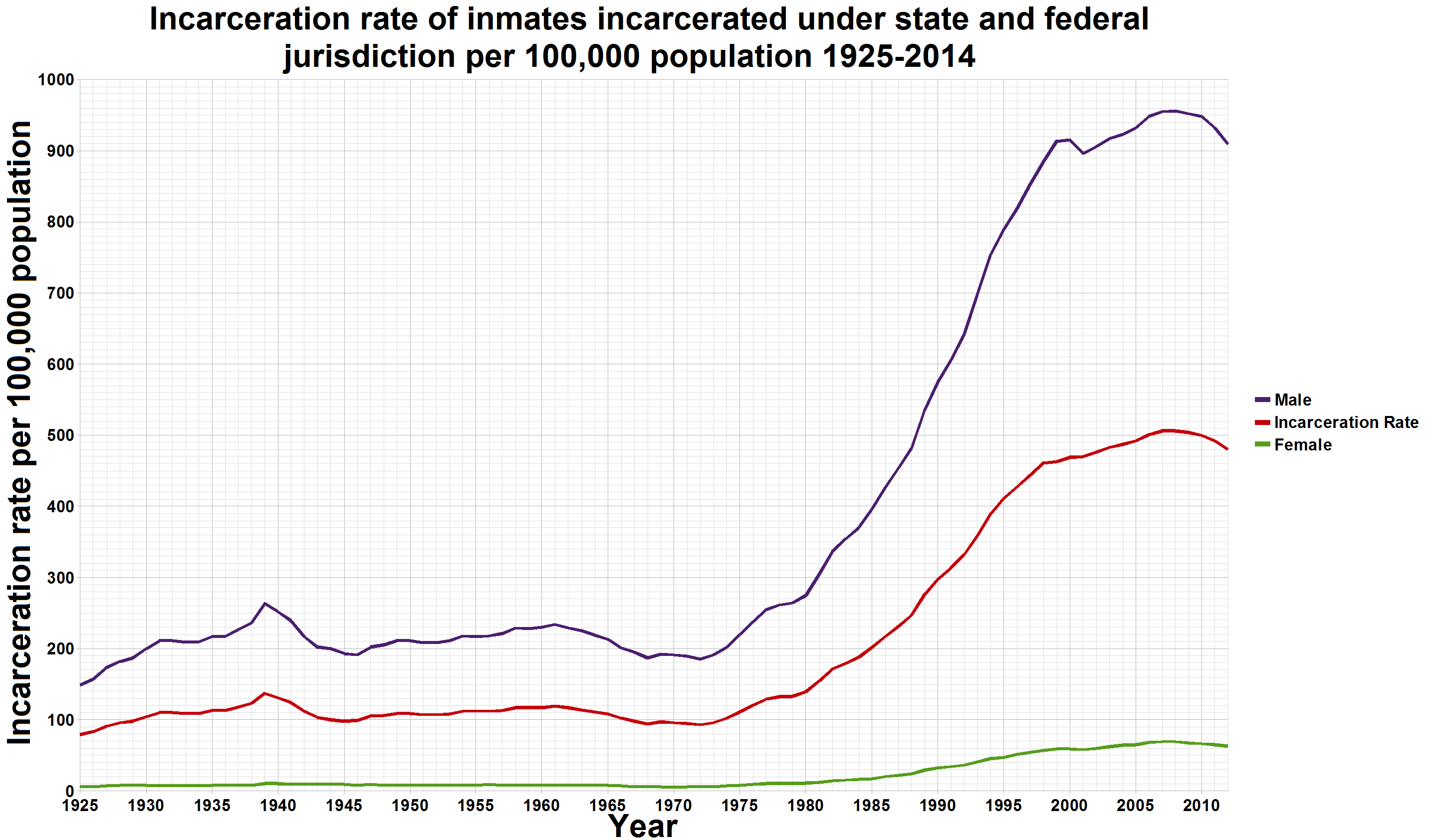
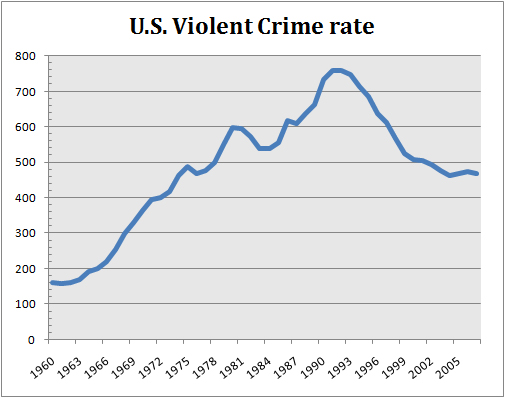
The popular counterargument is that the increase in crime is itself a result of the social effects of the Drug War, e.g. the impact on kids of fathers being sent to prison for decades on drug charges. But the Anti-Drug Abuse Act was passed in 1986, and the spike in violent crime rates started in 1960. The slope of the crime increase between 1966 and 1972 is as high as at any time after the drug war really got going in the 1980's, and 80% of the total increase in crime between the 1960 trough and the 1993 peak happened by 1980. It is simply inconsistent with the data to say that the increase in crime since 1960 were anything more than moderately impacted by the Drug War, which didn't really get going until long after crime had already skyrocketed.