Live data from Hacker News

Britain's police are restricting speech in worrying ways

economist.com

121–130 of 192 posts

Re: Britain's police are restricting speech in worrying ways

#121

Earlier quoted context omitted.

Vance isn't running policy. He is the vice president. Many people are arrested every day. Some are for justified reasons and some are not. "The result is identical." Intent and rationale matter.

[flagged]

Right I already said he's the vice president. That's the job. We started with a system where the runner-up was VP and had a bit more of a role, then changed it to this.

Re: Britain's police are restricting speech in worrying ways

#122
post #120

Earlier quoted context omitted.

That's basically irrelevant from where I stand. I don't subscribe to the idea that everything is relative. That we should "respect different choices". The point of an inalienable right is that it's intrinsic according to our basic values. The british failing to respect that doesn't change it.

There is no such thing as an unalienable right or as a human right. Rights are simply the expression of the interests of certain classes at a certain point in time. That said, I struggle to find "free speech" a compelling inalienable right when it's what has directly led to the disaster befalling the Americas in this very moment. Especially since the American conception of "free speech" isn't just to be able to expre…

Okay, I think we have a fundamental disagreement in our first principles that won't be reconciled. I hope people who believe as you do live abroad and do not bring those views to America where y'all could vote. Nothing personal but that's not a reconcilable difference.

Re: Britain's police are restricting speech in worrying ways

#123
post #111

Earlier quoted context omitted.

That's basically irrelevant from where I stand. I don't subscribe to the idea that everything is relative. That we should "respect different choices". The point of an inalienable right is that it's intrinsic according to our basic values. The british failing to respect that doesn't change it.

You would have to point out where the current law in the UK is unjust. The current law surrounding "inalienable rights" in the UK is based on the ECHR that I linked to.

I believe that America's standard of imminent lawless action is the only even remotely-okay circumstance under which you can punish speech directly. The ECHR really doesn't have any bearing on what is right and wrong; laws do not determine morality.

Re: Britain's police are restricting speech in worrying ways

#124
post #69

Earlier quoted context omitted.

> And the second goes for the people affected by the muddled laws too, who have way more discretion than the police. Are you arguing that the fault for being on the wrong side of the powerful lies with the people who could have just decided not to be on the wrong side of the powerful? We're discussing here laws where someone, whether the police or some other authority figure, is going to be deciding whether you're su…

> Are you arguing that the fault for being on the wrong side of the powerful lies with the people who could have just decided not to be on the wrong side of the powerful? No. I saying that people are responsible for their actions. In western society (democratic) laws are implemented by people put in a position of authority by the very people those laws apply to. I'm not really sure I understand the rest of what you'r…

> I saying that people are responsible for their actions.

> In western society (democratic) laws are implemented by people put in a position of authority by the very people those laws apply to.

Right (although I think that the latter sentence is, first, not limited to western societies, and, second, not ubiquitous in them), but the issue here is not whether people should escape consequences for actions that have been democratically deemed unacceptable (through direct democracy, or through people electing representatives who make the relevant laws). Rather it is, I think, the danger of using the cover of one action, that people have democratically agreed is unacceptable but that the makers or enforcers of law are not actually seeking to curtail, to regulate another action, that has not been democratically agreed to be unacceptable, and might actually be professed to be allowed or desirable while being indirectly and sometimes covertly suppressed.

> Either way the conversation about power and who has it and who doesn't doesn't strike me as helpful.

No matter what your philosophy of society and the role of law, it strikes me as hard to have such a philosophy that is of any use in actually helping to govern a society without paying attention to power, who has it, and who doesn't.
Re: Britain's police are restricting speech in worrying ways

#125
post #16

I used to think I lived in a democracy, but the last couple of years pulled back the curtain revealing the true nature of western democracy

Yes, there are definitely problems, but at least you can criticise the speech laws. And fight to change them. In fact if you feel strongly about it you can do something about it. The article mentions the Free Speech Union in the UK. There is also the EFF in the USA. Democracy requires that we fight for it. Otherwise it will disappear. In dicatorships there is no opportunity to speak out.

> In dicatorships there is no opportunity to speak out.

There is always opportunity to speak out.

In dictatorships, it usually costs more energy, money and sometimes lives. It tends to culminate in revolutions, and then the system changes.

In censored quasi-democracies like what we see in "the west", it tends to culminate in being ignored and the status quo being maintained or gradually worsened. Alternatively, you may become a pariah and either have to self-exile [0] or suffer years of isolation and torture [1].

[0] https://en.wikipedia.org/wiki/Edward_Snowden#Asylum_applicat...

[1] https://en.wikipedia.org/wiki/Julian_Assange#Imprisonment_in...

Re: Britain's police are restricting speech in worrying ways

#126

Earlier quoted context omitted.

In 2014, Police Scotland posted on its Twitter, "Please be aware that we will continue to monitor comments on social media & any offensive comments will be investigated." Met Police have taken similar actions in pursuit of chilling effects on social media. The Communications Act prohibits what are at best vaguely-defined "offensive communications" and created Ofcom. Because of this ridiculous violation of inalienable…

> Police Scotland posted on its Twitter, is a different body and has different laws to England. The Communications Act prohibits what are at best vaguely-defined "offensive communications" Actually is gross offense. > speech and almost half of those were prosecuted. For gross offense, or threatening communications? Because there is a world of difference. Its the same act that is used to procecute someone sending deat…

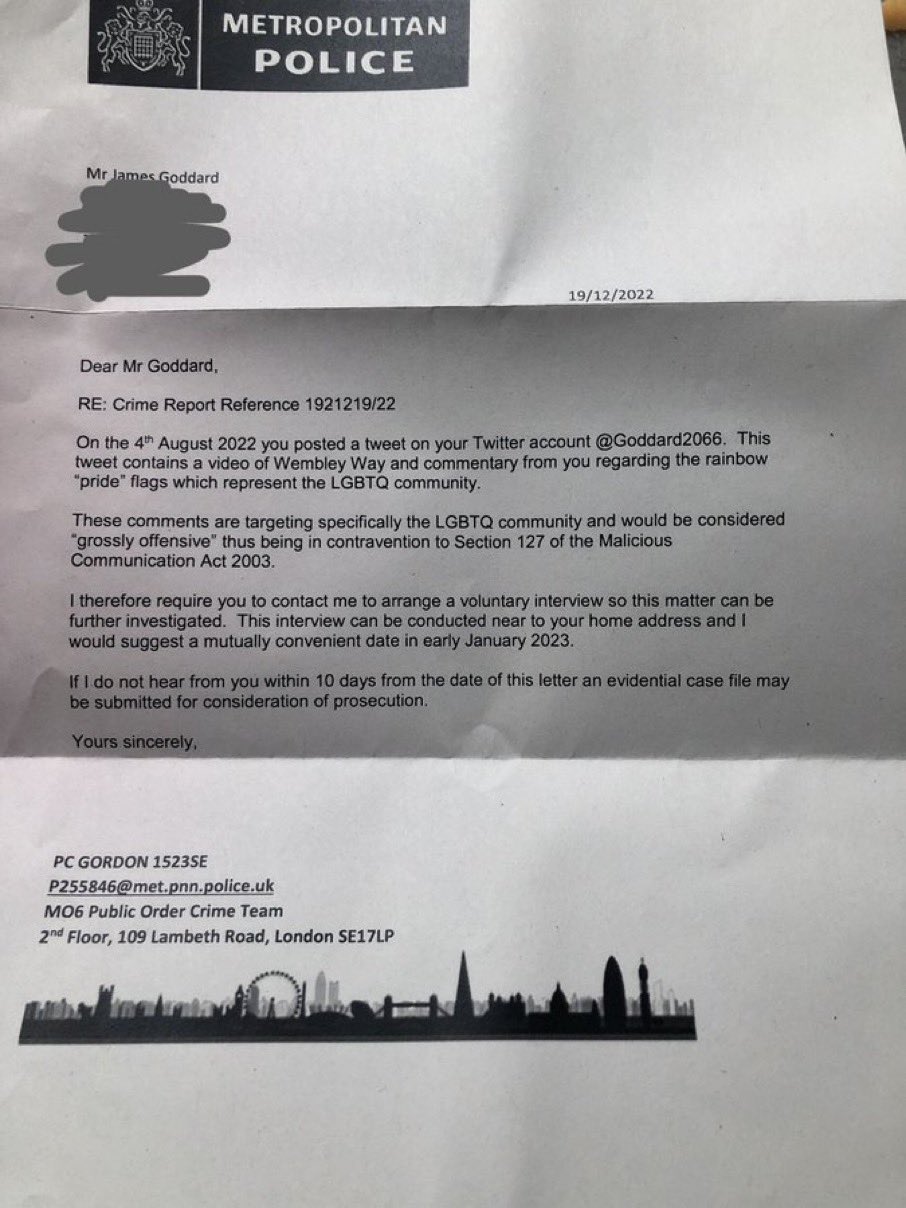
Did you miss the part where I specified the Met Police often do the same. Let me give you an example of "gross offense": "commentary from you regarding the rainbow flags which represent the LBGT community." https://pbs.twimg.com/media/Fl4VM7VXkAM8-km.jpg:large

"Offending someone" being a crime is basically immoral.

Lucy Connolly, the wife of a Conservative Party councilor, was the one jailed for her comments around mass deportation. 31 months. These statements wouldn't get someone investigated, let alone jailed, in America.

Due process isn't worth a damn morally if we are discussing unjust laws. Saying "but he got due process" doesn't matter if the law that is being applied is deeply, fundamentally, and inexcusably reprehensible.

Re: Britain's police are restricting speech in worrying ways

#127
post #119

Earlier quoted context omitted.

The person making the threat needs to be linked to the one taking the action (either via direct or indirect participation).

In this case, she was found guilty of "sending a communication threatening death or serious harm". >Sweeney wrote: "It’s absolutely ridiculous. Don’t protect the mosque. Blow the mosque up with the adults in it." https://www.bbc.co.uk/news/articles/cz6x105wgz5o

Also noted in the article: it was posted in the days after the riot and in response to seeing people cleaing up and repairing the damage.

Re: Britain's police are restricting speech in worrying ways

#128

> The couple’s alleged crime? Disparaging emails and WhatsApp messages about their daughter’s primary school. Well, what is the content of those e-mails? Dear The Economist, your story is not worth the paper it isn't printed on without the goddamned specifics . The content of those communications could well be reasonably actionable by police. Of course, those who were paid a visit by police will claim that they made…

I read that last example as saying that the pro-Palestinian protesters are one step away from storming Heathrow looking for Jewish arrivals, not that the person making the statement was.

I mean, maybe it's worth a look anyway, but not directly for the reason you stated.

The rest of your post I agree with.

Re: Britain's police are restricting speech in worrying ways

#130
post #119

Earlier quoted context omitted.

The person making the threat needs to be linked to the one taking the action (either via direct or indirect participation).

In this case, she was found guilty of "sending a communication threatening death or serious harm". >Sweeney wrote: "It’s absolutely ridiculous. Don’t protect the mosque. Blow the mosque up with the adults in it." https://www.bbc.co.uk/news/articles/cz6x105wgz5o

Not in the US's case. A direct link would be needed.

American jurisprudence on speech leans towards Free Speech Absolutism [0] due to jurisprudence from the 1970s-2000s, and the test for "clear and imminent danger" is extremely high.

Even though the US and the rest of the Anglophone speak English, America jurisprudence is extremely distinct from the rest of the Anglophone (and vice versa), and IMO it doesn't make sense to compare one with the other due to these significant differences.

For example, the UK dealt with the Troubles into the late 1990s, and the US never had a similar insurgency since the 1950s in Puerto Rico, so there is a hardening in NatSec laws in the UK compared to the US.

This is why the US often leverages allied states to help with this kind of monitoring to sidestep some of the legal implications domestically.

That said, I agree with your point to a certain extent, the issue is the US and other Anglophone countries have a different relation with speech and civil liberties. It doesn't make sense to compare the US with the UK or EU and vice versa.

[0] - https://legal-forum.uchicago.edu/print-archive/free-speech-o...

Post reply on HN